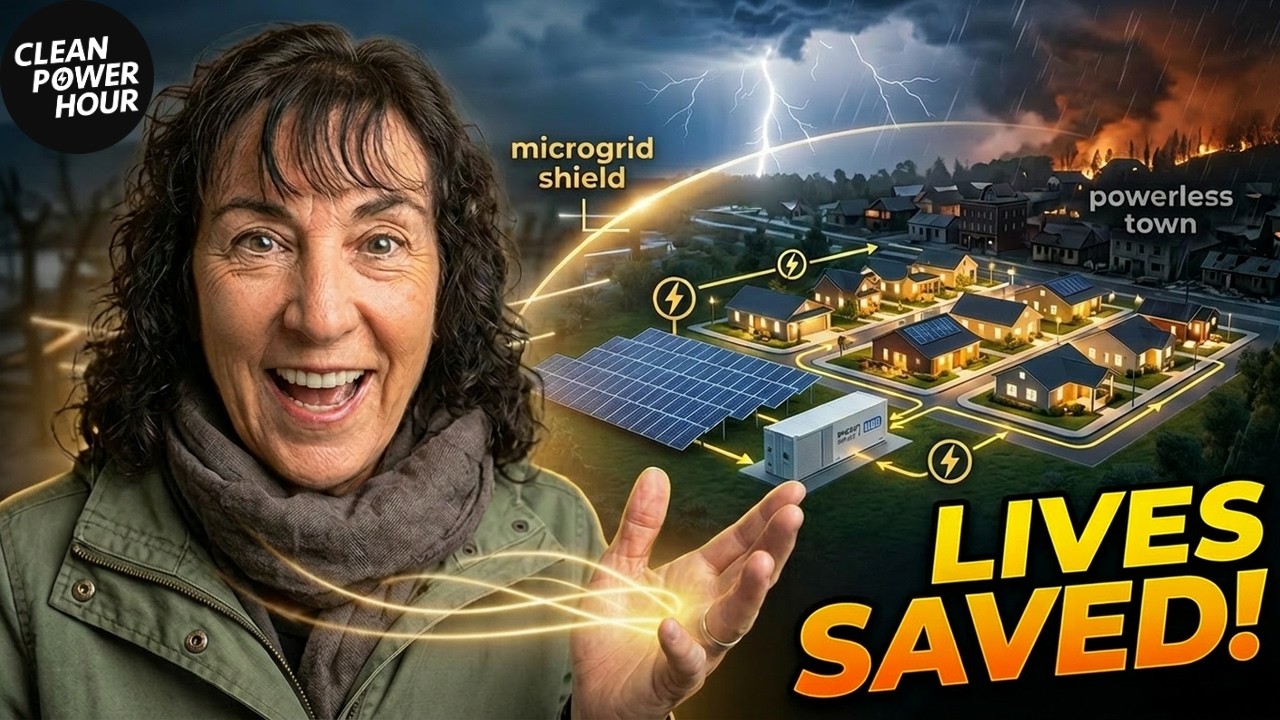
Wildfires, Blackouts, and the Communities That Fought Back
Keywords
Summary
172 words
Critical Evaluation
Value of the Information & Strength of the Argument
The value of the information lies in the practical insights from Lisa Cohn’s extensive experience tracking community microgrids. She provides concrete examples of successful projects and the funding mechanisms behind them, which is valuable for professionals in the renewable energy sector. The argumentation is based on anecdotal evidence and case studies rather than systematic data, but it is coherent and grounded in real-world observations. The discussion effectively highlights the barriers (funding, regulatory hurdles) and enablers (state incentives, utility partnerships) for community microgrid deployment.
Scientific Rigor, Source Quality, Title Accuracy
The scientific rigor is moderate; the episode is an expert opinion piece rather than a peer-reviewed study. Sources are not explicitly cited within the conversation, but the description provides links to Lisa Cohn’s website, Microgrid Knowledge, and other resources. The title accurately reflects the content, focusing on community resilience during wildfires and blackouts. No comments were provided for analysis.
157 words
Title / Content Match
The title accurately reflects the content, focusing on community microgrids as a resilience solution during wildfires and blackouts.
Quality & Reliability
7/10
The episode features an experienced journalist (Lisa Cohn) with decades of coverage, and discusses specific, documented case studies (Blue Lake Rancheria, Redwood Coast Airport) with funding details. However, claims are largely anecdotal and lack in-depth verification or data; the discussion is conversational and not peer-reviewed.
Key Moments
Markers derived by PSI from the transcript: the creator did not define chapters.
- Introduction of Lisa Cohn and her background in energy journalism.
- Discussion of Blue Lake Rancheria microgrid and its life-saving role during PSPS.
- Comparison of CMEP and MIP programs in California.
- Funding challenges and examples like Redwood Coast Airport microgrid.
- Public power vs. IOUs and the over-the-fence rule.
- Networked microgrids and future directions.
Cited Sources
- Clean Energy Writers — Lisa Cohn's website, mentioned as a way to connect with her.
- Microgrid Knowledge — Lisa Cohn's publication, mentioned as her platform.
- Clean Power Hour — The podcast's website, mentioned for more episodes.
Concurring Sources
- Microgrid Knowledge — Lisa Cohn's publication, which likely contains articles supporting the claims made.
External References
Contribution & Novelties
This episode provides a practitioner’s perspective on community microgrids, emphasizing real-world case studies and policy evolution. It highlights the shift from restrictive programs like CMEP to more flexible ones like MIP, and discusses innovative utility models and tribal projects. The concept of networked microgrids is presented as an emerging trend.
Pour aller plus loin :
- Microgrid Knowledge — A leading source for microgrid news and analysis, directly relevant to the episode’s topic.
- U.S. Department of Energy Microgrid Program — Official information on federal microgrid initiatives, relevant to funding and policy.
- California Microgrid Incentive Program — Details on the MIP program discussed in the episode.
104 words
Radar Profile
The radar profile shows balanced scores across information quantity, quality, technical level, and reliability, indicating a well-rounded but not exceptionally deep discussion. The moderate technical level suggests it is accessible to a broad audience while still providing useful insights for professionals.