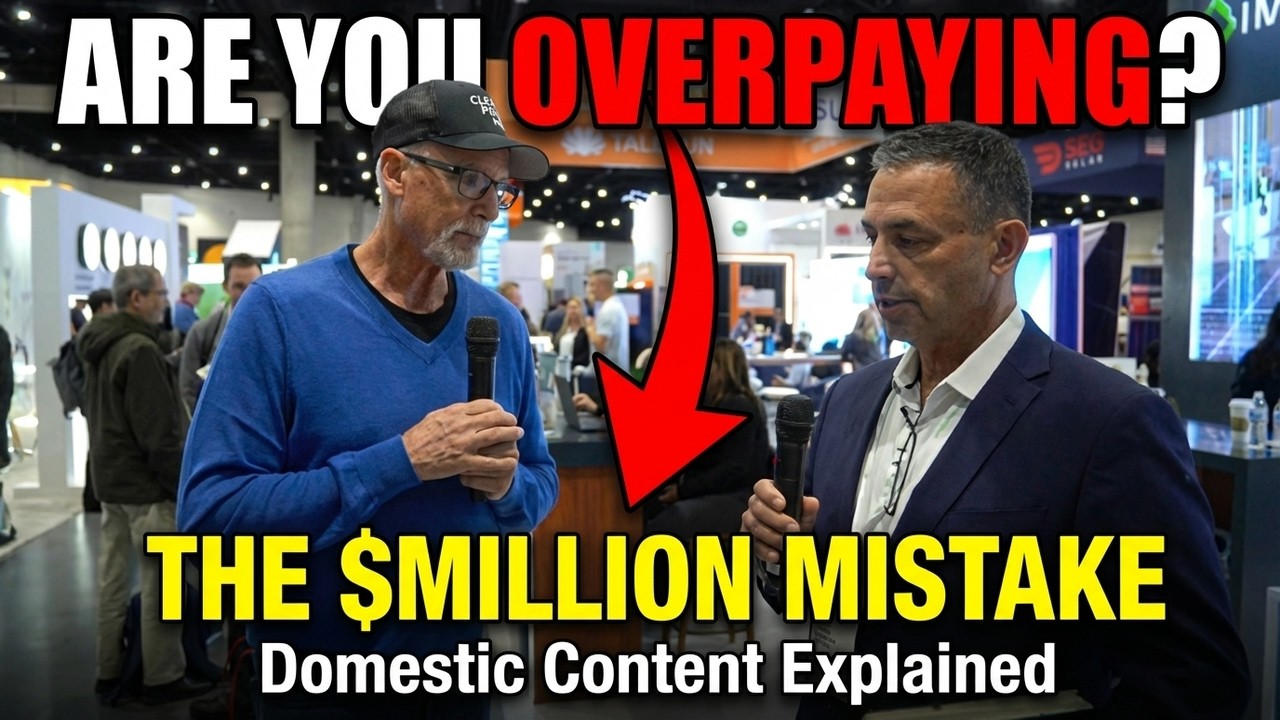
The Domestic Content Mistake Costing Solar Developers Millions
Keywords
Summary
190 words
Critical Evaluation
Value of the Information & Strength of the Argument
The video offers valuable, actionable information for solar professionals, particularly regarding FEOC compliance and domestic content optimization. Chris Lettman provides concrete examples and explains the cost implications of over-specifying domestic content, which is a common mistake. The argumentation is clear and practical, supported by specific numbers (e.g., 7% vs 35% domestic content) and real-world scenarios. However, the discussion is largely promotional, with limited critical analysis or independent data. The value lies in the insider perspective on market trends and regulatory impacts.
Scientific Rigor, Source Quality, Title Accuracy
The video maintains a reasonable level of scientific rigor for an industry interview. The information is presented by a manufacturer representative, so there is a potential bias, but the technical details about FEOC compliance and domestic content are consistent with known industry regulations. The sources cited are primarily company websites and LinkedIn profiles, which are not independent. The title accurately reflects the content, focusing on the financial mistake of over-specifying domestic content. No comments were provided for analysis.
174 words
Title / Content Match
The title accurately reflects the core message about the financial impact of over-specifying domestic content.
Quality & Reliability
7/10
The video provides practical, industry-specific insights from a solar manufacturer representative, with concrete examples and clear explanations of FEOC compliance and domestic content strategies. However, it is promotional in nature and lacks independent verification of claims.
Key Moments
Markers derived by PSI from the transcript: the creator did not define chapters.
- Introduction and context of the interview at Intersolar San Diego.
- Chris Lettman discusses FEOC compliance as the first question buyers ask.
- Explanation of Imperial Star's manufacturing facilities and domestic content options.
- Discussion on the 'domestic light' configuration and its cost benefits.
- Chris explains his teaching approach to help customers right-size domestic content.
- Outlook on the ITC phase-out and future of solar industry.
Cited Sources
- Imperial Star Solar — Company website mentioned as a resource for more information.
- Chris Lettman LinkedIn — LinkedIn profile for the interviewee.
- Clean Power Hour — Podcast website for episodes and resources.
- Wired for Sun: The Commercial Solar Playbook — Book by Tim Montague mentioned in the description.
Concurring Sources
- DOE FEOC Guidance — Official guidance on FEOC compliance, supporting the video's claims.
- SEIA Domestic Content Resources — Industry association resources on domestic content requirements.
External References
Contribution & Novelties
The video provides a practical, insider perspective on FEOC compliance and domestic content optimization, highlighting a common costly mistake. It offers specific strategies for right-sizing domestic content based on project type, which is not widely discussed in general media. The interview also sheds light on the changing manufacturing landscape and the expected consolidation in the industry.
Pour aller plus loin :
- FEOC (Foreign Entity of Concern) definition — Official DOE resource on FEOC rules.
- Investment Tax Credit (ITC) for solar — Overview of the ITC and its phase-out.
- Suniva — US-based solar cell manufacturer mentioned in the video.
98 words
Radar Profile
The radar profile shows balanced scores across information quantity, quality, technical level, and reliability, with a slight emphasis on practical applicability. The video is strong in providing actionable insights but may lack depth in independent verification.