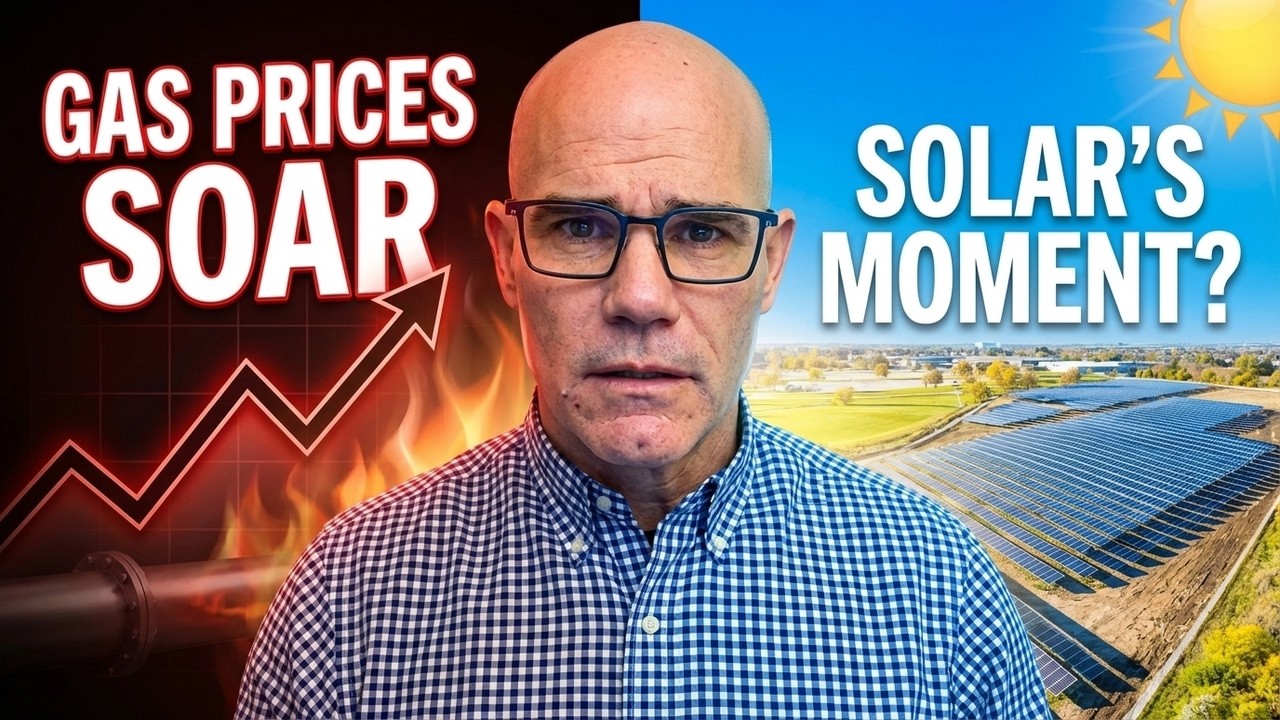
Iran War Sends Natural Gas Prices Soaring: What It Means for Solar
Keywords
Summary
185 words
Critical Evaluation
Value of the Information & Strength of the Argument
The video provides valuable insights into the current energy market dynamics, connecting geopolitical events to practical implications for solar professionals. The hosts effectively argue that natural gas price volatility directly affects electricity costs and solar economics, citing specific data and reports. They present a balanced view, acknowledging both challenges (increased shipping costs) and opportunities (higher value of solar). The argumentation is solid, though sometimes opinionated, and they encourage professionals to adapt their business models accordingly.
Scientific Rigor, Source Quality, Title Accuracy
The video demonstrates good scientific rigor by referencing multiple credible sources, including SEIA, PV Magazine, Clean Air Task Force, Canary Media, and PV Tech. The hosts provide context and data to support their claims. The title accurately reflects the content, focusing on the impact of the Iran war on natural gas prices and solar. The discussion is well-structured, though some segments are more conversational than analytical. No comments were provided for analysis.
162 words
Title / Content Match
The title accurately reflects the main topic, focusing on the impact of the Iran war on natural gas prices and its implications for solar.
Quality & Reliability
7/10
The hosts cite specific reports and data from reputable sources (SEIA, PV Magazine, Clean Air Task Force, Canary Media, PV Tech) and provide context. However, the discussion is largely opinion-driven and lacks deep technical analysis, with some claims not fully substantiated.
Key Moments
Markers derived by PSI from the transcript: the creator did not define chapters.
- Introduction and overview of the Iran war's impact on energy prices.
- Discussion on natural gas price surge in Europe and its effect on US markets.
- Analysis of shipping disruptions in the Strait of Hormuz and oil supply cut.
- Review of Clean Air Task Force report on electricity price increases.
- Solar's fastest growth in a decade: 8.5% of US electricity from solar.
- Discussion on emissions increase despite solar growth.
- Global solar and wind set to pass nuclear in 2026.
- SEIA 2025 installation report: 43 GW deployed, 15% less than 2024.
- Virginia rejoins RGGI and its impact on solar incentives.
- Quaise Energy's geothermal project and perovskite solar cell milestone.
Cited Sources
- Data-driven look at rising US electricity costs and policy solutions — Referenced in discussion about electricity price increases due to natural gas.
- Solar's fastest growth in a decade, fossils fall again, but emissions rise — Referenced for solar generation growth data.
- Solar Market Insight Report 2025 Year in Review — Referenced for 2025 US solar installation figures.
- Democrats pass bill to return Virginia to RGGI — Referenced for Virginia's re-entry into RGGI.
- Quaise superhot geothermal power plant in Oregon — Referenced for Quaise Energy's geothermal project.
- Maxwell develops perovskite-silicon HJT cell 32.5% conversion efficiency — Referenced for perovskite solar cell milestone.
- Michael Liebreich post on solar and wind passing nuclear — Referenced for global electricity generation data.
Concurring Sources
- EIA data on electricity generation — Provides official data supporting the growth in solar generation.
Contribution & Novelties
The video provides a timely analysis of how geopolitical events (Iran war) directly impact the solar industry, offering practical advice for professionals to adjust their business models. It synthesizes multiple recent reports and data points, making it a valuable resource for staying updated. The discussion on the ITC phase-out and its ripple effects is particularly insightful.
Pour aller plus loin :
- Strait of Hormuz — Key chokepoint for global oil shipments, central to the discussion.
- Investment Tax Credit (ITC) for Solar — Relevant to the ITC phase-out discussion.
- Perovskite Solar Cells — Background on the technology mentioned in the video.
100 words
Radar Profile
The radar profile shows high scores in quantity of information and reliability, with moderate technical depth. This indicates a well-informed discussion suitable for professionals, though it may lack deep technical analysis for experts.