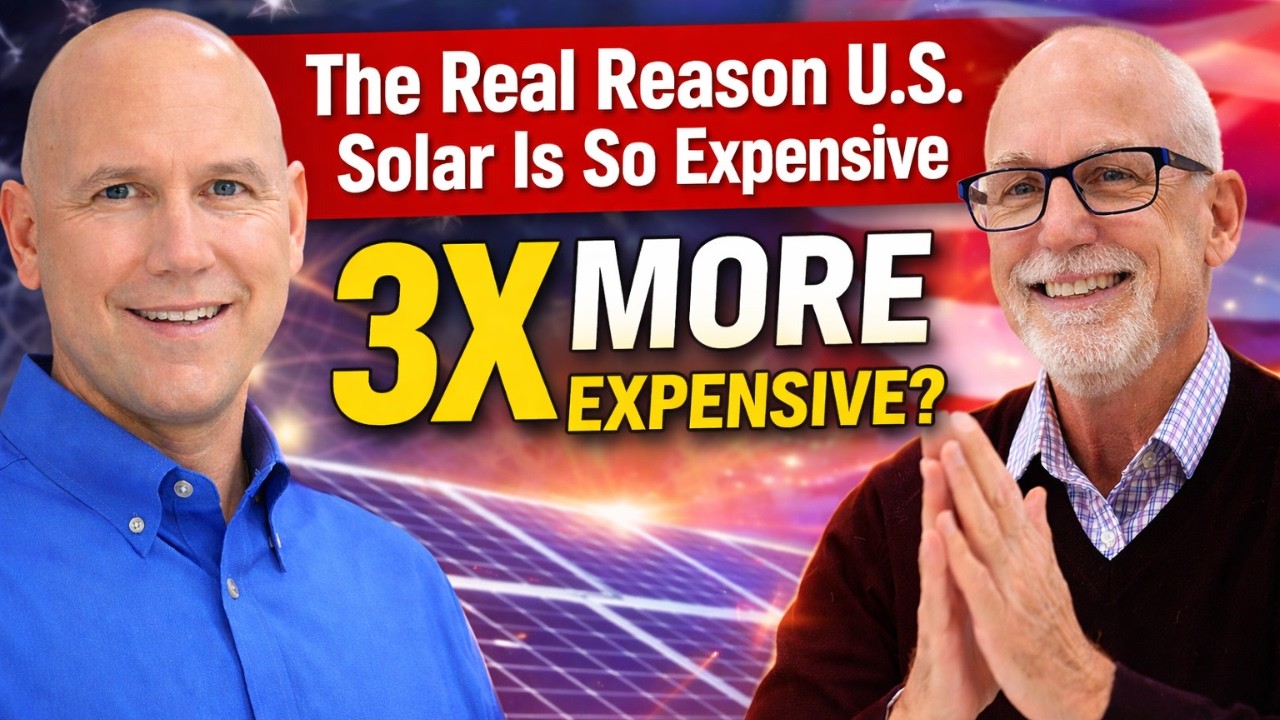
Why Solar Panels Are Cheap but Installation Is NOT in the U.S.
Keywords
Summary
173 words
Critical Evaluation
Value of the Information & Strength of the Argument
The value of the information lies in the firsthand account of a veteran solar professional, providing insights into the industry’s evolution and the specific factors driving U.S. installation costs. The argumentation is coherent, with Greenfield clearly explaining the historical context and current challenges. He effectively contrasts the U.S. situation with Australia and Germany, attributing the cost difference to soft costs like permitting and lack of standardization. The discussion is grounded in practical experience, though it lacks quantitative data or formal studies to support some claims.
Scientific Rigor, Source Quality, Title Accuracy
The scientific rigor is moderate; the episode is an expert opinion rather than a peer-reviewed analysis. The sources cited are primarily the guest’s own experience and references to industry initiatives like the Solar App. The title accurately reflects the content, focusing on the cost disparity. The description provides links to the guest’s LinkedIn and company website, which serve as supplementary sources. The discussion is well-structured but relies on anecdotal evidence, which limits its scientific robustness.
175 words
Title / Content Match
The title accurately reflects the main topic of the episode, which discusses the cost disparity between solar panels and installation in the U.S.
Quality & Reliability
7/10
The discussion is based on the guest's extensive industry experience and provides specific historical data points, but lacks formal citations and relies on anecdotal evidence.
Key Moments
Markers derived by PSI from the transcript: the creator did not define chapters.
- Introduction of guest Geoff Greenfield and his background.
- Discussion on NABCEP's importance and certification.
- Geoff's early days in solar, starting in 2000 with 53W panels.
- Evolution of solar costs from $8/W to current commodity prices.
- Comparison of U.S. installation costs with Australia and Germany.
- Soft costs as the main driver of high installation costs.
- Transition from residential to commercial solar and company growth.
- Role of battery storage and resilience in solar adoption.
- Future outlook and need for standardization and systems thinking.
Cited Sources
- Geoff Greenfield - LinkedIn — Guest's professional profile.
- Kokosing Solar — Company website of the acquiring firm.
- Wired for Sun: The Commercial Solar Playbook — Book by the host on commercial solar.
- Consulting & Strategy Call — Booking link for consulting services.
- Merchandise Store — Merchandise store for the podcast.
Concurring Sources
- U.S. Department of Energy - Soft Costs — Official source on soft costs in solar.
- NABCEP — Certification body mentioned in the episode.
Contribution & Novelties
The episode provides a unique retrospective from a veteran solar professional, offering insights into the industry’s evolution and the specific reasons for high U.S. installation costs. It highlights the importance of soft costs and the need for standardization, which are often overlooked in discussions about solar affordability.
Pour aller plus loin :
- Solar soft costs — U.S. Department of Energy page on soft costs.
- NABCEP — Certification body for solar professionals.
- Grid parity — Wikipedia article on grid parity.
79 words
Radar Profile
The radar profile shows a balanced performance across all dimensions, with slightly lower scores in technical depth and source rigor, reflecting the conversational and experience-based nature of the content.
💬 No comments were provided for analysis.