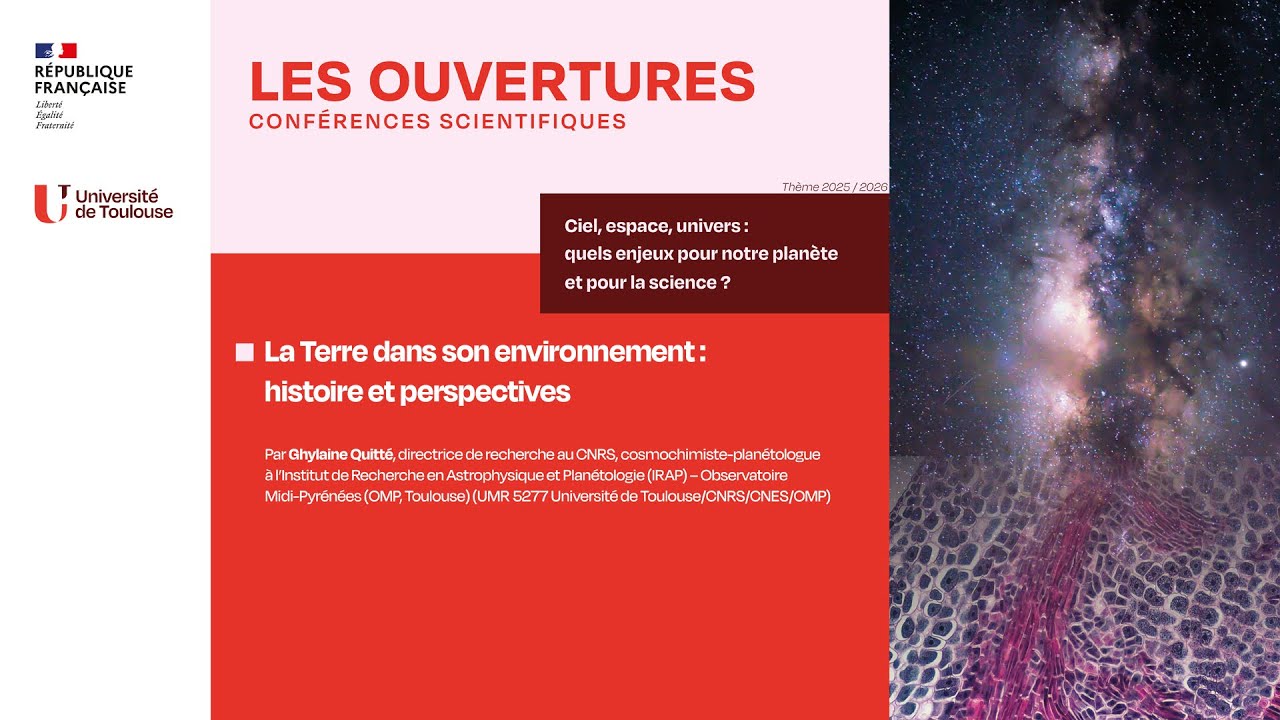
La Terre dans son environnement : histoire et perspectives
Keywords
Summary
179 words
Critical Evaluation
Value of the Information & Strength of the Argument
The lecture provides valuable insights into Earth’s formation and the origins of its water and metals, synthesizing current scientific knowledge. The argumentation is solid, supported by isotopic data and comparisons with other planetary bodies. The speaker effectively explains complex processes like planetary differentiation and the late veneer, making them accessible. The discussion of space missions adds practical relevance, highlighting both scientific and resource-exploitation perspectives.
Scientific Rigor, Source Quality, Title Accuracy
The scientific rigor is high, given the speaker’s expertise and the use of established concepts and mission data. However, specific sources are not cited in the talk, and the presentation is aimed at a general audience. The title accurately reflects the content, which covers Earth’s history and future exploration. The lecture is well-structured and coherent, with clear explanations of key processes.
140 words
Title / Content Match
The title accurately reflects the content, which covers Earth's formation in the solar system and future space exploration perspectives.
Quality & Reliability
8/10
The speaker is a CNRS research director and cosmochemist, providing expert-level content. The presentation is well-structured, cites specific missions and scientific concepts, and includes isotopic data. However, it is a general-audience lecture without detailed citations or peer-reviewed references.
Key Moments
Markers derived by PSI from the transcript: the creator did not define chapters.
- Introduction to the lecture and speaker's background.
- Overview of the solar system and small bodies.
- Formation of the solar system from a molecular cloud.
- Thermal structure of the protoplanetary disk and its effects on composition.
- Focus on metals and the use of meteoritic iron in ancient artifacts.
- Planetary differentiation and the formation of iron meteorites.
- The late veneer and the delivery of siderophile elements and water.
- Origin of Earth's water: comets vs. asteroids, using D/H ratios.
- Comparison with Venus and Mars, explaining water loss.
- Space missions: asteroid sample return and planetary defense (DART).
Cited Sources
- Hayabusa2 mission — Mentioned as a Japanese space agency mission for asteroid sample return.
- OSIRIS-REx mission — Mentioned as a NASA mission for asteroid sample return.
- DART mission — Mentioned as the first mission to intentionally deflect an asteroid.
Concurring Sources
- NASA Solar System Exploration — General reference for solar system bodies and missions.
Contribution & Novelties
The lecture provides a comprehensive overview of Earth’s formation and the role of small bodies, synthesizing current knowledge. It emphasizes the importance of asteroid sample return missions and planetary defense. The discussion of the late veneer and water origins is particularly insightful.
Pour aller plus loin :
- Late Heavy Bombardment — Relevant to the discussion of the late veneer and water delivery.
- Isotopic signature of water on Earth — Relevant to the D/H ratio discussion.
- Planetary differentiation — Relevant to the formation of iron meteorites and Earth’s core.
88 words
Radar Profile
The radar profile shows high scores in information quantity, quality, and reliability, with a moderate technical level. This indicates a well-balanced lecture that is both informative and accessible, suitable for a general audience interested in planetary science.
💬 Sur les 0 commentaires analysés, aucune tendance n'a pu être dégagée.