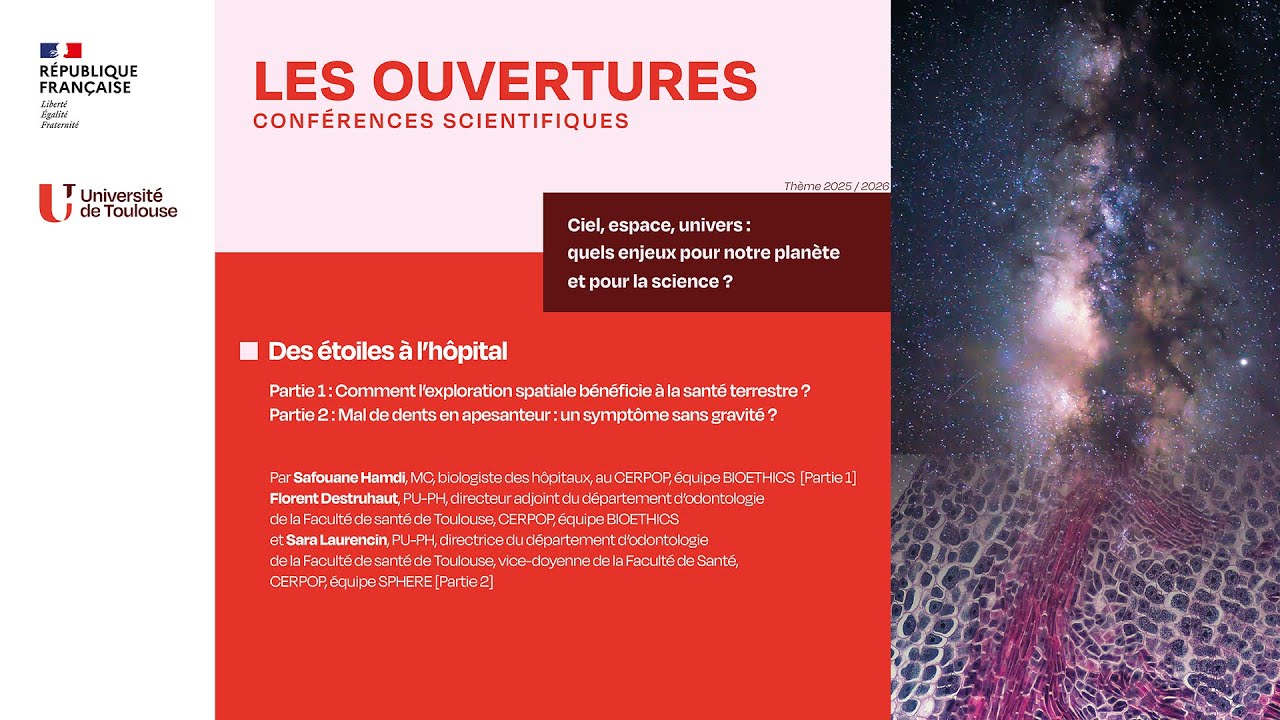
Des étoiles à l’hôpital
Keywords
Summary
229 words
Critical Evaluation
Value of the Information & Strength of the Argument
The value of the information is high, as it provides a comprehensive overview of space medicine’s contributions to terrestrial health, supported by specific examples and historical references. The argumentation is solid, with each claim backed by examples from NASA missions and technological developments. The speakers effectively demonstrate how space exploration has led to innovations in telemedicine, diagnostics, and imaging. The presentation is well-structured, with clear transitions between topics, and the speakers maintain a logical flow. However, the talk is primarily descriptive rather than critical, and it does not delve deeply into potential limitations or controversies in the field.
Scientific Rigor, Source Quality, Title Accuracy
The scientific rigor is generally good, as the speakers are qualified professionals and the content aligns with established knowledge in space medicine. They reference specific missions (e.g., Skylab, ISS) and technologies (e.g., Canadarm, James Webb Telescope) without providing formal citations. The sources are not explicitly listed, but the information is consistent with known facts. The title accurately reflects the content, and the talk is well-organized. The speakers do not overstate claims and acknowledge uncertainties, such as the unknown effects of long-duration missions. Overall, the presentation is scientifically sound for a general audience.
205 words
Title / Content Match
The title 'From Stars to the Hospital' accurately reflects the content, which explores how space exploration benefits terrestrial health.
Quality & Reliability
8/10
The conference is presented by qualified medical professionals and researchers (MCU-PH, PU-PH) affiliated with the University of Toulouse and CERPOP. They provide a historical overview and specific examples of space medicine applications, referencing NASA missions and technologies. The content is well-structured and appears scientifically sound, though it is a popular science talk without detailed citations.
Key Moments
Markers derived by PSI from the transcript: the creator did not define chapters.
- Introduction of the conference and speakers.
- Overview of upcoming space missions in February 2026.
- Historical timeline of human spaceflight and medical discoveries.
- Discussion of medical risks for astronauts, including bone loss and radiation.
- Introduction to biotelemetry and the 1975 NASA experiment in Arizona.
- Explanation of modern telemedicine and its use in space and on Earth.
- Advances in biological analysis: lab-on-a-chip and non-invasive sampling.
- Imaging technologies: image processing and miniaturized ultrasound.
- Robotic surgery and other spin-offs like lidar in ophthalmology.
- Second part: dental health in microgravity by Sara Laurencin and Florent Destruhaut.
Cited Sources
- Wikipedia: Human spaceflight — Referenced for the timeline of human spaceflight missions.
- NASA: Space Medicine — Referenced for medical research and technologies.
- Médecins Sans Frontières: Telemedicine — Referenced as an example of telemedicine application.
Concurring Sources
- NASA: Human Research Program — Supports the discussion on medical risks and countermeasures.
- European Space Agency: Space Medicine — Corroborates the benefits of space research for health.
Contribution & Novelties
The conference provides a valuable synthesis of how space exploration has contributed to medical advancements, highlighting specific technologies and historical milestones. It offers a unique perspective by connecting space medicine to terrestrial health applications, which is often overlooked. The talk also introduces the audience to the emerging field of space dentistry, a niche area.
Pour aller plus loin :
- NASA Human Research Program — Official source for space medicine research.
- Telemedicine on Wikipedia — Overview of telemedicine and its applications.
- Microgravity effects on human body — NASA’s summary of physiological changes in microgravity.
93 words
Radar Profile
The radar profile shows high scores in information quantity, quality, technical level, and reliability, indicating a well-rounded and informative presentation. The talk is comprehensive and technically sound, making it a valuable resource for understanding the intersection of space and medicine.
💬 No comments were provided for analysis.