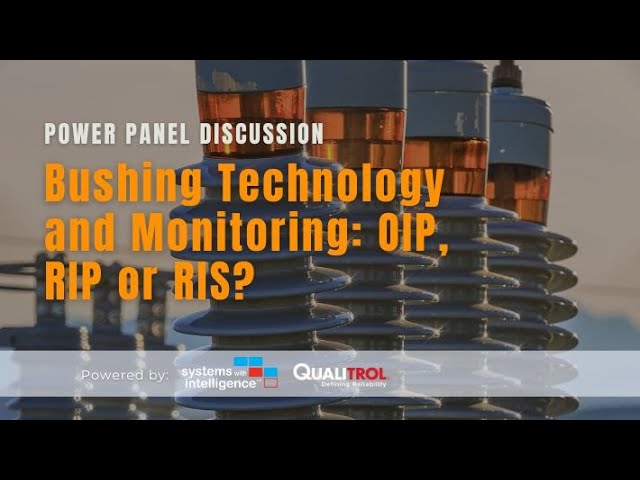
Bushing Technology and Monitoring: OIP, RIP or RIS?
Keywords
Summary
194 words
Critical Evaluation
Value of the Information & Strength of the Argument
The video provides valuable insights from experienced professionals in the field. The discussion is grounded in practical experience, with Randy Williams citing his involvement in thousands of bushing tear-downs and field investigations. The panelists present a balanced view of the technologies, acknowledging trade-offs between OIP, RIP, and RIS. The argumentation is solid, relying on real-world examples and industry knowledge. However, the lack of formal data or references limits the depth of scientific rigor. The discussion on monitoring strategies is particularly valuable, highlighting the importance of continuous monitoring and the challenges of condition-based maintenance.
Scientific Rigor, Source Quality, Title Accuracy
The video is a panel discussion with no formal citations or references to scientific literature. The experts rely on their extensive industry experience, which adds credibility but not academic rigor. The title accurately reflects the content, focusing on bushing technology and monitoring. The description mentions that 20% of transformer failures are linked to bushings, a statistic that is commonly cited in the industry. The video does not provide sources for this claim, but it is plausible. The discussion is consistent with known industry knowledge, and the experts’ backgrounds lend authority to their statements. No comments were provided for analysis.
207 words
Title / Content Match
The title accurately reflects the content, which compares OIP, RIP, and RIS bushing technologies and discusses monitoring strategies.
Quality & Reliability
7/10
Panel discussion with industry experts (Randy Williams, Thomas Lynn, Brad Bonus) providing practical insights and experience-based knowledge. No formal citations or peer-reviewed sources, but speakers have extensive field experience. Technical details are plausible and consistent with industry knowledge.
Chapters
- Introductions: Meet the Panel
- OIP, RIP & RIS: Bushing Technology Explained
- RIP vs RIS: Manufacturing Trade-Offs & Production Timelines
- Utility Strategies: Condition-Based vs Targeted Monitoring
- Why Bushings Fail & the Importance of Thermal Monitoring
- Operating Conditions, Transients & the Health Index Approach
- Touchless Monitoring: Continuous Visual & Thermal Systems
- Renewables, DER & Choosing the Right Bushing Material
- The Transformer Supply Crunch: Specifying New vs Retrofitting
- IEEE Standards, Lead Times & Manufacturing Capacity Reality
- The Future: AI, Machine Learning & the Talent Pipeline
- Audience Q&A: Altitude, Tan Delta, Oversizing & Vacuum Breakers
Cited Sources
- Power Systems Technology LinkedIn — Official LinkedIn page of the channel, mentioned for updates.
- Transformer Technology LinkedIn — LinkedIn page for Transformer Technology, related to the topic.
- Women in Power Systems LinkedIn — LinkedIn page for Women in Power Systems, mentioned as a resource.
- Power Systems Technology Website — Official website for more resources.
- Power Systems Technology Newsletter — Newsletter subscription for exclusive content.
Concurring Sources
- Transformer bushing — General information on transformer bushings, consistent with the video's content.
Contribution & Novelties
The video offers a practical, expert-driven overview of bushing technologies and monitoring strategies, which is valuable for professionals in the power industry. It highlights the trade-offs between OIP, RIP, and RIS, and emphasizes the importance of continuous monitoring. The discussion on the future of AI and machine learning in monitoring provides forward-looking insights.
Pour aller plus loin :
- Transformer bushing — Wikipedia article providing general background on transformer bushings.
- Condition monitoring — Wikipedia article on condition monitoring techniques.
- Dissolved gas analysis — Wikipedia article on DGA, a key monitoring technique for transformers.
92 words
Radar Profile
The radar profile shows high scores in quantity of information and fiabilite, reflecting the depth of expert discussion and credible experience. The niveau technique is moderate, indicating that the content is accessible to a technical audience but not overly complex. The overall balance suggests a valuable resource for professionals seeking practical insights.