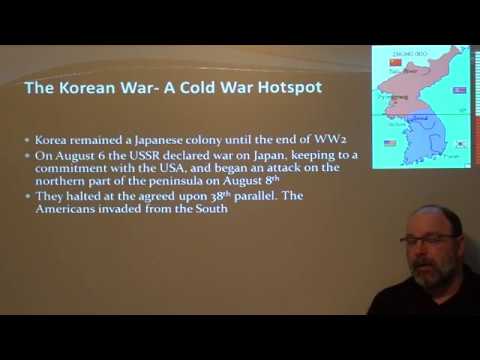
The Korean War - Lecture by Eric Tolman
Keywords
Summary
152 words
Critical Evaluation
Value of the Information & Strength of the Argument
The lecture offers a clear and accessible narrative of the Korean War, emphasizing the geopolitical context and the decisions of key figures. It argues that the war was a direct result of Cold War tensions and the division of Korea, and that American involvement was driven by the Truman Doctrine and domestic anti-communist sentiment. The argumentation is logical and coherent, but it relies on a simplified interpretation of events and does not engage with historiographical debates. The value lies in its synthesis of basic facts and its emphasis on the role of individual leaders, particularly MacArthur, in shaping the conflict. However, it lacks depth in analyzing the motivations of other actors, such as China and the Soviet Union, and does not provide a critical examination of the sources.
Scientific Rigor, Source Quality, Title Accuracy
The lecture demonstrates a basic level of historical rigor, presenting a chronological account of events without citing specific sources. It relies on general knowledge and does not reference primary documents or scholarly works. The title accurately reflects the content, which is a brief overview. The lecture’s strength is its clarity and structure, but its weakness is the absence of citations and the lack of engagement with alternative perspectives. The lecturer’s interpretation is presented as authoritative without supporting evidence, which limits its scientific value.
226 words
Title / Content Match
The title accurately reflects the content, which is a concise overview of the Korean War.
Quality & Reliability
6/10
The lecture provides a coherent narrative of the Korean War's causes and key events, but lacks citations and in-depth analysis. It is based on general historical knowledge and personal interpretation, with no references to specific scholarly works.
Key Moments
Markers derived by PSI from the transcript: the creator did not define chapters.
- Introduction: lecture on Korean War, part of Cold War series.
- Korea as Japanese colony until end of WWII; Soviet declaration of war and invasion.
- Division at 38th parallel; US and USSR support rival governments.
- Withdrawal of forces in 1949; both Koreas aim for unification.
- North Korean invasion June 25, 1950; UN resolution due to Soviet boycott.
- Inchon landing; UN forces push North Koreans back.
- UN crosses 38th parallel; captures Pyongyang; China warns.
- Chinese intervention with 300,000 troops; UN pushed south.
- MacArthur fired for insubordination; armistice signed July 1953.
- Conclusion: no peace treaty; DMZ remains; lecture series context.
Contribution & Novelties
The lecture provides a concise synthesis of the Korean War’s key events and actors, making it a useful introduction for students. Its original contribution is the emphasis on the role of individual decisions, particularly MacArthur’s, in escalating the conflict. However, it does not offer new research or unique insights.
Pour aller plus loin :
- Korean War - Wikipedia — Comprehensive overview with references.
- Truman Doctrine - Wikipedia — Context on US foreign policy.
- Douglas MacArthur - Wikipedia — Biography and role in the war.
84 words
Radar Profile
The radar profile shows moderate scores across all dimensions, indicating a balanced but not exceptional lecture. The highest score is in quantity of information, reflecting the coverage of key events, while the lowest is in technical level, as the content is accessible to a general audience.