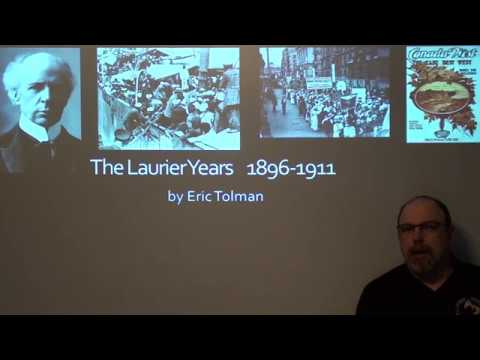
The Laurier Years 1896-1911 Part 1 - Lecture by Eric Tolman
Keywords
Summary
200 words
Critical Evaluation
Value of the Information & Strength of the Argument
The lecture provides a broad overview of the Laurier era, emphasizing key political and social themes. The value lies in its accessible narrative that connects various events, such as immigration, technological change, and imperial relations, into a coherent story. The argumentation is generally logical, but it often relies on generalizations and lacks depth in analysis. For example, the discussion of the Boer War simplifies the motivations of both Britain and the Boers, and the treatment of French-English relations is somewhat superficial. The speaker occasionally makes subjective comments (e.g., ‘I think Bourassa was kind of right’) without providing a balanced perspective. Overall, the lecture is informative for a general audience but does not offer rigorous scholarly argumentation.
Scientific Rigor, Source Quality, Title Accuracy
The lecture does not cite specific sources, and the description provides no links. The speaker mentions that he has other lectures on related topics but does not reference academic works. The title accurately reflects the content, as the lecture indeed covers the Laurier years. However, the lack of citations and the occasional uncertainty about facts (e.g., the number of Canadian volunteers in the Boer War) reduce its scientific rigor. The lecture is more of an educational overview than a scholarly presentation.
212 words
Title / Content Match
The title accurately reflects the content, which focuses on the Laurier years from 1896 to 1911, covering political, social, and economic developments.
Quality & Reliability
6/10
The lecture provides a coherent narrative of Canadian history during the Laurier era, but relies on general knowledge and lacks specific citations. The speaker occasionally shows uncertainty about figures (e.g., number of volunteers) and makes subjective interpretations. Overall, it is a reasonable educational overview but not a rigorously sourced academic work.
Key Moments
Markers derived by PSI from the transcript: the creator did not define chapters.
- Introduction to the lecture series and overview of the Laurier era.
- Discussion of Wilfrid Laurier as Canada's first French-Canadian prime minister and the context of French-English tensions.
- Explanation of Canada's interest in immigration and the goal to fill the Prairies with farmers.
- Creation of Saskatchewan and Alberta as provinces in 1905, making Canada a coast-to-coast nation.
- Impact of technological innovations like the telephone, radio, and automobile on connecting isolated communities.
- Growing demands for rights by women, First Nations, and new immigrants.
- The Manitoba Schools Question and its role in Laurier's election.
- Canada's relationship with the British Empire and the Boer War.
- The naval issue and Laurier's Naval Services Act of 1910.
- Discussion of Canada's limited industrial capacity and the state of the navy by 1914.
Contribution & Novelties
The lecture offers a concise synthesis of the Laurier era, highlighting the interplay between immigration, technological change, and imperial relations. It provides a useful starting point for understanding this period, but it does not present new research or original insights. The speaker’s perspective as a history educator adds a pedagogical value, but the content is largely based on established historical knowledge.
Pour aller plus loin :
- Wilfrid Laurier — Overview of Laurier’s life and political career.
- Boer War — Detailed account of the South African War and its international context.
- Canadian Naval Service — Historical background on the development of Canada’s navy, including the Naval Services Act.
107 words
Radar Profile
The radar profile shows moderate scores across all dimensions, with the highest in quantity of information and the lowest in technical level. This indicates a lecture that provides a broad overview but lacks depth and technical rigor, suitable for a general audience rather than specialists.