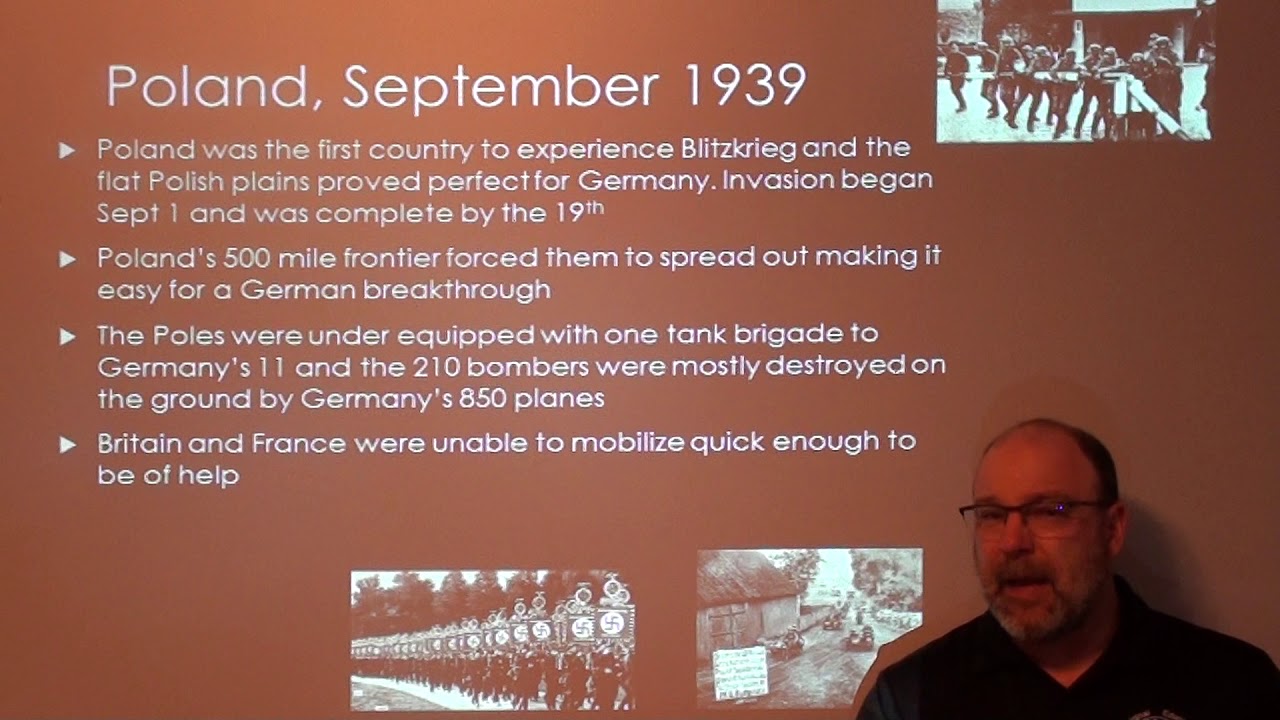
World War 2 Part 1 - Lecture by Eric Tolman
Keywords
Summary
172 words
Critical Evaluation
Value of the Information & Strength of the Argument
The lecture provides a solid overview of the early events of World War II, with clear explanations of military tactics and strategic decisions. Tolman’s argumentation is coherent, linking the development of Blitzkrieg to earlier tactics and explaining its successes and limitations. He presents multiple perspectives, such as the debate over Hitler’s hesitation at Dunkirk, and supports his points with historical examples. However, the lecture is introductory and lacks depth in some areas, such as the political and social contexts of the countries involved. The value lies in its accessibility and the lecturer’s engaging narrative style, which helps viewers understand the sequence of events and the significance of key battles.
Scientific Rigor, Source Quality, Title Accuracy
The lecture demonstrates a good understanding of the historical events, but it does not explicitly cite sources. Tolman mentions primary resources like photographs and films, but he does not provide specific references. The title accurately reflects the content, as it is a lecture on World War II. The lecture is based on well-established historical knowledge, and Tolman’s interpretations are generally consistent with mainstream historiography. However, some statements, such as the claim about the origins of Blitzkrieg, are presented without citation, which could be seen as a lack of rigor. Overall, the lecture is informative and reliable for a general audience, but it would benefit from more explicit sourcing.
232 words
Title / Content Match
The title accurately reflects the content, which is a lecture covering the early phase of World War II.
Quality & Reliability
7/10
The lecture is based on established historical knowledge and includes references to primary sources and historical debates. However, it lacks explicit citations and relies on the lecturer's interpretation, which may oversimplify complex events.
Key Moments
Markers derived by PSI from the transcript: the creator did not define chapters.
- Introduction to the lecture series and overview of World War II.
- Explanation of Blitzkrieg and its origins.
- Invasion of Poland and the use of Blitzkrieg.
- The Phoney War and the Maginot Line.
- The invasion of Norway and the fall of Chamberlain.
- The fall of France and the Dunkirk evacuation.
- The Battle of Britain and Churchill's leadership.
- Lend-Lease and American aid to Britain.
Contribution & Novelties
The lecture provides a concise and engaging overview of the early stages of World War II, with a particular focus on the evolution of military tactics. It offers a fresh perspective by linking Blitzkrieg to earlier tactics like the creeping barrage, which may not be commonly known. The lecture also highlights the importance of leadership and the role of key figures like Churchill. For viewers new to the topic, it serves as an excellent introduction.
Pour aller plus loin :
- Blitzkrieg — Provides a detailed explanation of the tactics and its historical context.
- Dunkirk evacuation — Offers comprehensive information on the evacuation and its significance.
- Winston Churchill — Biographical details and his role during the war.
116 words
Radar Profile
The radar profile shows a balanced performance across all dimensions, with slightly higher scores in information quantity and quality, reflecting the lecture's comprehensive yet accessible nature. The technical level is moderate, suitable for a general audience, while reliability is solid due to the use of established historical facts.