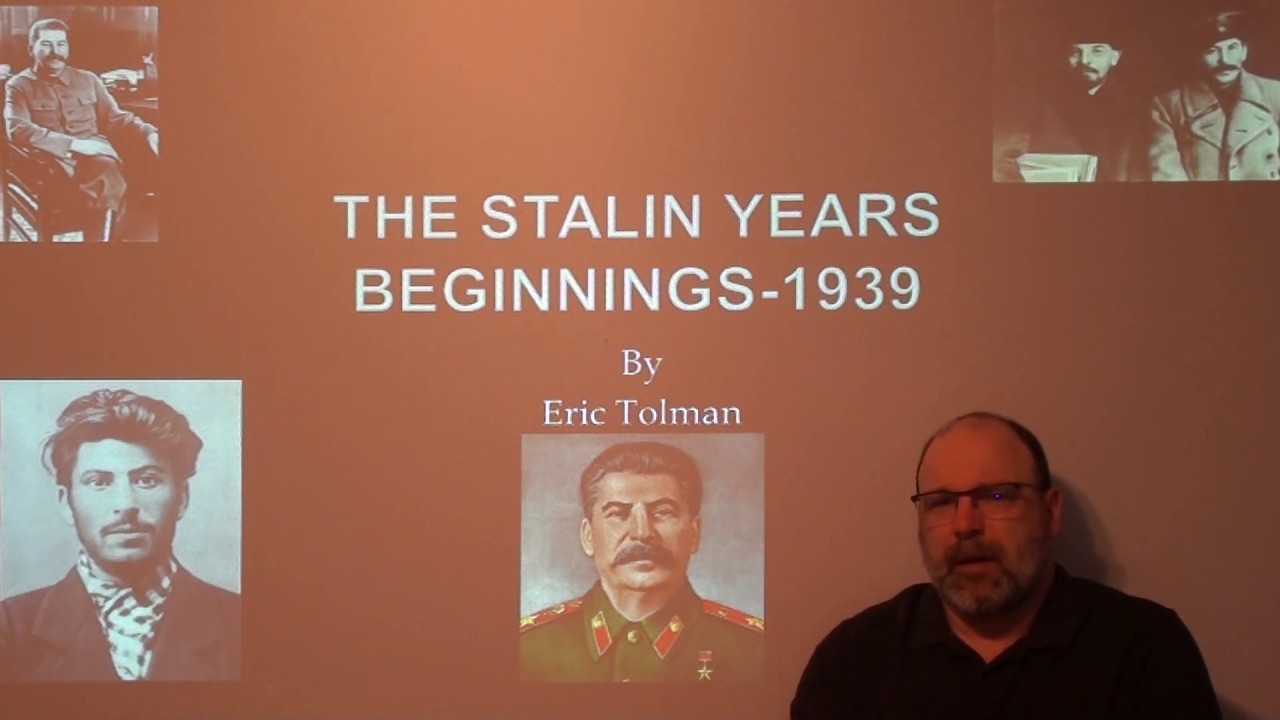
The Stalin Years to 1939 - Lecture by Eric Tolman
Keywords
Summary
182 words
Critical Evaluation
Value of the Information & Strength of the Argument
The lecture provides a valuable narrative of Stalin’s early life and rise to power, drawing on a well-known biography and general historical knowledge. The argumentation is coherent, presenting a clear thesis that Stalin’s personality was shaped by his abusive childhood and his experiences in the violent Caucasus. Tolman effectively argues that Stalin’s underestimated political skills, combined with his control over appointments, allowed him to defeat more prominent rivals. However, the lecture lacks critical engagement with sources, and some claims are presented as fact without citation. The argumentation is persuasive but not deeply analytical, focusing more on storytelling than on historiographical debate.
Scientific Rigor, Source Quality, Title Accuracy
The lecture relies primarily on Simon Sebag Montefiore’s ‘Young Stalin’ and general historical consensus, but it does not cite specific sources or provide a bibliography. The quality of sources is moderate, as the presenter does not critically evaluate them. The title accurately reflects the content, which covers Stalin’s life up to 1939. The lecture is well-structured and informative, but the lack of explicit sourcing and the informal tone reduce its scientific rigor. No comments were provided for analysis.
194 words
Title / Content Match
The title accurately reflects the content, which covers Stalin's early life, rise to power, and rule up to 1939.
Quality & Reliability
7/10
The lecture is based on a well-regarded biography (Young Stalin by Simon Sebag Montefiore) and general historical consensus, but it includes some anecdotal details and personal interpretations without rigorous sourcing. The presenter is a history teacher, not a specialized Stalin scholar, and the content is presented in an engaging but somewhat informal manner.
Key Moments
Markers derived by PSI from the transcript: the creator did not define chapters.
- Introduction to the lecture series and overview of Stalin's early life.
- Discussion of the opening of Soviet archives and new insights into Stalin's childhood.
- Description of Stalin's birthplace Gori and his violent upbringing.
- Stalin's education at the seminary and his early rebelliousness.
- Stalin's involvement in criminal activities and revolutionary circles.
- Stalin's meeting with Lenin and his role in the Bolshevik party.
- Stalin's appointment as General Secretary and his use of patronage.
- Power struggle after Lenin's death between Stalin and Trotsky.
- Stalin's consolidation of power and the expulsion of Trotsky.
- Implementation of the first Five-Year Plan and the beginning of Stalin's totalitarian rule.
Cited Sources
- Young Stalin — Mentioned as a key source for understanding Stalin's early life.
Concurring Sources
- Young Stalin — The lecture's main source, which aligns with its narrative.
Contribution & Novelties
The lecture offers a compelling synthesis of Stalin’s early life and rise to power, emphasizing the role of personality and environment. It provides a narrative that is accessible and engaging, making it useful for educational purposes. However, it does not present new research or original analysis, relying on existing biographies and historical accounts.
Pour aller plus loin :
- Stalin - Wikipedia — Overview of Stalin’s life and rule.
- Russian Revolution - Wikipedia — Context for the revolutionary period.
- Five-Year Plans - Wikipedia — Details on Stalin’s economic policies.
88 words
Radar Profile
The radar profile shows high scores in quantity of information and fiabilite, but lower in technical level, reflecting the lecture's accessible yet comprehensive nature. The balance suggests a good introductory resource for students.