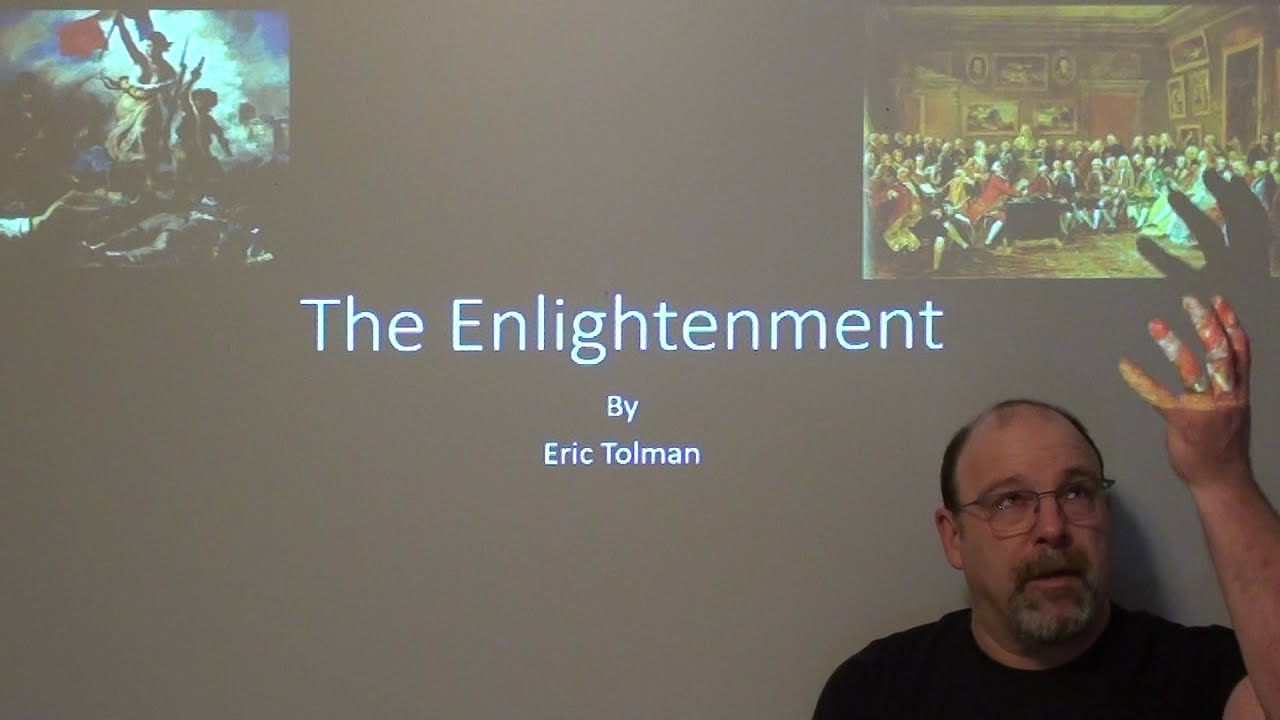
The Enlightenment - Lecture by Eric Tolman
Keywords
Summary
182 words
Critical Evaluation
Value of the Information & Strength of the Argument
The lecture offers a clear and accessible synthesis of Enlightenment ideas, making it valuable for students or general audiences. Tolman effectively connects the scientific revolution to the political and social thought of the Enlightenment, and he explains complex concepts like the social contract and tabula rasa in an understandable manner. However, the argumentation is largely narrative and lacks critical analysis or engagement with historiographical debates. The speaker relies on a traditional, Whiggish interpretation of the Enlightenment as a progressive force, without addressing recent scholarship that complicates this view. The lecture also includes some tangential discussions, such as on alcoholism and peasant life, which, while interesting, detract from the core focus. Overall, the value lies in its educational clarity rather than in presenting new or nuanced arguments.
Scientific Rigor, Source Quality, Title Accuracy
The lecture demonstrates a reasonable level of scientific rigor for an introductory survey. Tolman accurately presents the main ideas of key thinkers like Locke, Voltaire, and Montesquieu, and he correctly situates the Enlightenment within the broader context of the scientific revolution. However, he does not cite specific sources or provide references to primary texts or scholarly works, which limits the verifiability of his claims. The title accurately reflects the content, as the lecture is indeed about the Enlightenment. The speaker’s expertise is evident, but the lack of citations and the occasional oversimplification (e.g., describing deism as ‘God created the pieces and left them scattered’) reduce the overall rigor. No comments were provided for analysis.
255 words
Title / Content Match
The title accurately reflects the content, which is a lecture on the Enlightenment, its origins, key thinkers, and impact.
Quality & Reliability
7/10
The lecture provides a coherent overview of Enlightenment ideas, but relies on general historical narratives without citing specific primary sources or recent scholarship. The speaker's expertise is evident, but the content is largely based on common historical knowledge, with some personal interpretations and occasional tangents.
Key Moments
Markers derived by PSI from the transcript: the creator did not define chapters.
- Introduction to the Enlightenment and its impact on revolutions.
- Recap of Renaissance humanism, deism, and empiricism.
- Discussion of the scientific revolution and its influence on rational thought.
- Contrast between peasant life and the nobility's lifestyle.
- Introduction of John Locke's ideas on natural rights and social contract.
- Explanation of Locke's tabula rasa and its implications for society.
- Discussion of French philosophes and salon culture.
- Impact of Enlightenment ideas on criticism of monarchy and church.
Cited Sources
- No external sources cited in the video description or transcript. — The lecture does not reference any specific sources or provide links in the description.
Concurring Sources
- Enlightenment - Britannica — Provides a scholarly overview of the Enlightenment, consistent with the lecture's content.
Contribution & Novelties
The lecture provides a clear and engaging introduction to the Enlightenment, synthesizing key ideas and figures for a general audience. Its originality lies in its pedagogical approach, connecting the scientific revolution to political thought and emphasizing the social context of the time. However, it does not present new research or unique interpretations.
Pour aller plus loin :
- Enlightenment - Wikipedia — A comprehensive overview of the Enlightenment, its major thinkers, and its historical context.
- John Locke - Stanford Encyclopedia of Philosophy — Detailed analysis of Locke’s philosophy, including his theories of knowledge and government.
- The Social Contract - Jean-Jacques Rousseau — Primary text of Rousseau’s influential work on political philosophy.
- Voltaire - Internet Encyclopedia of Philosophy — Overview of Voltaire’s life and ideas, including his advocacy for civil liberties.
129 words
Radar Profile
The radar profile shows moderate scores across all dimensions, with slightly higher scores in information quantity and quality, reflecting the lecture's comprehensive but not deeply technical nature. The low technical level indicates that the content is accessible to a general audience, while the moderate reliability score suggests a lack of explicit sourcing.