Causes of the French Revolution - Lecture by Eric Tolman
Keywords
Summary
198 words
Critical Evaluation
Value of the Information & Strength of the Argument
The lecture offers a valuable synthesis of the causes of the French Revolution, connecting political, economic, and social factors in a clear narrative. Tolman effectively argues that the revolution was driven by a combination of long-term structural issues (absolutism, aristocratic privilege) and short-term crises (bankruptcy, harvest failures). He draws parallels between Louis XVI and Tsar Nicholas II, and between the French and American revolutions, which enriches the analysis. The argumentation is solid, though it relies on general historical interpretations rather than presenting new research. The speaker’s informal style and occasional digressions (e.g., the anecdote about Louis XIV’s cook) make the content accessible, but they also dilute the focus. Overall, the lecture provides a compelling and coherent explanation of the causes, though it does not delve into historiographical debates or alternative perspectives.
Scientific Rigor, Source Quality, Title Accuracy
The lecture demonstrates a reasonable level of scientific rigor, as it aligns with mainstream historical understanding of the French Revolution’s causes. However, Tolman does not cite specific sources or reference scholarly works, which limits the verifiability of his claims. He occasionally expresses uncertainty about dates and details (e.g., the age of Louis XIV’s accession), which he acknowledges, but this does not undermine the overall accuracy. The title accurately reflects the content, as the lecture focuses exclusively on the causes leading up to the revolution. The description provided is minimal and does not include additional resources. No comments were provided for analysis, so public reception cannot be assessed.
253 words
Title / Content Match
The title accurately reflects the content, as the lecture focuses exclusively on the causes leading up to the French Revolution, ending with the storming of the Bastille.
Quality & Reliability
7/10
The lecture provides a coherent narrative of the causes of the French Revolution, drawing on established historical knowledge. However, it lacks explicit citations and relies on general interpretations, with occasional uncertainties (e.g., dates, ages of monarchs) that are acknowledged by the speaker. The content is accurate but not deeply sourced.
Key Moments
Markers derived by PSI from the transcript: the creator did not define chapters.
- Introduction to the lecture series and overview of the French Revolution's significance.
- Discussion of the connection between the American and French Revolutions and the financial impact of French involvement.
- Introduction to the concept of the Ancien Régime and the role of the bourgeoisie.
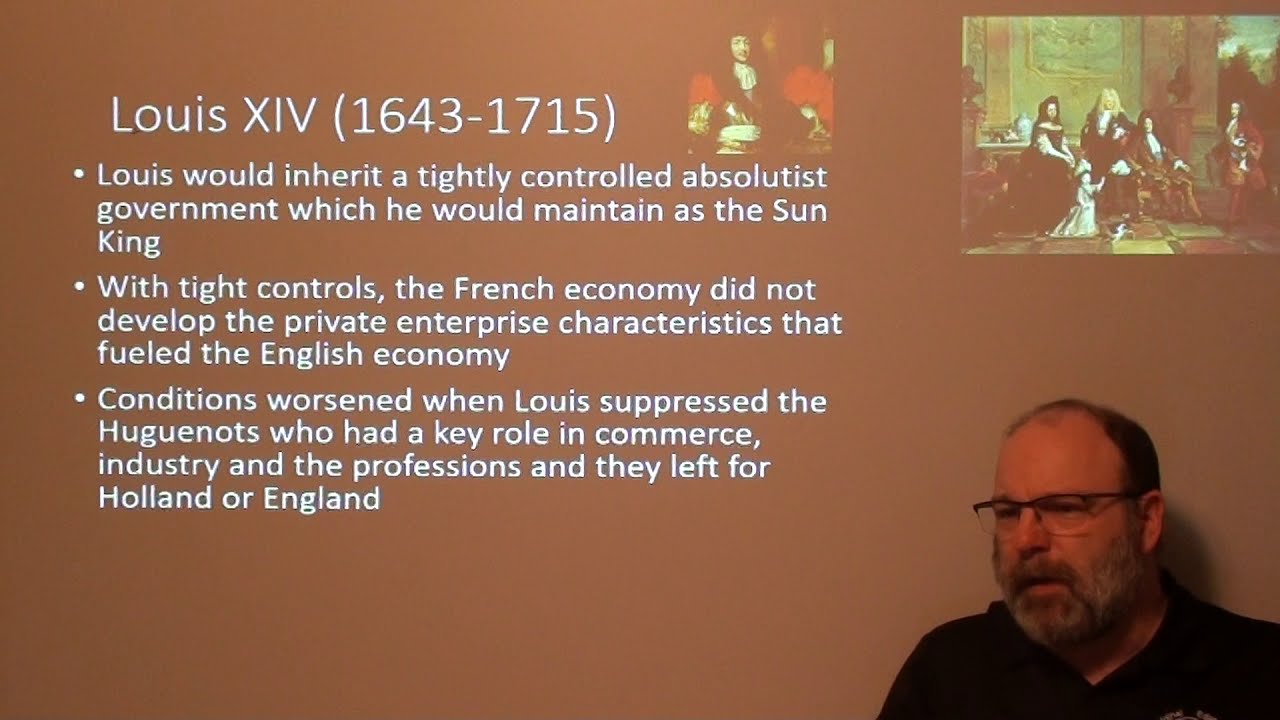
- Analysis of the reign of Louis XIV, including absolutism and the suppression of the Huguenots.
- Discussion of the economic consequences of Louis XIV's wars and the transition to Louis XV.
- Examination of the weak leadership of Louis XV and Louis XVI, and the growth of salon culture.
- Impact of the Seven Years' War and American War of Independence on the French economy.
- Social conditions in France: population growth, peasant hardship, and urban unemployment.
- The role of bread shortages and hunger in triggering revolutionary violence.
- Conclusion: the combination of Enlightenment ideas and material suffering as the driving forces behind the revolution.
Concurring Sources
- The French Revolution: A History — Thomas Carlyle's classic work, which, while older, aligns with the general narrative of economic and social causes.
Contribution & Novelties
The lecture provides a comprehensive and accessible synthesis of the causes of the French Revolution, integrating political, economic, and social factors. It offers a clear narrative that connects the long-term structural issues of absolutism and aristocratic privilege with the short-term crises of bankruptcy and harvest failures. The comparison between Louis XVI and Tsar Nicholas II, and between the French and American revolutions, adds a comparative perspective that is not always present in standard accounts. However, the lecture does not present new research or original interpretations; it is a pedagogical overview rather than a contribution to scholarly debate.
Pour aller plus loin :
- French Revolution - Wikipedia — Provides a comprehensive overview of the revolution, its causes, and its aftermath.
- Ancien Régime - Wikipedia — Explains the social and political structure of pre-revolutionary France.
- Louis XIV - Wikipedia — Details the reign of the Sun King and his impact on French absolutism.
- The Enlightenment - Wikipedia — Discusses the intellectual movement that inspired revolutionary ideas.
164 words
Radar Profile
The radar profile shows high scores in quantity of information and fiabilité globale, reflecting the lecture's comprehensive coverage and general accuracy. The niveau technique is moderate, indicating that the content is accessible to a general audience but lacks deep technical detail. The overall balance suggests a solid educational resource, though not a cutting-edge scholarly contribution.