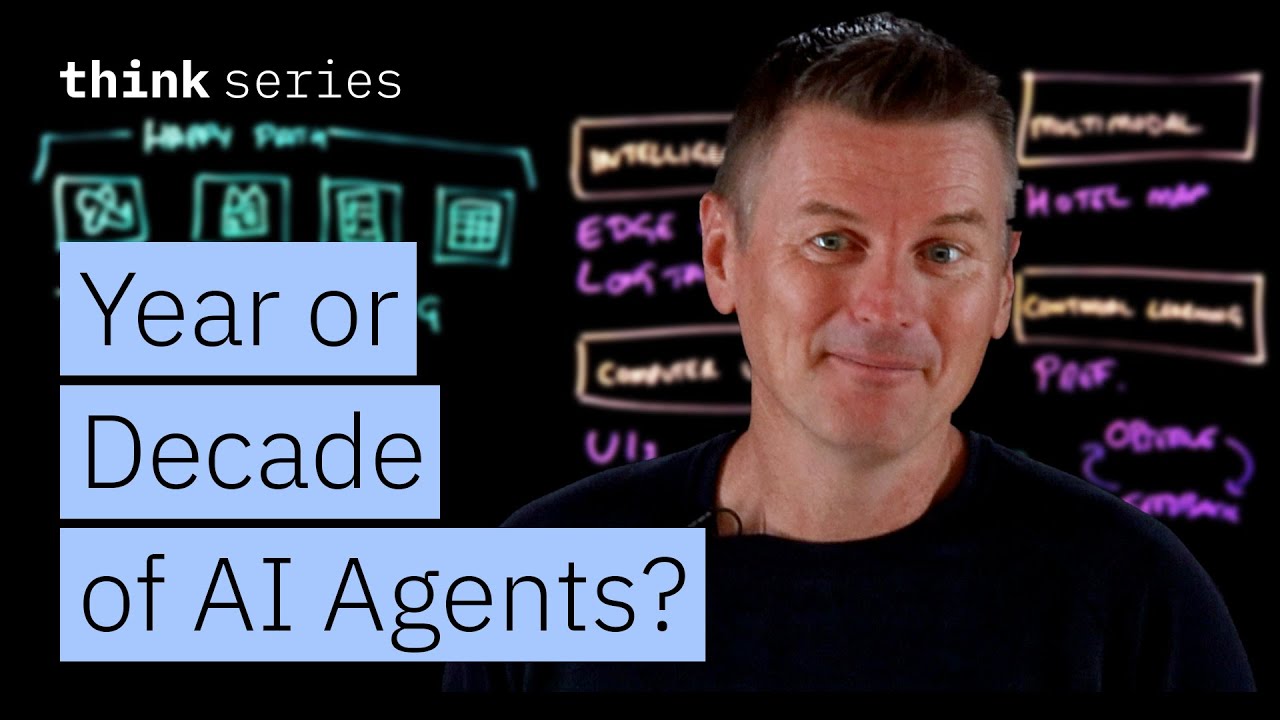
Is this the YEAR or DECADE of AI Agents & Agentic AI?
Keywords
Summary
188 words
Critical Evaluation
The video provides a clear and structured analysis of the current state of AI agents, focusing on three representative use cases. The presenter, Martin Keen, an IBM Technology expert, demonstrates a good understanding of the technical capabilities and limitations of AI agents. The argumentation is logical: he defines four key capabilities (intelligence, computer use, multimodal, continual learning) and systematically evaluates each use case against them. This framework is effective for comparing the maturity of different applications.
The strength of the video lies in its balanced perspective. It acknowledges that coding assistants are already providing significant utility, while travel booking and IT support are not yet reliable enough for full autonomy. This nuanced view avoids both hype and undue skepticism, which is valuable in a field often characterized by extremes.
However, the video has some weaknesses. It relies heavily on anecdotal evidence and personal experience rather than citing specific studies or data. For instance, when discussing travel booking failures, he mentions his own struggles but does not provide concrete examples or statistics. This reduces the scientific rigor of the content. Additionally, the video does not reference any external sources, such as research papers or industry reports, which would strengthen the credibility of the claims. The lack of citations is a notable omission for a technical audience.
The adéquation between title and content is good: the title poses a question that the video directly addresses, and the conclusion is clear. The video is well-paced and accessible, but it does not delve deeply into technical details, which might leave advanced viewers wanting more.
Overall, the video is a valuable overview for those interested in the practical applications of AI agents. It offers a realistic assessment of their current capabilities and future potential. However, for a more rigorous analysis, viewers would need to consult additional sources. The video’s strength is its clarity and structure, but its reliance on opinion rather than data limits its scientific value.
322 words
Title / Content Match
The title accurately reflects the content, which explores whether AI agents are ready for widespread adoption now or in the next decade.
Quality & Reliability
7/10
The video presents a balanced expert opinion from an IBM Technology representative, discussing the current capabilities and limitations of AI agents. It is well-structured and uses concrete examples, but lacks citations to external sources and relies on anecdotal evidence.
Key Moments
Markers derived by PSI from the transcript: the creator did not define chapters.
- Introduction: The debate between 'year' and 'decade' of AI agents, citing Andrej Karpathy's skepticism.
- Overview of four AI agent capabilities: intelligence, computer use, multimodal, continual learning.
- Use case 1: Coding assistants - why they work well (structured code, pattern matching, clear feedback).
- Use case 2: Travel booking - simple scenarios work, but edge cases and UI navigation cause issues.
- Use case 3: Automated IT support - aspirational, but requires high reliability and learning.
- Conclusion: Year for narrow tasks, decade for broader vision.
Cited Sources
- IBM watsonx AI Assistant certification — Mentioned in description as a certification opportunity.
- IBM AI newsletter — Mentioned in description for AI updates.
- IBM AI Agents learning resources — Mentioned in description as a link to learn more about AI agents.
Concurring Sources
- IBM AI Agents learning resources — IBM's official resources on AI agents align with the video's content.
Contribution & Novelties
The video provides a clear framework for evaluating AI agent readiness across different use cases, emphasizing the importance of structured environments and feedback loops. It offers a balanced perspective on the hype versus reality, which is valuable for practitioners.
Pour aller plus loin :
- Agentic AI - Wikipedia — Overview of agentic AI concepts.
- Large language model - Wikipedia — Background on the models behind AI agents.
- Reinforcement learning - Wikipedia — Relevant to continual learning aspects.
77 words
Radar Profile
The radar profile shows moderate scores across all dimensions, indicating a balanced but not deeply technical presentation. The video is informative but lacks rigorous citations, which is reflected in the lower reliability score.