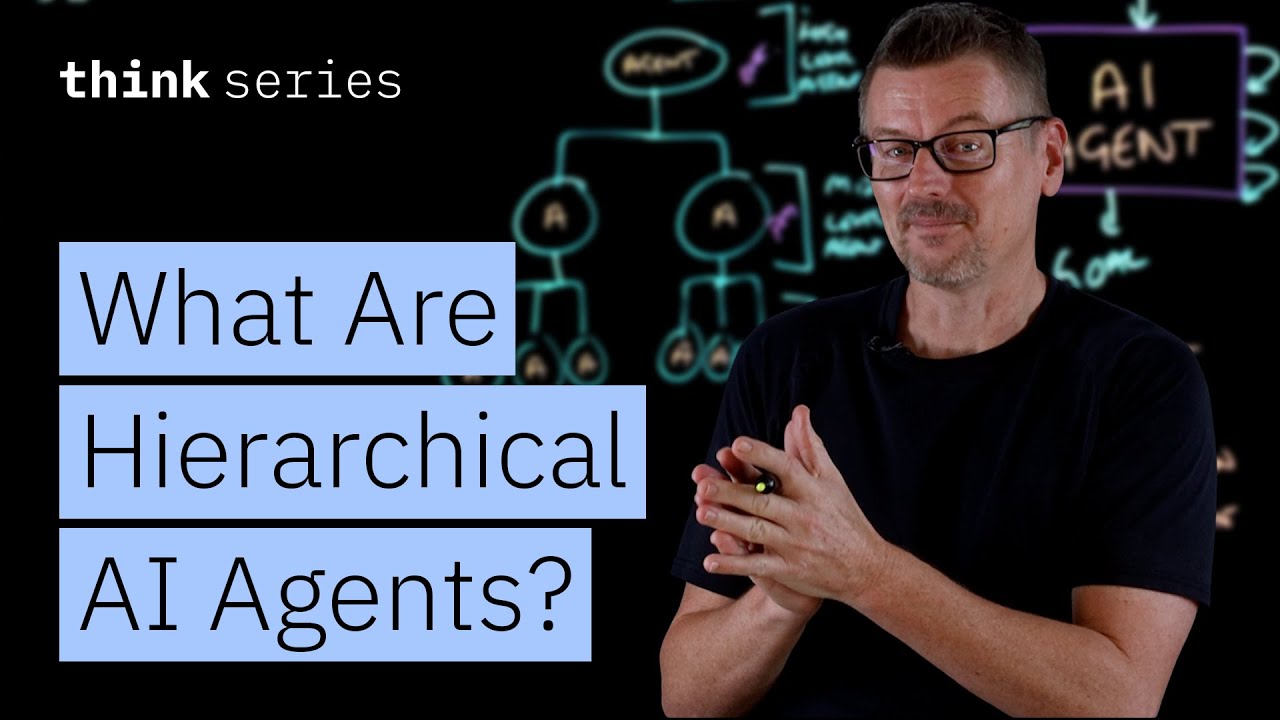
What Are Hierarchical AI Agents? Solving Context & Task Challenges
Keywords
Summary
160 words
Critical Evaluation
The video provides a solid, accessible introduction to hierarchical AI agents, effectively explaining their architecture and benefits. The presenter, Martin Keen, is an IBM Technology expert, lending credibility to the content. The explanation of context dilution, tool saturation, and the ’lost in the middle’ phenomenon is accurate and well-illustrated with practical examples. The analogy to corporate hierarchies is helpful for understanding the structure. The application of software engineering principles like separation of concerns and least privilege is appropriate and adds depth. However, the video lacks specific citations to research papers or empirical studies, relying on general knowledge and anecdotal evidence. The discussion of limitations is balanced, acknowledging the challenges of task decomposition and orchestration overhead. The ’telephone game’ effect is a useful metaphor for potential miscommunication. The video does not delve into implementation details or provide code examples, which might be a drawback for practitioners seeking actionable guidance. The adéquation between title and content is strong, as the video directly addresses context and task challenges. Overall, the video is informative and well-structured, but it could benefit from more concrete references and deeper technical insights. The public comments (not provided) would likely reflect appreciation for the clear explanations, but some might desire more advanced content. The video is a valuable resource for those new to AI agent architectures, offering a comprehensive overview without overwhelming detail.
224 words
Title / Content Match
The title accurately reflects the content, which focuses on defining hierarchical AI agents and addressing context and task challenges.
Quality & Reliability
8/10
The video provides a clear, well-structured explanation of hierarchical AI agents, grounded in established software engineering principles (separation of concerns, least privilege) and known LLM limitations (context dilution, lost in the middle). The presenter is an IBM Technology expert, and the content aligns with current industry trends. However, it lacks empirical data or citations to specific studies, relying on anecdotal examples and general knowledge.
Key Moments
Markers derived by PSI from the transcript: the creator did not define chapters.
- Introduction to AI agents and their problems in long-horizon tasks
- Explanation of context dilution, tool saturation, and lost in the middle
- Introduction to hierarchical AI agents and their three-tier structure
- Analogy to corporate hierarchy and separation of concerns
- Benefits: context packets, tool specialization, model flexibility, modularity, parallelism, recursive feedback
- Limitations: task decomposition difficulty, orchestration overhead, telephone game effect
- Conclusion: treat hierarchy as a production system, design handoffs, validate work
Cited Sources
- IBM watsonx Data Scientist certification — Promotional link for certification, mentioned at the beginning.
- Learn more about Hierarchical AI Agents — Link provided in the description for further reading on the topic.
- IBM AI newsletter — Link to sign up for monthly AI updates from IBM.
Concurring Sources
- IBM watsonx Data Scientist certification — Promotional link, not directly related to content.
- Learn more about Hierarchical AI Agents — Link provided in the description for further reading on the topic.
- IBM AI newsletter — Link to sign up for monthly AI updates from IBM.
Contribution & Novelties
The video offers a clear, structured overview of hierarchical AI agents, synthesizing known concepts into an accessible framework. Its novelty lies in the explicit connection to software engineering principles and the practical discussion of benefits and limitations. It does not present new research but serves as a valuable educational resource.
Pour aller plus loin :
- LangChain documentation on multi-agent systems — Official documentation on building multi-agent systems, relevant for implementation.
- AutoGen: Enabling Next-Gen LLM Applications via Multi-Agent Conversation — Research paper on a framework for multi-agent conversations, directly related to hierarchical agents.
- The Lost in the Middle: How Language Models Use Long Contexts — Study on the ’lost in the middle’ phenomenon, a key challenge addressed by hierarchical agents.
- Separation of Concerns — Wikipedia article on the software engineering principle applied in the video.
134 words
Radar Profile
The radar profile shows high scores in quality and reliability, moderate in quantity and technical level, indicating a well-explained but not deeply technical overview. The balance suggests a good introductory resource.