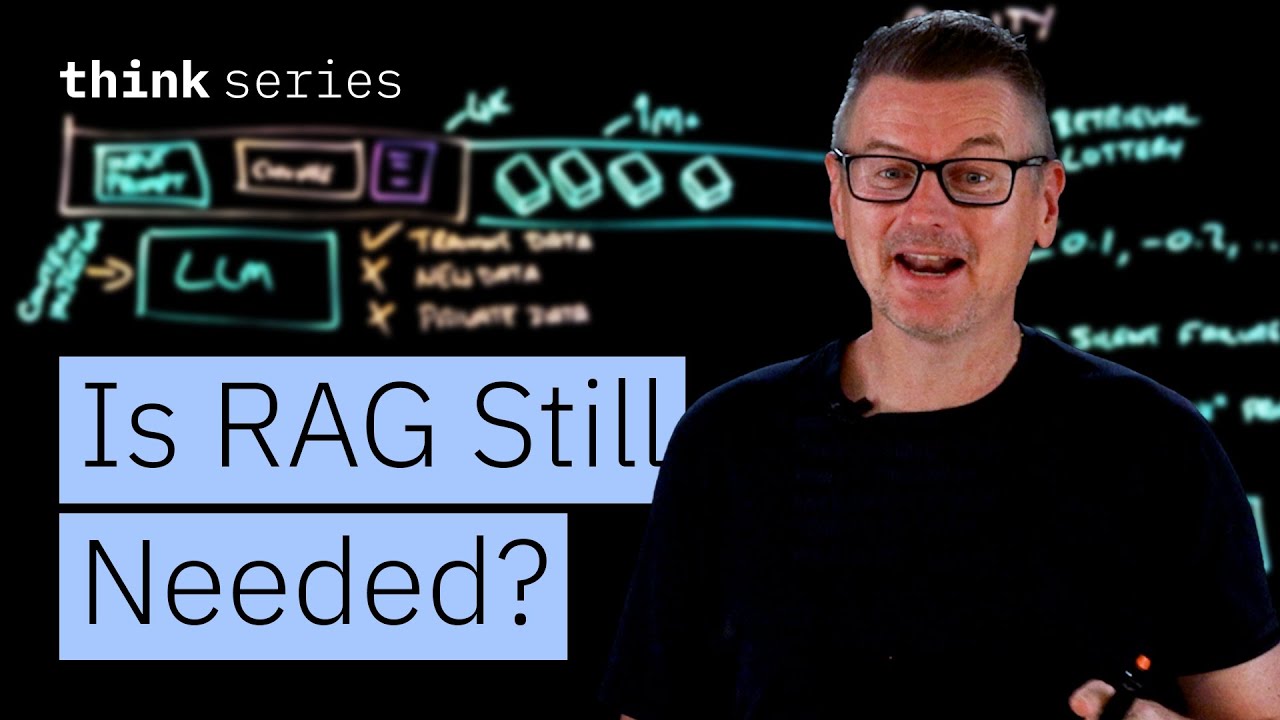
Is RAG Still Needed? Choosing the Best Approach for LLMs
Keywords
Summary
144 words
Critical Evaluation
The video provides a clear and balanced comparison of RAG and long context approaches for LLMs, addressing a timely question in AI engineering. The presenter, Martin Keen, is an experienced IBM technologist, and the content reflects a solid understanding of the subject. The argumentation is structured around three reasons for each approach, making it easy to follow. The technical explanations are accurate, though they lack depth in some areas, such as the specifics of attention mechanisms and retrieval algorithms. The video does not cite specific research or sources, which limits its scientific rigor, but it aligns with widely accepted knowledge in the field. The use of examples like the ‘whole book problem’ and ’needle in a haystack’ effectively illustrates the concepts. The adéquation between title and content is strong, as the video directly addresses the question posed. The presentation style is engaging, with clear visuals and a logical flow. However, the video could benefit from mentioning cost considerations, as highlighted by some comments, and from discussing hybrid approaches in more detail. Overall, the video is a valuable resource for practitioners, offering practical guidance without oversimplifying the trade-offs. The lack of citations is a minor weakness, but the content is reliable and well-presented.
202 words
Title / Content Match
The title accurately reflects the content, which directly addresses the question of whether RAG is still needed and compares it with long context.
Quality & Reliability
8/10
The video provides a balanced, well-structured comparison of RAG and long context approaches, based on established concepts in AI. It cites no specific research but aligns with common knowledge in the field. The presenter is an IBM expert, and the content is technically accurate, though it lacks empirical data or citations.
Key Moments
Markers derived by PSI from the transcript: the creator did not define chapters.
- Introduction: LLMs are frozen in time, need context injection.
- Explanation of RAG: chunking, embedding, vector database, semantic search.
- Introduction of long context approach: brute force, no database.
- Context window size comparison: million tokens, Lord of the Rings example.
- Reason 1 for long context: collapsing infrastructure.
- Reason 2 for long context: retrieval lottery and silent failures.
- Reason 3 for long context: whole book problem, global reasoning.
- Reason 1 for RAG: rereading text, compute inefficiency.
- Reason 2 for RAG: needle in a haystack problem, attention dilution.
- Reason 3 for RAG: infinite data set, enterprise scale.
- Conclusion: choice depends on use case, bounded vs infinite data.
Cited Sources
- Learn more about RAG — IBM's resource on RAG, mentioned in the video description.
- watsonx AI Assistant Engineer certification — Promotional link for IBM certification, mentioned in the description.
- IBM AI newsletter — Newsletter sign-up for AI updates, mentioned in the description.
Concurring Sources
- Lost in the Middle: How Language Models Use Long Contexts — Research showing that LLMs often fail to use information in the middle of long contexts, supporting the needle-in-a-haystack argument.
- Retrieval-Augmented Generation for Knowledge-Intensive NLP Tasks — The original RAG paper, providing foundational evidence for RAG's effectiveness.
Dissenting Sources
- Long context models may not need RAG — Some recent models with very long context windows claim to handle large documents effectively, potentially reducing the need for RAG in certain scenarios.
Contribution & Novelties
The video provides a clear, balanced comparison of RAG and long context, highlighting key trade-offs in infrastructure complexity, retrieval reliability, and computational efficiency. It offers practical guidance for choosing between the two approaches based on dataset size and reasoning requirements.
Pour aller plus loin :
- Retrieval-Augmented Generation (RAG) - Wikipedia — Provides a comprehensive overview of RAG, its components, and variants.
- Attention Is All You Need - arXiv — The foundational paper on the Transformer architecture, essential for understanding attention mechanisms and context windows.
- Lost in the Middle: How Language Models Use Long Contexts - arXiv — Research on how LLMs handle long contexts, relevant to the needle-in-a-haystack problem discussed.
- Vector Database - Wikipedia — Explains vector databases and their role in semantic search, central to RAG.
- Semantic Search - Wikipedia — Overview of semantic search techniques, relevant to RAG’s retrieval step.
142 words
Radar Profile
The radar profile shows high scores in information quantity, quality, and reliability, with a slightly lower technical depth. This indicates a well-balanced, informative video that is accessible to a broad audience while maintaining scientific accuracy.
💬 Très positif. Les 30 commentaires analysés sont majoritairement élogieux, saluant la clarté de l'explication et la pertinence du sujet, avec quelques débats constructifs sur les coûts et les approches hybrides.