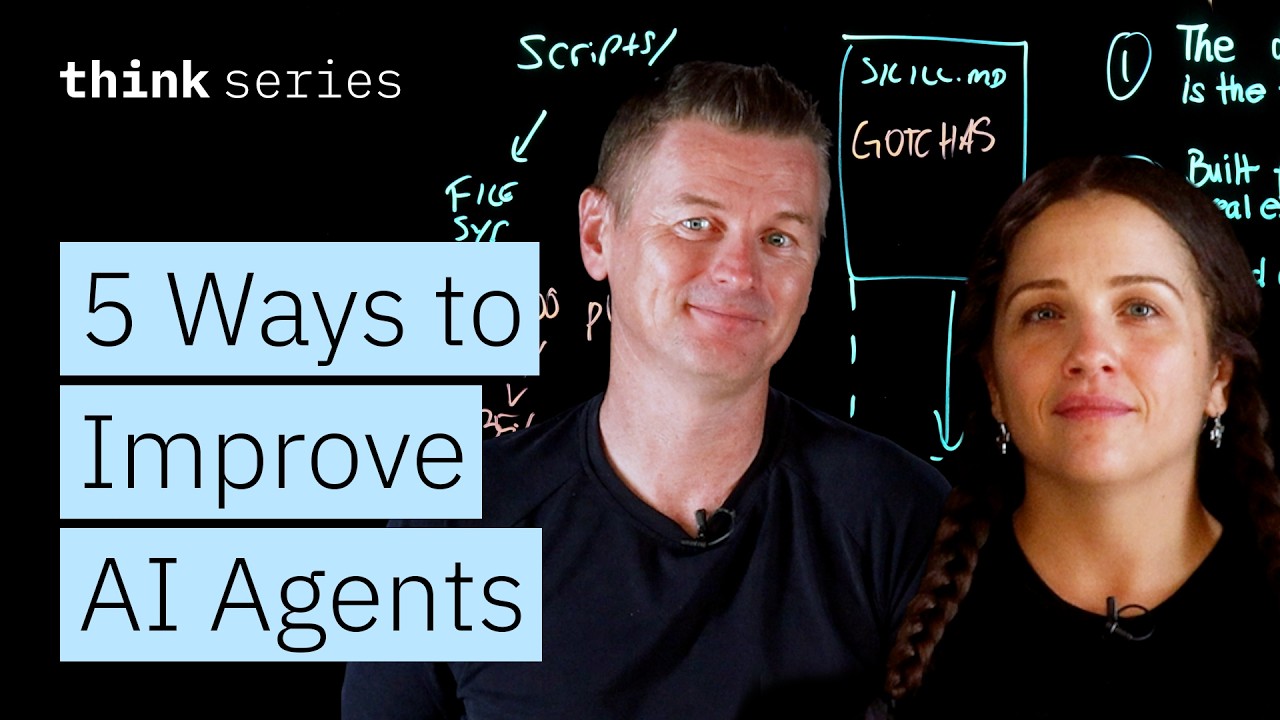
5 Best Practices for Building AI Agent Skills
Keywords
Summary
177 words
Critical Evaluation
The video offers a concise, well-structured overview of best practices for building AI agent skills, grounded in the presenters’ practical experience. The advice is actionable and aligns with emerging industry standards, particularly the open agent skills standard (agentskills.io). The emphasis on writing trigger descriptions that are specific and slightly ‘pushy’ is a nuanced insight that addresses a common failure mode in agent design. The recommendation to build skills from real expertise, rather than relying on LLM-generated content, is sound and echoes the principle that domain knowledge should be encoded explicitly. The practice of keeping skills lean to manage context window usage is technically justified, as context is a finite resource in LLM-based agents. The suggestion to use deterministic scripts for fragile steps is a critical best practice, as it reduces the risk of probabilistic errors in high-stakes operations. The security vetting practice is particularly important, given the cited audit showing that over 35% of public skills have security flaws. The video’s credibility is enhanced by referencing the open standard and the audit, though it does not provide direct links to these sources in the description. The presentation is clear and engaging, with a conversational tone that makes complex topics accessible. However, the video could benefit from more concrete examples or case studies to illustrate the practices in action. Additionally, while the advice is practical, it is largely based on anecdotal experience rather than empirical research, which limits its generalizability. The adéquation between the title and content is excellent, as the video directly addresses the five practices. Overall, the video provides valuable, actionable guidance for practitioners, but its reliance on experiential knowledge rather than formal evidence slightly reduces its scientific rigor. The lack of detailed citations for the audit and standard is a minor weakness, but the core recommendations are sound and likely to improve the reliability and security of AI agent skills.
312 words
Title / Content Match
The title accurately reflects the content, which systematically covers five best practices for building AI agent skills.
Quality & Reliability
8/10
The video provides practical, experience-based guidance from IBM experts, referencing an open standard (agentskills.io) and citing an audit of public skills. The advice is actionable and aligns with known best practices in AI agent development, though it lacks formal citations or empirical validation.
Chapters
Cited Sources
- 2026 Guide to AI Agents — Referenced in the video description as a resource for learning more about AI agents.
- IBM AI Newsletter — Mentioned in the video description as a monthly newsletter for AI updates.
Concurring Sources
- Agent Skills Standard — The video references this open standard for defining agent skills, which aligns with the best practices discussed.
Contribution & Novelties
The video synthesizes practical best practices for building AI agent skills, emphasizing the importance of trigger descriptions, real expertise, context management, deterministic scripts, and security vetting. It provides actionable guidance for developers, particularly the use of progressive disclosure and the separation of deterministic logic from probabilistic reasoning.
Pour aller plus loin :
- Agent Skills Standard — Official site for the open agent skills standard, referenced in the video.
- Progressive Disclosure — Concept used to manage context by revealing information only when needed.
- Prompt Injection — Security threat mentioned in the context of skill vetting.
94 words
Radar Profile
The radar profile shows strong scores in quality of information and reliability, with slightly lower scores in quantity and technical depth. This indicates a focused, expert-driven presentation that prioritizes actionable advice over exhaustive coverage.