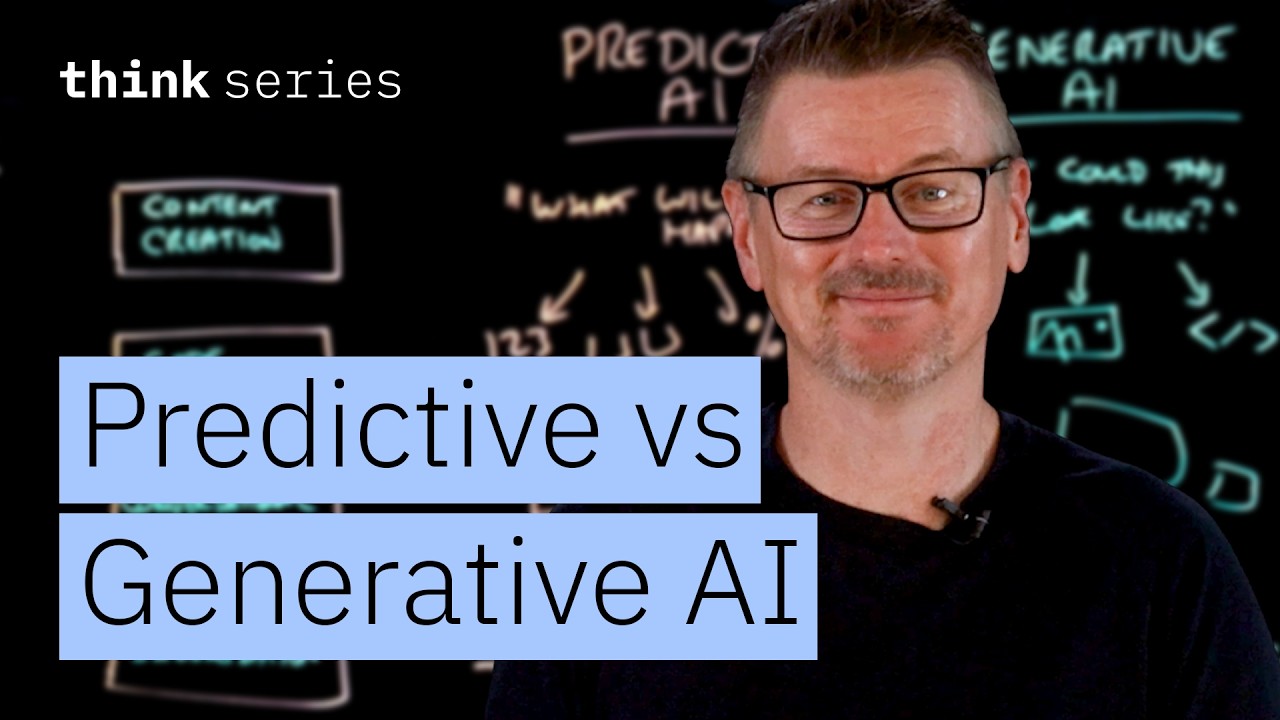
Predictive vs Generative AI: How They Work and When to Use Each
Keywords
Summary
159 words
Critical Evaluation
The video provides a solid, accessible introduction to the differences between predictive and generative AI, a topic often misunderstood. The presenter, Martin Keen, is an IBM employee, lending credibility, and the content aligns with industry knowledge. The explanation of predictive AI covers key techniques (regression, classification, time series) and algorithms (decision trees, random forests, gradient boosting, LSTMs), which is accurate and well-illustrated with use cases like fraud detection and predictive maintenance. For generative AI, the video correctly identifies the transformer architecture and attention mechanism, and explains diffusion models in a simplified but accurate manner. The discussion of LLMs as next-token predictors is nuanced, acknowledging the technical mechanism while clarifying the generative purpose, which is a valuable point for viewers. The video also emphasizes the complementary nature of the two AI types, offering a practical perspective. However, the content is introductory and lacks depth in mathematical or technical details, which might be a limitation for advanced viewers. The sources cited are limited to IBM’s own resources, which are relevant but not exhaustive. The video does not address potential limitations or ethical considerations of either AI type, which could be a gap. Overall, the video is informative, well-structured, and reliable for its intended audience, though it could benefit from more rigorous citations and a deeper exploration of the subject.
217 words
Title / Content Match
The title accurately reflects the content, which systematically compares predictive and generative AI, explaining their mechanisms and applications.
Quality & Reliability
8/10
The video is produced by IBM Technology, a reputable source, and presents accurate, well-structured explanations of predictive and generative AI. It correctly distinguishes the two paradigms, explains underlying techniques (regression, classification, time series, transformers, diffusion models), and provides practical use cases. The content is technically sound, though it lacks in-depth mathematical derivations and does not cite specific research papers, but it is reliable for an introductory audience.
Key Moments
Markers derived by PSI from the transcript: the creator did not define chapters.
- Introduction: distinguishing predictive vs generative AI
- Outputs of predictive AI: numbers, categories, probabilities
- Data types: structured vs unstructured
- Discussion on LLMs and next-token prediction
- How predictive AI works: regression, classification, time series
- Algorithms: decision trees, random forests, gradient boosting, LSTMs
- Use cases for predictive AI: fraud detection, demand forecasting, predictive maintenance, credit scoring
- Generative AI: transformer architecture and attention
- Diffusion models for image generation
- Use cases for generative AI: content creation, code assistance, conversational AI, summarization
- How predictive and generative AI work together
- Conclusion and call to action
Cited Sources
- IBM - Predictive AI vs Generative AI — Referenced in the video description as a resource to learn more about the topic.
- IBM AI Newsletter — Mentioned in the description for signing up to receive AI updates.
Concurring Sources
- IBM - What is predictive AI? — IBM's official page on predictive AI, aligning with the video's explanations.
- IBM - What is generative AI? — IBM's official page on generative AI, supporting the video's content.
Dissenting Sources
- Some argue that LLMs are both predictive and generative — The video addresses this viewpoint, explaining that while LLMs predict the next token, their purpose is generative, which is a nuanced position.
Contribution & Novelties
The video provides a clear and concise comparison between predictive and generative AI, clarifying common misconceptions and offering practical guidance on when to use each. It emphasizes that predictive AI is deterministic and used for forecasting, while generative AI is probabilistic and used for content creation. The explanation of LLMs as next-token predictors is nuanced, and the discussion of how the two types can complement each other is valuable.
Pour aller plus loin :
- Transformer architecture — Provides a detailed overview of the transformer model, foundational to generative AI.
- Diffusion models — Explains the concept of diffusion models used for image generation.
- Machine learning — General resource on machine learning, covering predictive techniques.
113 words
Radar Profile
The radar profile shows high scores in information quantity, quality, and technical level, with a slightly lower but still strong reliability score. This indicates a well-balanced, informative video that is technically sound and reliable, though not extremely deep.
💬 Sur les 0 commentaires analysés, aucune tendance n'est disponible.