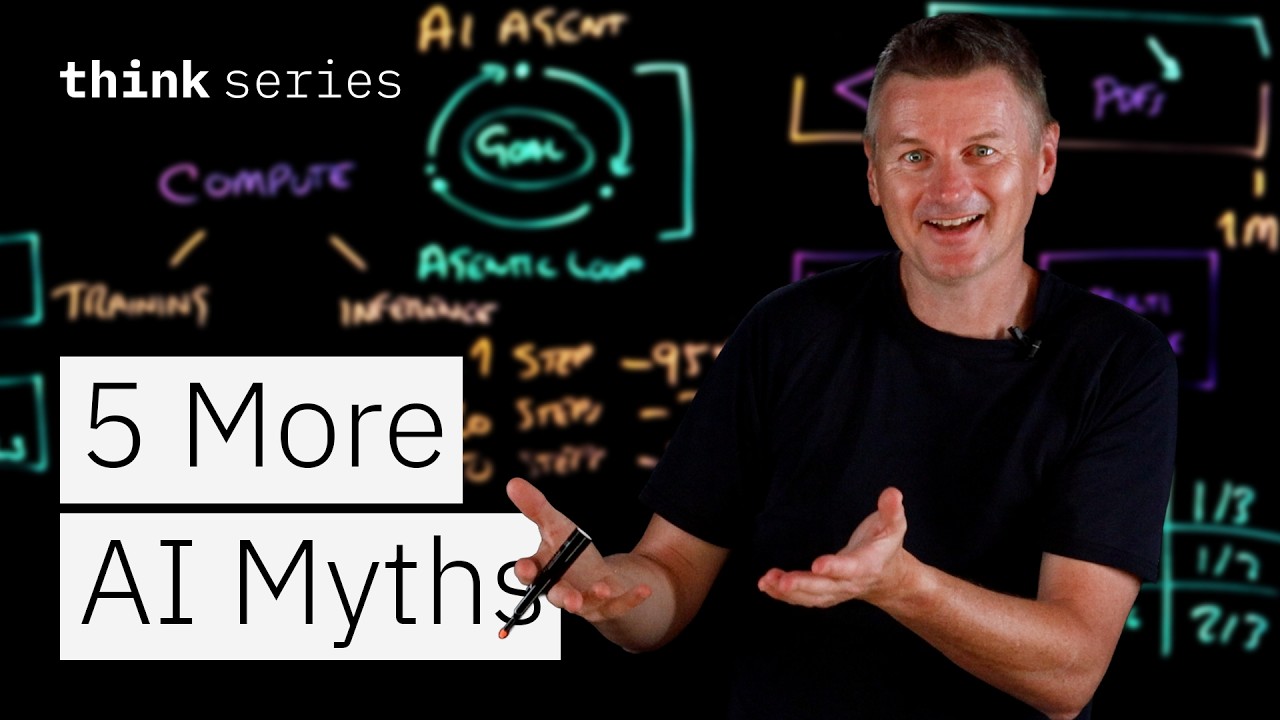
5 AI Myths & The Truth Behind Them: ML, Context, Agents & More
Keywords
Summary
181 words
Critical Evaluation
The video provides a well-structured and informative overview of five prevalent AI myths, effectively separating fact from fiction. Martin Keen demonstrates a strong command of the subject matter, using concrete examples and analogies to explain complex concepts. The discussion on hallucinations is nuanced, acknowledging that while not eliminated, they are significantly reduced with modern techniques. The explanation of reasoning traces as post hoc rationalizations is particularly insightful, drawing on the concept of faithfulness in AI interpretability. The shift in compute from training to inference is well-supported with projections, and the discussion on context windows correctly highlights the difference between single and multi-needle tasks. The treatment of AI agents is balanced, acknowledging their current limitations due to compounding errors. The video’s strengths lie in its clarity, technical accuracy, and practical relevance. However, it lacks formal citations or references to specific studies, relying instead on general industry knowledge. The presenter’s affiliation with IBM could introduce a slight bias, though the content appears objective. The adéquation between title and content is strong, as the video directly addresses the five myths listed. Overall, this is a high-quality educational piece suitable for a technical audience, though it could benefit from more rigorous sourcing.
198 words
Title / Content Match
The title accurately reflects the content, which debunks five common AI myths with technical explanations.
Quality & Reliability
8/10
The video is presented by an IBM Technology expert, referencing specific technical concepts and benchmarks. It includes practical examples and cites industry trends, but lacks formal citations or peer-reviewed sources.
Key Moments
Markers derived by PSI from the transcript: the creator did not define chapters.
- Introduction to AI myths and the question of whether asking 'are you sure' improves accuracy.
- Myth 1: AI models hallucinate frequently. Explanation of how tool use, refusal calibration, and extended thinking reduce hallucinations.
- Myth 2: You can watch AI think. Discussion of chain-of-thought traces and faithfulness.
- Myth 3: Training is where AI compute goes. Shift to inference compute and reasoning models.
- Myth 4: Large context windows let you offload data. Needle-in-a-haystack and multi-needle benchmarks.
- Myth 5: AI agents can work fully autonomously. Compounding errors and human-in-the-loop solutions.
Cited Sources
- IBM AI newsletter signup — Mentioned for AI updates.
- Learn more about AI Misinformation — Referenced in the video description for further reading.
Concurring Sources
- IBM AI newsletter signup — Provides updates on AI topics consistent with the video's content.
- Learn more about AI Misinformation — Offers additional resources on AI misinformation, aligning with the video's theme.
Contribution & Novelties
The video provides a clear and concise debunking of five common AI myths, offering current insights into the state of AI technology. It highlights the reduction in hallucinations due to modern techniques, the non-faithful nature of reasoning traces, the shift in compute from training to inference, the limitations of large context windows in multi-needle tasks, and the challenges of autonomous agents.
Pour aller plus loin :
- Chain-of-thought reasoning — Overview of the technique and its implications.
- Hallucination in large language models — Background on the phenomenon.
- Agentic AI — General concept of agents and autonomy.
95 words
Radar Profile
The radar profile shows high scores across all dimensions, indicating a well-rounded and reliable video. The strongest areas are information quantity and quality, while technical depth is slightly lower, suggesting it is accessible to a broad audience.
💬 No comments provided.