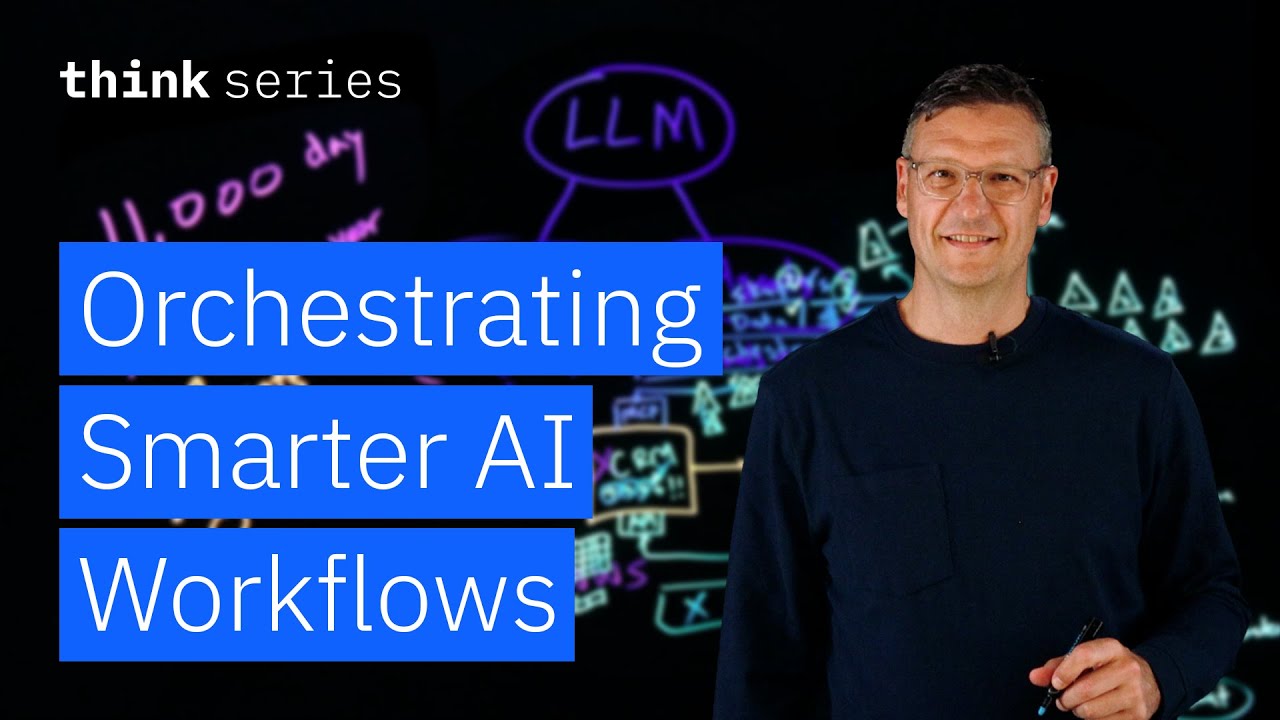
Orchestrating Complex AI Workflows with AI Agents & LLMs
Keywords
Summary
179 words
Critical Evaluation
The video provides a valuable introduction to AI agent orchestration, particularly for professionals familiar with RPA. Eric Pritchett’s explanation is clear and well-structured, using a concrete business scenario to illustrate the differences between RPA and agent-based orchestration. The comparison is effective: RPA requires explicit triggers and structured data, while agents can handle ambiguity by leveraging LLMs and MCP services. The emphasis on defining goals and outcomes, rather than prompts, is a key conceptual distinction that is well articulated.
From a scientific rigor perspective, the video is more of an expert opinion than a rigorous technical analysis. It does not cite specific research papers or official documentation, and some claims, such as the daily creation of 11,000 AI agents, are anecdotal and lack verifiable sources. However, the technical concepts discussed, such as MCP, are accurate and align with industry trends. The explanation of MCP as a client-server architecture for connecting agents to data sources is correct, though it could have been more detailed.
The argumentation is solid, but it could benefit from addressing potential challenges or limitations of agent orchestration, such as security risks, error handling, and the need for robust governance. The video also assumes a certain level of technical familiarity, which may limit its accessibility to a broader audience, but this is not a major drawback given the target audience of IT professionals.
The adéquation between title and content is strong; the video indeed focuses on orchestrating complex AI workflows with agents and LLMs. The presence of a brief sponsorship segment (for IBM certification) is noted but does not detract from the content.
Overall, the video is informative and well-presented, offering practical insights for those looking to implement agent-based orchestration. However, it lacks depth in terms of technical details and references, which prevents it from being a comprehensive resource. It serves as a good starting point for understanding the concepts, but viewers seeking deeper technical guidance would need to consult additional resources.
323 words
Title / Content Match
The title accurately reflects the content, which focuses on orchestrating AI workflows using AI agents and LLMs.
Quality & Reliability
8/10
The video provides a clear, expert-led explanation of AI agent orchestration, contrasting it with traditional RPA. It uses a concrete example (customer quote generation) and references industry concepts like MCP. However, it lacks citations to specific research or documentation, and some claims (e.g., 11,000 agents per day) are anecdotal.
Key Moments
Markers derived by PSI from the transcript: the creator did not define chapters.
- Introduction: AI agents are being created at a rapid pace, and orchestration is an extension of existing frameworks.
- Distinction between assistants (prompt-response) and agents (goal-outcome with agency).
- Discussion on how LLMs bring language understanding to automation, and the importance of software engineering best practices.
- Introduction of the customer quote example and the question: Is orchestration just RPA with LLMs?
- Explanation of RPA limitations: requires explicit triggers and structured data, making it difficult to handle ambiguity.
- Introduction of agent-based orchestration: multiple agents working together, each with narrow job stories.
- Detailed example: master agent delegates to sub-agents for CRM, data fetching, SKU validation, and pricing.
- Explanation of MCP (Model Context Protocol) as a client-server architecture for agents to access data sources.
- Comparison of orchestration vs RPA: orchestration handles ambiguity and adapts to changing conditions.
- Conclusion: orchestration with agents is a powerful evolution, and developers can leverage existing skills.
Cited Sources
- NirvanAi - Agentic Workflows — Referenced in the description as a resource to learn more about agentic workflows.
- IBM watsonx Data Scientist Certification — Mentioned in the description as a certification opportunity with a discount code.
- IBM AI Newsletter — Linked in the description for monthly AI updates from IBM.
Concurring Sources
- IBM watsonx Orchestrate — IBM's orchestration platform, which aligns with the concepts discussed in the video.
Dissenting Sources
- Gartner: AI agents will be used in 40% of enterprise automation projects by 2025
Contribution & Novelties
The video provides a clear, practical explanation of how AI agents and LLMs can be used to orchestrate complex workflows, contrasting with traditional RPA. It introduces the concept of using MCP (Model Context Protocol) to enable agents to interact with data sources, and emphasizes the importance of defining goals and outcomes rather than prompts. The example of generating a customer quote illustrates the flexibility and adaptability of agent-based orchestration.
Pour aller plus loin :
- Model Context Protocol (MCP) — Official documentation for MCP, the protocol mentioned in the video for connecting agents to data sources.
- AI agent — Wikipedia article on intelligent agents, providing background on the concept of agency in AI.
- Robotic process automation — Wikipedia article on RPA, useful for understanding the traditional approach contrasted in the video.
130 words
Radar Profile
The radar profile shows a balanced performance across all dimensions, with slightly higher scores in quality of information and reliability, reflecting the expert's clear and accurate explanations. The lower score in quantity of information indicates that the video could have provided more technical depth or additional examples.
💬 Très positif. Sur les 30 commentaires analysés, la grande majorité exprime un enthousiasme marqué pour la clarté et la pertinence de l'explication, avec des remerciements répétés à Eric Pritchett et des éloges sur la qualité pédagogique de la vidéo.