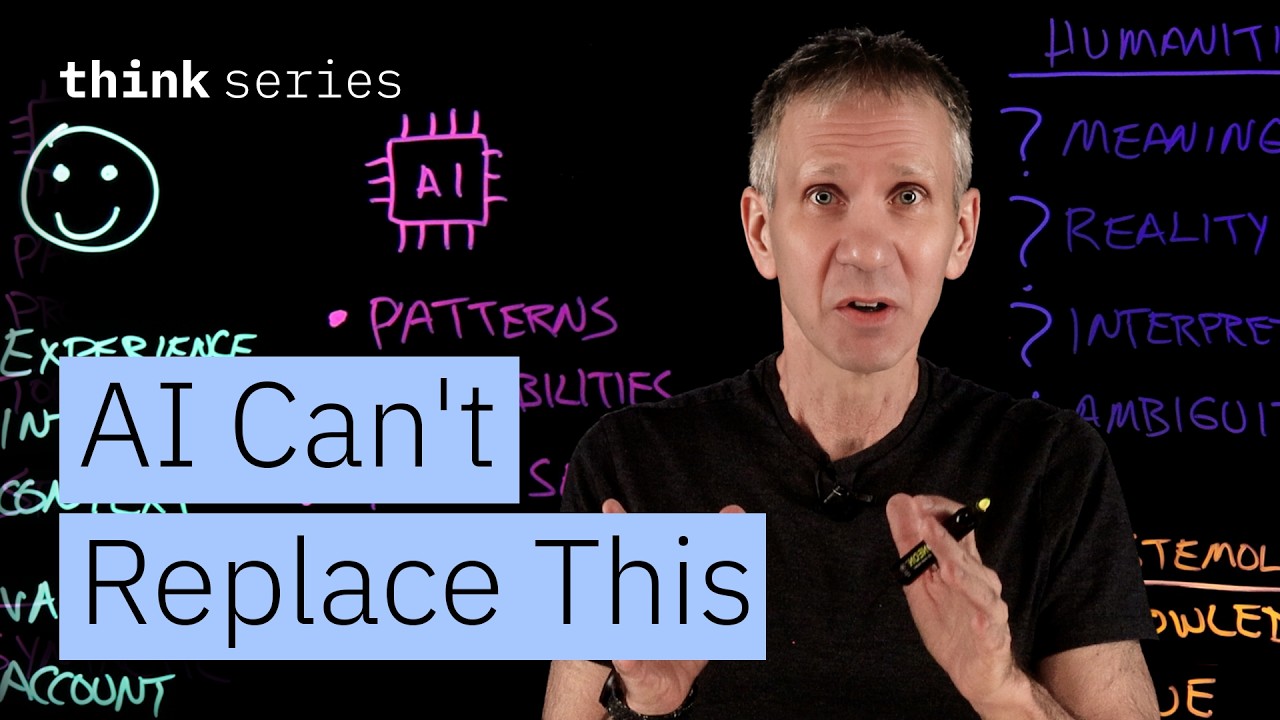
Why AI Makes the Humanities More Important Than Ever
Keywords
Summary
156 words
Critical Evaluation
The video presents a compelling and well-articulated argument for the importance of humanities in the AI era. Jeff Crume, an IBM Distinguished Engineer, brings credibility and communicates complex ideas clearly. The argument is logically structured, moving from the limitations of AI (syntactic vs. semantic) to the necessity of human interpretation and judgment. He effectively uses philosophical concepts like epistemology and hermeneutics to ground his claims, making the case that these are not abstract but practical tools for AI users. The discussion of AI’s non-neutrality and the embedded assumptions in training data is particularly insightful, as it challenges the common misconception that AI is objective. The analogy between prompt engineering and rhetoric is apt and provides a tangible application of humanities skills. However, the video is an opinion piece and lacks empirical evidence or specific examples to support its claims. While the reasoning is sound, it remains at a high level and could benefit from concrete case studies or references to research. The sources cited are limited to IBM promotional links, which do not directly support the content. The video’s strength lies in its clarity and the authority of the speaker, but it does not offer new research or data. The adéquation titre/contenu is excellent, as the title precisely captures the thesis. Overall, the video is a valuable contribution to the discourse on AI ethics and education, but it is more of a persuasive essay than a rigorous scientific analysis. The comments reflect a highly positive reception, with viewers appreciating the depth and relevance of the topic, indicating that the video resonates with its audience.
264 words
Title / Content Match
The title accurately reflects the content, which argues that humanities are essential for responsible AI use.
Quality & Reliability
8/10
The video presents a well-structured argument grounded in established philosophical concepts (epistemology, hermeneutics, rhetoric) and practical AI considerations. The speaker, Jeff Crume, is an IBM Distinguished Engineer, lending authority. However, it is an opinion piece without empirical data or citations, and the argument relies on generalities rather than specific examples or studies.
Key Moments
Markers derived by PSI from the transcript: the creator did not define chapters.
- Introduction: AI generates answers but lacks understanding; humanities provide judgment.
- AI is syntactic, humans are semantic; humanities teach meaning and interpretation.
- Epistemology: how we know what is true; AI can hallucinate and internet data is unreliable.
- AI is not neutral; designers, users, and society embed assumptions and incentives.
- Interpretation is key; hermeneutics helps interpret AI outputs under uncertainty.
- Communication as system control; rhetoric and prompt engineering are analogous.
- Humanities training detects bias and cultural nuance; critical thinking is the most valuable skill.
Cited Sources
- IBM AI newsletter signup — Mentioned at the end of the video for AI updates.
- IBM Human Centered AI — Referenced in the video description as a resource for human-centered AI.
Concurring Sources
- IBM Human Centered AI — The video's description links to IBM's human-centered AI resources, which align with the video's emphasis on human judgment.
Contribution & Novelties
This video provides a clear and accessible argument for the essential role of humanities in AI development and use, synthesizing concepts like epistemology, hermeneutics, and rhetoric into practical guidance for AI users. It emphasizes that AI increases, rather than decreases, the need for human interpretive and ethical skills.
Pour aller plus loin :
- Epistemology (Wikipedia) — Foundational to the video’s discussion of knowledge and truth.
- Hermeneutics (Wikipedia) — Central to the video’s argument about interpretation.
- Rhetoric (Wikipedia) — Directly linked to the video’s comparison with prompt engineering.
- AI ethics (Wikipedia) — Relevant to the discussion of responsible AI use.
- Critical thinking (Wikipedia) — The video’s core recommendation for AI users.
110 words
Radar Profile
The radar profile shows high scores in quality of information and reliability, reflecting the speaker's expertise and coherent argumentation. The lower score in technical level indicates that the video is accessible to a general audience, while the quantity of information is moderate, as it covers a broad topic without deep technical detail.
💬 Très positif : Sur les 30 commentaires analysés, l'accueil est extrêmement favorable, les spectateurs saluant la profondeur du sujet, la clarté de l'exposé et la pertinence des idées, certains exprimant même le souhait d'un cours complet sur le thème.