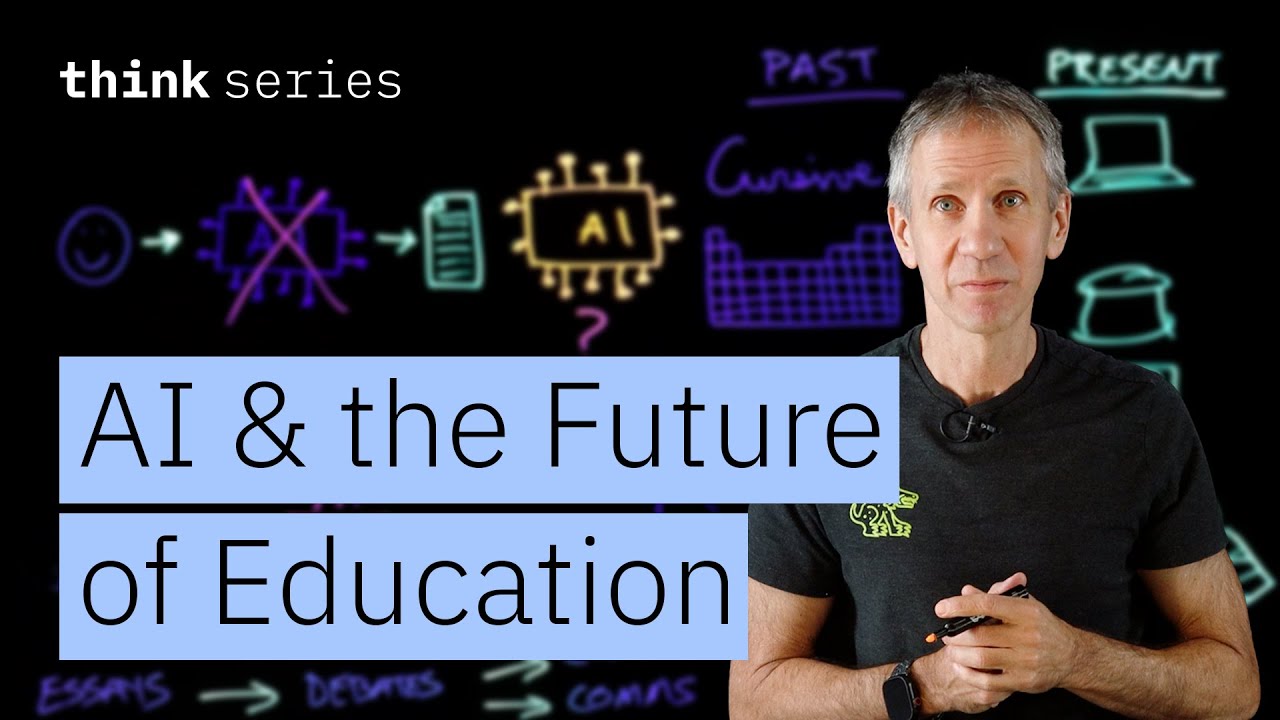
AI & Education: Generative AI & the Future of Critical Thinking
Keywords
Summary
121 words
Critical Evaluation
The video offers a thoughtful and balanced perspective on integrating generative AI into education. Jeff Crume, drawing on his experience as an adjunct professor, presents a compelling case for shifting educational focus from rote memorization to higher-order thinking skills. His historical analogies, such as the decline of cursive and memorization of the periodic table, effectively illustrate how educational priorities have adapted to technological changes. The argument that critical thinking becomes paramount in an AI-augmented world is well-reasoned and aligns with contemporary educational discourse.
The strengths of the video include its clear structure, practical examples, and emphasis on the potential benefits of AI, such as personalized tutoring and accessibility. Crume’s suggestion to use AI for debate preparation and drills is innovative and actionable. He also appropriately acknowledges the need for AI literacy and ethical considerations, which are crucial for responsible implementation.
However, the video lacks empirical evidence or citations to support its claims. While Crume’s points are plausible, they are based on anecdotal experience and general reasoning rather than research findings. The discussion could benefit from referencing studies on AI in education or cognitive science to strengthen its arguments. Additionally, the video does not delve deeply into potential drawbacks, such as the risk of over-reliance on AI or the digital divide, beyond a brief mention.
The adéquation between title and content is strong, as the video directly addresses the future of critical thinking in the context of generative AI. The production quality is professional, with clear visuals and pacing. Overall, the video provides a valuable perspective for educators and policymakers, but it would be enhanced by more rigorous evidence and a more critical examination of challenges.
275 words
Title / Content Match
The title accurately reflects the content, which discusses the impact of generative AI on education and critical thinking.
Quality & Reliability
7/10
The video presents a well-structured expert opinion by an adjunct professor, drawing on historical analogies and practical classroom experience. While not a formal study, it offers reasoned arguments and acknowledges limitations. The description provides links to IBM resources, but no specific academic sources are cited. The content is credible but relies on anecdotal evidence and general reasoning.
Key Moments
Markers derived by PSI from the transcript: the creator did not define chapters.
- Introduction: Jeff Crume shares his initial reaction to generative AI and the need to embrace it in education.
- Historical examples of skills that have become less important, such as cursive and memorization.
- Discussion of key skills for the AI era: flexibility, adaptability, creativity, and critical thinking.
- Advantages of AI in education: just-in-time education, personalized tutoring, and editing assistance.
- AI for accessibility and as a teaching assistant.
- Practical examples: using AI for debates and drills to enhance critical thinking.
- The need for AI literacy and ethical considerations.
- Conclusion: call to re-engineer learning objectives and embrace AI.
Cited Sources
- IBM - Artificial Intelligence (AI) Learning Resources — Link in description to learn more about AI.
- IBM AI Newsletter — Link to sign up for monthly AI updates.
- IBM watsonx AI Assistant Engineer Certification — Link to certification exam with discount code.
Concurring Sources
- UNESCO - Artificial Intelligence in Education — UNESCO's work on AI in education aligns with the video's themes of opportunities and challenges.
- OECD - AI and Education — OECD's research on AI in education supports the discussion on skills and policy.
Dissenting Sources
- The Impact of AI on Critical Thinking — Some studies suggest that over-reliance on AI may hinder critical thinking development, contrasting with the video's optimistic view.
Contribution & Novelties
The video provides a practical, educator-focused perspective on integrating generative AI into classrooms, emphasizing the need to shift from memorization to critical thinking. It offers concrete examples of AI applications, such as debate preparation and personalized tutoring, which are actionable for teachers.
Pour aller plus loin :
- Bloom’s Taxonomy — Relevant for understanding educational objectives and higher-order thinking.
- Constructivism (philosophy of education) — Relevant to the idea of active learning and student-centered approaches.
- AI literacy — Relevant to the video’s emphasis on understanding AI capabilities and limitations.
87 words
Radar Profile
The radar profile shows balanced scores across information quantity, quality, technical level, and reliability, indicating a well-rounded but not deeply technical presentation. The video is strong on practical insights but lacks rigorous evidence, resulting in moderate reliability.
💬 Positif. Sur les 30 commentaires analysés, la majorité exprime un accord avec la vision de Jeff Crume, saluant la clarté et la pertinence de ses arguments, bien que certains soulèvent des préoccupations sur la mémorisation et l'importance des compétences de base.