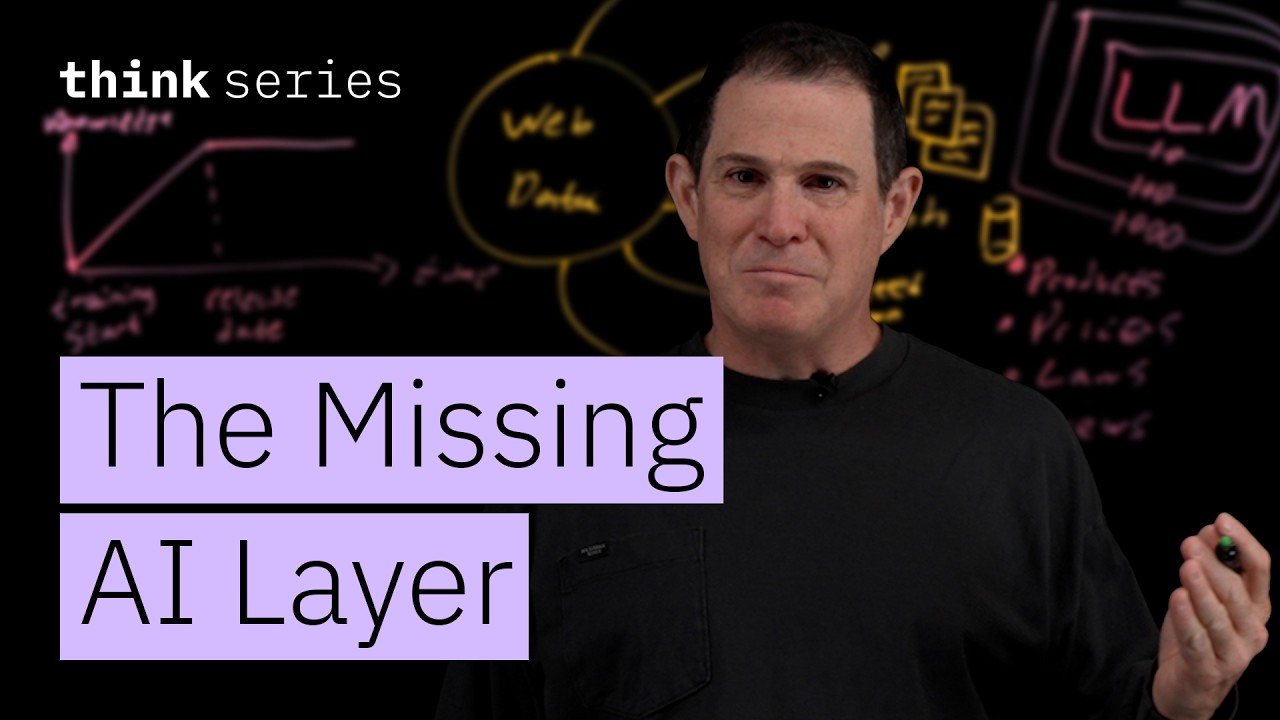
Why Does AI Need Access to the Web?
Keywords
Summary
198 words
Critical Evaluation
Value of the Information & Strength of the Argument
The video provides valuable insights into a practical problem in AI deployment: the need for real-time data to ground AI responses. The speaker uses clear analogies (e.g., IKEA furniture, sports commentator) and a structured framework (the five elements) to make the argument accessible. The argumentation is coherent, moving from the problem (frozen knowledge) to the solution (knowledge layer and web data infrastructure). However, the value is somewhat limited by the lack of empirical evidence or case studies with quantitative results. The speaker’s affiliation with Bright Data, a company that provides web data services, introduces a potential commercial bias, though the technical arguments stand on their own.
Scientific Rigor, Source Quality, Title Accuracy
The video does not cite specific scientific sources or studies; it relies on the speaker’s expertise and illustrative examples. The description provides links to IBM’s newsletter and a ‘Knowledge Layers’ resource, but these are not directly referenced in the video. The title accurately reflects the content, and the video stays on topic. The lack of citations reduces the scientific rigor, but the explanations are technically sound and align with common knowledge in the field.
195 words
Title / Content Match
The title accurately reflects the content, which explains why AI models need web access and how a web data infrastructure layer can provide it.
Quality & Reliability
7/10
The video presents a clear, expert-led explanation of the need for real-time web data in AI systems, with practical examples and a structured framework (the five elements). However, it is largely opinion-based, lacks empirical data or citations to specific studies, and the speaker is affiliated with a commercial entity (Bright Data) that benefits from the promoted approach.
Key Moments
Markers derived by PSI from the transcript: the creator did not define chapters.
- Introduction: LLMs are pre-trained and their knowledge freezes at release.
- Example of hallucination about a new phone, and why it happens.
- AI agents can act on wrong answers at scale, leading to costly mistakes.
- Introduction of the knowledge layer and web data infrastructure layer.
- Five elements of trustworthy web data: grounded, deep, fresh, formatted, timely.
- Challenges of direct web access: CAPTCHAs, HTML complexity.
- Example of e-commerce data decay and the need for real-time refresh.
- Summary: the data layer is the hardest part of reliable AI systems.
Cited Sources
- IBM AI newsletter — Mentioned in the description for AI updates.
- Knowledge Layers resource — Linked in the description as a resource to learn more about knowledge layers.
Concurring Sources
- Retrieval-Augmented Generation for Knowledge-Intensive NLP Tasks — Academic paper on RAG, which aligns with the idea of augmenting LLMs with external knowledge.
- Wikipedia: Hallucination (artificial intelligence) — General reference on AI hallucinations, supporting the problem described.
Dissenting Sources
- On the Dangers of Stochastic Parrots: Can Language Models Be Too Big? 🦜 — This paper critiques the reliance on large language models and highlights risks, which could be seen as a counterpoint to the optimistic view of AI agents presented in the video.
Contribution & Novelties
The video offers a clear, practitioner-oriented explanation of why AI models need live web data and how to architect a solution. It introduces the concept of a ‘knowledge layer’ and a ‘web data infrastructure layer’ as distinct components, and provides a practical checklist of five elements for trustworthy data. This is a valuable contribution for developers and decision-makers building AI systems that require real-time information.
Pour aller plus loin :
- Retrieval-Augmented Generation (RAG) — A key technique for grounding LLMs with external data, directly related to the knowledge layer concept.
- Hallucination (artificial intelligence) — The phenomenon of confident false answers, which the video addresses.
- Web scraping — The technical process underlying the web data infrastructure layer.
- Data freshness — A concept central to the ‘fresh’ element of trustworthy data.
129 words
Radar Profile
The radar profile shows a balanced but moderate performance across all dimensions, with slightly higher scores in information quantity and quality, and lower in technical depth and reliability. This suggests the video is informative and well-structured but lacks deep technical detail and strong source backing.