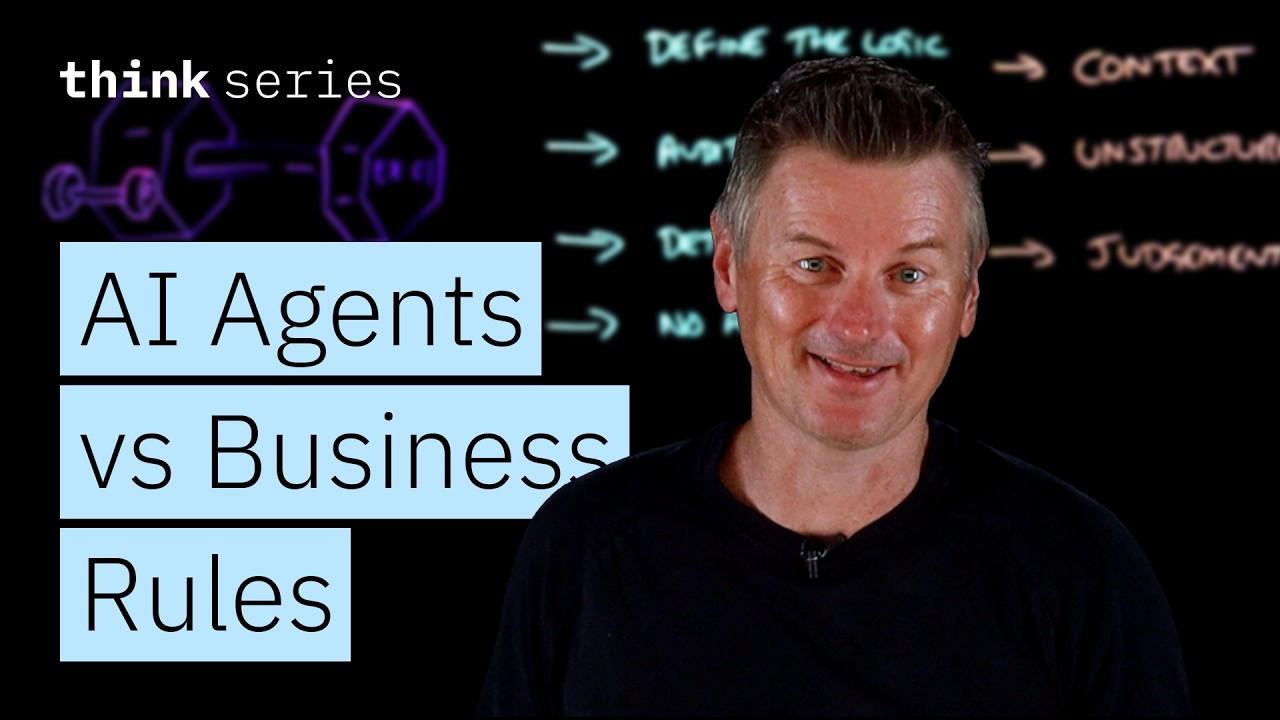
AI Agents vs Business Rules: Which Should Make Decisions?
Keywords
Summary
177 words
Critical Evaluation
Value of the Information & Strength of the Argument
The video provides a clear and valuable comparison between business rules and AI agents, effectively explaining the core distinction between deterministic and probabilistic systems. The argumentation is logical and well-structured, using a concrete refund example to illustrate the concepts. The presenter makes a compelling case for a hybrid approach, which is a practical and nuanced perspective that avoids the common pitfall of advocating for one technology over the other. The explanation of when to use each method is grounded in real-world considerations such as cost, auditability, and data structure. However, the argumentation is largely conceptual and lacks empirical evidence or case studies to support the claims. The video would be stronger with examples of real-world implementations or performance metrics.
Scientific Rigor, Source Quality, Title Accuracy
The video is scientifically rigorous in its conceptual explanations, accurately describing the nature of business rules and AI agents. The sources cited are IBM’s own resources, which are relevant but not independent. The title accurately reflects the content, which directly addresses the comparison and decision-making context. The video does not delve into potential limitations or failure modes of either approach, which could be seen as a lack of critical depth. Overall, the content is reliable for an introductory understanding, but it would benefit from referencing external studies or industry reports to enhance its credibility.
228 words
Title / Content Match
The title accurately reflects the content, which compares AI agents and business rules for decision-making.
Quality & Reliability
8/10
Clear, well-structured explanation of deterministic vs probabilistic decision-making, with practical hybrid architecture. Author is an IBM expert, but content is largely conceptual and lacks empirical data or citations.
Key Moments
Markers derived by PSI from the transcript: the creator did not define chapters.
- Introduction to business rules and AI agents as decision automation methods.
- Explanation of business rules with a refund example, highlighting deterministic logic.
- Contrast with AI agents, which are probabilistic and use LLMs to generate responses.
- Discussion of when to use business rules: well-defined, structured, regulated decisions.
- Discussion of when to use AI agents: unstructured data, judgment, and unanticipated cases.
- Proposal of a hybrid architecture: rules first, escalate to agent, then guardrails and human oversight.
- Conclusion: agents and rules complement each other for better decisions.
Cited Sources
- IBM AI Agents — Referenced as a resource to learn more about AI agents.
- IBM Business Rules — Referenced as a resource to learn more about business rules.
- IBM AI Newsletter — Referenced for signing up for AI updates from IBM.
Concurring Sources
- IBM AI Agents — Supports the discussion of AI agents and their capabilities.
- IBM Business Rules — Supports the discussion of business rules and their deterministic nature.
Contribution & Novelties
The video provides a clear and practical framework for integrating AI agents with traditional business rules, emphasizing a hybrid approach that leverages the strengths of both. It offers a nuanced perspective that is often missing in discussions that pit new AI technologies against established systems. The concept of using deterministic guardrails to check AI agent recommendations is a valuable addition to the discourse on AI safety and governance.
Pour aller plus loin :
- Business rules engine — Provides background on the technology and its applications.
- Large language model — Explains the probabilistic nature of LLMs, which underpins the discussion of AI agents.
- Human-in-the-loop — Relevant to the video’s mention of human oversight in high-stakes decisions.
115 words
Radar Profile
The radar profile shows high scores in quality and reliability, with moderate scores in quantity and technical depth. This indicates a well-explained but not deeply technical overview, suitable for a broad audience seeking to understand the trade-offs between AI agents and business rules.
💬 No comments were provided for analysis.