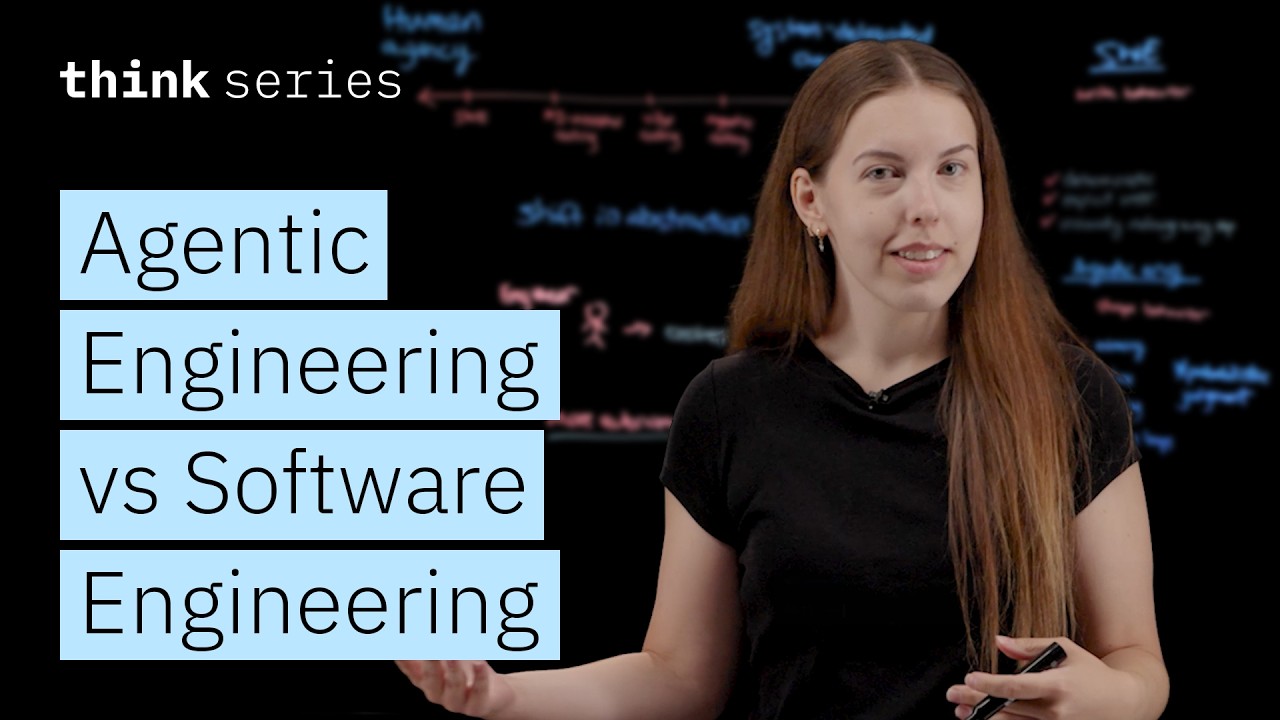
Agentic Engineering vs Software Engineering: Beyond Vibe Coding
Keywords
Summary
124 words
Critical Evaluation
The video offers a well-structured and insightful overview of agentic engineering, a topic of growing relevance. Anna Gutowska, presumably an expert from IBM, provides a clear conceptual framework that helps distinguish between related terms like AI-assisted coding, vibe coding, and agentic coding. The use of a spectrum to illustrate the shift in human vs. system agency is particularly effective, as it avoids a simplistic binary and acknowledges the gradual transition. The argument that agentic engineering increases the importance of human oversight is compelling and counteracts common misconceptions about AI replacing developers. The speaker also rightly points out the risks of technical debt in vibe coding, emphasizing the need for engineering discipline. However, the video lacks concrete examples or case studies to illustrate the concepts in practice, which would strengthen the argument. The sources provided are limited to IBM promotional links, and no external references are cited, which somewhat limits the scientific rigor. The presentation is clear and accessible, but it remains at a conceptual level without delving into technical details or empirical evidence. The adéquation between title and content is excellent, as the video directly addresses the comparison and goes beyond vibe coding. Overall, this is a valuable resource for understanding the evolving landscape of software engineering, but it would benefit from more concrete evidence and external references.
218 words
Title / Content Match
The title accurately reflects the content, which systematically compares agentic engineering with software engineering and related concepts.
Quality & Reliability
8/10
The video provides a clear conceptual framework distinguishing agentic engineering from related terms, grounded in the speaker's expertise at IBM. It avoids overclaiming and emphasizes human oversight. However, it lacks empirical data or citations to specific studies, and the sources provided are IBM promotional links.
Chapters
Cited Sources
- IBM Newsletter for AI Updates — Mentioned in the description as a resource for AI news and updates.
- Learn more about Agentic Engineering — Provided in the description as a link to learn more about agentic engineering.
Concurring Sources
- IBM Technology — The channel and organization behind the video, providing context on AI and technology.
Contribution & Novelties
The video provides a clear conceptual distinction between agentic engineering and related terms, emphasizing the shift from deterministic to probabilistic workflows and the increased importance of human oversight. It offers a practical spectrum for understanding the evolution of developer roles.
Pour aller plus loin :
- AI agent — Provides foundational concepts of AI agents.
- Large language model — Explains the underlying technology.
- Technical debt — Discusses the risks mentioned in the video.
72 words
Radar Profile
The radar profile shows high scores in quality and reliability, with moderate scores in quantity and technical level, indicating a well-explained conceptual overview rather than a deep technical dive.