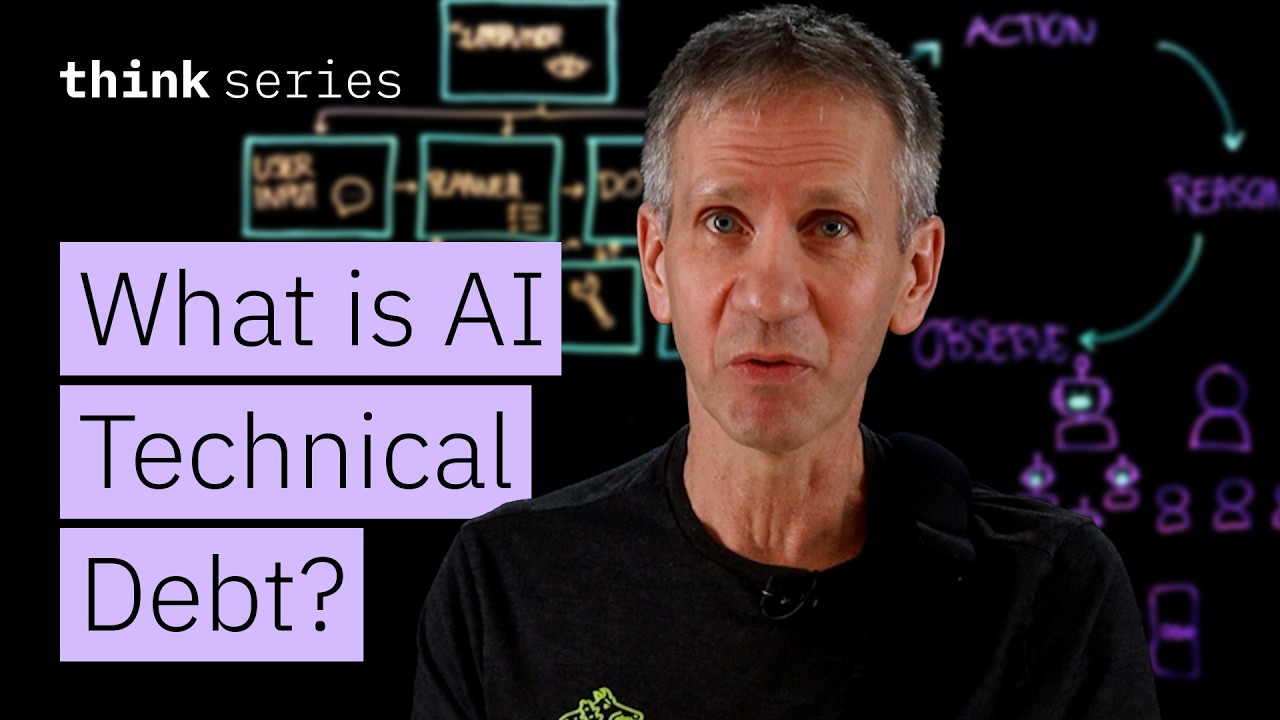
What is AI Technical Debt? Key Risks for Machine Learning Projects
Keywords
Summary
152 words
Critical Evaluation
The video offers a comprehensive and accessible overview of AI technical debt, a topic of growing importance as AI adoption accelerates. Jeff Crume, an IBM veteran, delivers the content with clarity and practical insight, drawing on his extensive experience. The strength of the video lies in its structured categorization of debt types—data, model, prompt, and organizational—which provides a useful framework for practitioners to identify and address potential pitfalls. The analogy to traditional software engineering principles (e.g., SDLC) is effective, grounding the discussion in established practices. However, the video is primarily an expert opinion piece rather than a rigorous scientific analysis. It lacks empirical evidence, case studies, or quantitative data to support its claims. While the examples are illustrative, they are anecdotal. The sources cited are limited to IBM resources, which may introduce a bias toward IBM’s solutions, though the content itself is vendor-neutral. The discussion of prompt injection and AI gateways is particularly relevant, but the video could have delved deeper into mitigation strategies. The adéquation between title and content is strong, as the video directly addresses the definition and risks of AI technical debt. The speaker’s personal anecdote about his injury serves as a memorable metaphor but does not detract from the technical content. Overall, the video is a valuable educational resource for professionals entering the AI field, providing a solid foundation for understanding and managing technical debt. It would benefit from more concrete examples and references to external research, but as an introductory overview, it excels.
248 words
Title / Content Match
The title accurately reflects the content, which focuses on defining AI technical debt and its key risks.
Quality & Reliability
8/10
The video provides a clear, well-structured overview of AI technical debt, drawing on established software engineering principles and practical examples. The speaker is an IBM expert, and the content aligns with industry best practices. However, it lacks empirical data or case studies, and the sources are limited to IBM resources.
Key Moments
Markers derived by PSI from the transcript: the creator did not define chapters.
- Introduction: The elephant in the room - AI technical debt and the speaker's broken shoulder as a metaphor.
- Definition of AI technical debt: trading speed now for costs later, with examples.
- Comparison between traditional software (deterministic) and AI (probabilistic) and how debt compounds faster in AI.
- First category: Data debt - data quality, bias, drift, poisoning, and anonymization.
- Second category: Model debt - version control, evaluation, rollback, and penetration testing.
- Third category: Prompt debt - undocumented prompts, prompt injection, data leakage, and AI gateways.
- Fourth category: Organizational debt - ownership, governance, red teaming, latency, and scalability.
- Solution: Following the SDLC (requirements, architecture, implementation, testing, deployment, evaluation) and the formula: speed minus discipline equals debt.
- Conclusion: The Cheshire Cat quote - 'If you don't know where you're going, any road will take you there.'
Cited Sources
- IBM Technical Debt Resource — Referenced in the video description as a resource to learn more about technical debt.
- IBM AI Newsletter — Mentioned in the video description for signing up for AI updates from IBM.
Concurring Sources
- AI Technical Debt - Google Research — This paper by Sculley et al. is a foundational work on technical debt in ML systems, aligning with the video's themes.
- Machine Learning Systems - Wikipedia — This article discusses challenges in ML systems, including technical debt, supporting the video's points.
Dissenting Sources
- No specific discordant sources found — The video's content is generally aligned with industry consensus; no major contradictions were identified.
Contribution & Novelties
The video provides a clear, structured framework for understanding AI technical debt, categorizing it into data, model, prompt, and organizational debt. It emphasizes that AI’s probabilistic nature accelerates debt accumulation and stresses the importance of applying traditional software engineering disciplines to AI projects. The speaker’s practical experience and clear explanations make it a valuable resource for practitioners.
Pour aller plus loin :
- AI Technical Debt - Google Research — This paper by Sculley et al. is a seminal work on technical debt in machine learning systems, providing a comprehensive overview of the issue.
- Machine Learning Systems - Wikipedia — This article discusses the challenges and best practices in building ML systems, including technical debt.
- Prompt Injection - OWASP — This resource from OWASP explains prompt injection attacks and mitigation strategies, directly relevant to the video’s discussion of prompt debt.
139 words
Radar Profile
The radar profile shows high scores in information quantity, quality, and reliability, with a slightly lower technical depth. This indicates a well-balanced, informative video that is accessible to a broad audience while maintaining scientific rigor.
💬 Très positif. Sur les 30 commentaires analysés, la grande majorité exprime une appréciation forte, soulignant la clarté, la pertinence et la valeur éducative du contenu, avec quelques souhaits de rétablissement pour le présentateur.