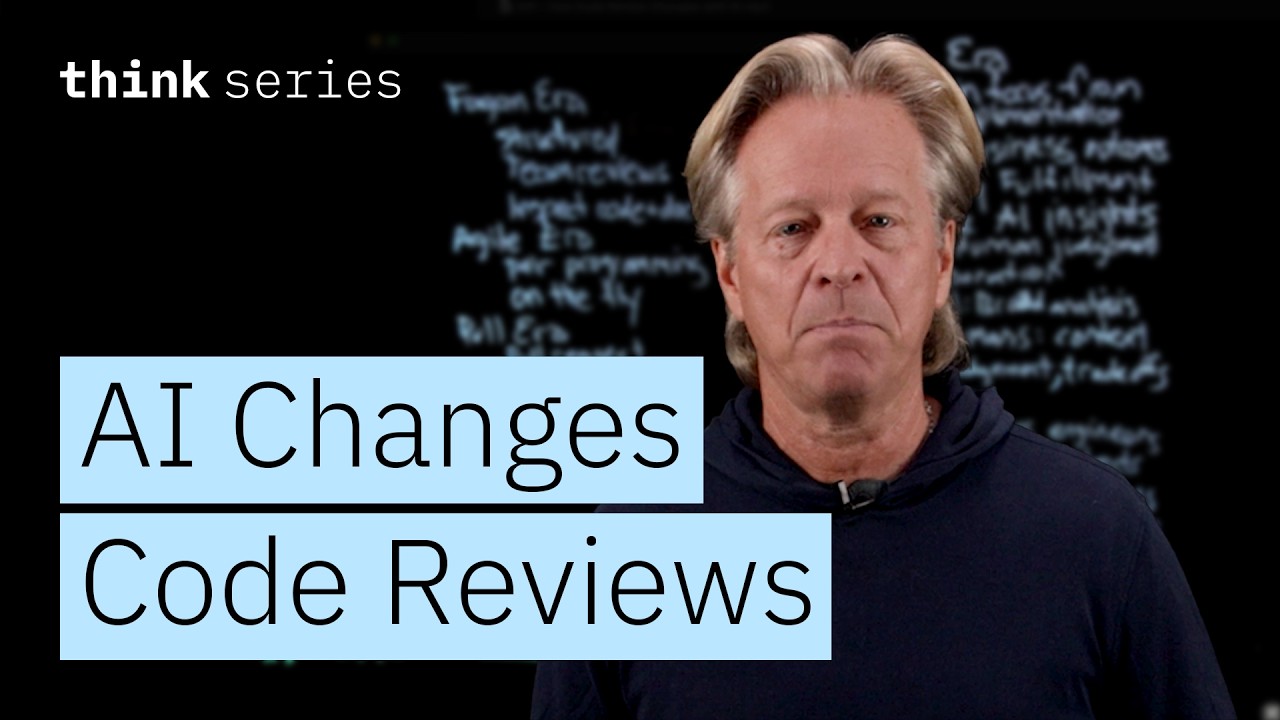
How AI Is Changing Code Reviews & Software Development
Keywords
Summary
135 words
Critical Evaluation
Value of the Information & Strength of the Argument
The video offers a clear and structured narrative of the evolution of code reviews, providing a useful framework for understanding the shift towards AI-assisted development. The argumentation is logical and builds progressively from historical practices to a future vision. However, the value is limited by the lack of concrete examples, case studies, or empirical data to support the claims. The presenter relies on general industry trends and personal expertise, which weakens the argument’s persuasiveness. The discussion of AI’s role in code review is conceptual rather than practical, with no mention of specific tools, metrics, or challenges.
Scientific Rigor, Source Quality, Title Accuracy
The video demonstrates moderate scientific rigor. It references historical concepts like Fagan inspections and pair programming, but does not provide any citations or links to supporting literature. The description includes links to IBM resources, but these are promotional rather than academic. The title accurately reflects the content, which is a high-level overview rather than a detailed technical analysis. The lack of sources and empirical evidence reduces the overall reliability of the information presented.
184 words
Title / Content Match
The title accurately reflects the content, which focuses on the evolution of code reviews and the impact of AI on software development practices.
Quality & Reliability
6/10
The video provides a coherent historical overview and a plausible future outlook, but lacks concrete data, case studies, or references to specific tools or research. The argument is based on general industry trends and personal expertise, with no empirical evidence or citations to support claims.
Key Moments
Markers derived by PSI from the transcript: the creator did not define chapters.
- Introduction to the topic and the evolution of code reviews.
- Discussion of the Fagan era and structured team inspections.
- Transition to the Agile era with pair programming.
- Introduction of the pull era and consensus reviews.
- Automation era with CI/CD pipelines and system checks.
- Shift to the AI era and the role of LLMs in development.
- Collaboration between AI and humans, focusing on outcomes.
- Conclusion on the future of code reviews as outcome validation.
Cited Sources
- Learn more about AI Code Review — Link provided in the video description for further information on AI code review.
- Monthly AI newsletter from IBM — Link provided in the video description for AI updates.
Concurring Sources
- Fagan inspection — Supports the historical description of early code review methods.
- Pair programming — Supports the description of Agile-era review practices.
Contribution & Novelties
The video provides a conceptual framework for understanding the evolution of code reviews, highlighting the shift from implementation-focused to outcome-focused reviews in the AI era. It emphasizes the collaborative role of AI and humans, where AI handles broad analysis and humans focus on intent and business impact. This perspective is valuable for software engineers and managers adapting to AI-assisted development.
Pour aller plus loin :
- Fagan inspection — Historical context on structured code reviews.
- Pair programming — Agile practice discussed in the video.
- Continuous integration — Related to the automation era and CI/CD pipelines.
- Large language model — Core technology behind AI-assisted development.
103 words
Radar Profile
The radar profile shows moderate scores across all dimensions, indicating a balanced but not exceptional video. The information quantity and quality are adequate, but the technical depth and reliability are limited by the lack of concrete examples and sources.