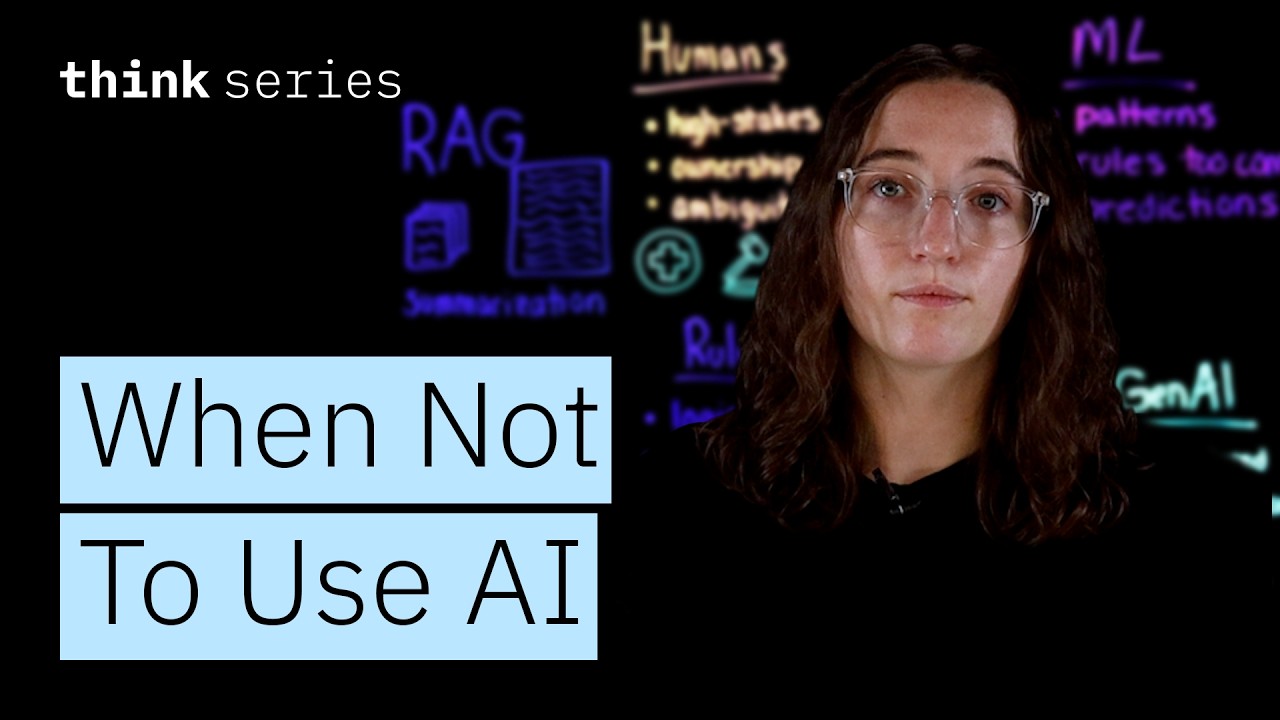
Knowing When Not to Use AI: AI Agents vs Rules vs ML
Keywords
Summary
154 words
Critical Evaluation
The video offers a valuable and well-structured overview of when to use different types of AI and traditional computing methods. The presenter, Sam Anthony, is an IBM expert, which lends credibility to the content. The argumentation is logical and grounded in practical examples, such as credit card processing, fraud detection, and customer support, which help illustrate the trade-offs. The framework presented is consistent with established software engineering principles and AI best practices, and it effectively communicates the importance of considering non-determinism, cost, and risk when integrating AI. However, the video lacks detailed citations or references to specific research or case studies, which limits its scientific rigor. The content is more of an expert opinion than a data-driven analysis. Additionally, while the presenter mentions model drift and explainability, these topics are not explored in depth. The video’s strength lies in its clarity and practical heuristic, but it could benefit from more concrete examples of hybrid systems and potential pitfalls. The adéquation between title and content is excellent, as the video directly addresses the question of when not to use AI. Overall, the video is informative and useful for practitioners, but it is not a comprehensive scientific review. The lack of sources and empirical evidence prevents it from being rated higher on scientific rigor.
212 words
Title / Content Match
The title accurately reflects the content, which focuses on decision-making for AI adoption and compares AI agents, rules, and ML.
Quality & Reliability
8/10
The video provides a clear, structured framework for choosing between human judgment, rules, ML, and generative AI, with practical examples and trade-offs. The content is consistent with established software engineering and AI best practices, though it lacks detailed citations or empirical data. The presenter is an IBM expert, and the video is published on IBM Technology channel, lending credibility.
Key Moments
Markers derived by PSI from the transcript: the creator did not define chapters.
- Introduction: The trap of using AI for everything and the need for strategic choices.
- Overview of four solution types: humans, rules, ML, and generative AI.
- Humans: strengths in judgment, ethics, and accountability; trade-offs of cost and scalability.
- Rules/code: ideal for deterministic logic and stable requirements; examples like payment processing.
- Machine learning: excels at pattern recognition and predictions; examples like fraud detection.
- Generative AI: suited for unstructured data and flexible reasoning; examples like customer support.
- Trade-offs of generative AI: non-determinism, testing difficulty, and cost.
- Hybrid systems: combining approaches for optimal results; example of spending analysis.
- Actionable heuristic for choosing the right approach; conclusion on the importance of disciplined choices.
Cited Sources
- Balancing AI (IBM) — Referenced in the video description as a resource for learning more about balancing AI.
- IBM AI Newsletter — Mentioned in the description as a monthly newsletter for AI updates.
Concurring Sources
- AI agents (IBM) — IBM's overview of AI agents, aligning with the video's discussion of agent capabilities and use cases.
- Machine learning (IBM) — IBM's explanation of machine learning, consistent with the video's description of ML's strengths.
Dissenting Sources
- The Limits of AI (MIT Technology Review) — This article discusses limitations of AI, which may contrast with the video's optimistic view of AI's potential when used appropriately.
Contribution & Novelties
The video provides a clear, actionable framework for deciding between human judgment, rules, ML, and generative AI, emphasizing trade-offs and hybrid solutions. It contributes to the ongoing discussion on AI adoption by offering a practical heuristic that can guide system design decisions.
Pour aller plus loin :
- AI agent (Wikipedia) — Provides background on AI agents and their capabilities.
- Machine learning (Wikipedia) — Explains the fundamentals of ML and its applications.
- Rule-based system (Wikipedia) — Details on rule-based systems and their use cases.
- Generative AI (Wikipedia) — Overview of generative AI and its applications.
- Model drift (Wikipedia) — Discusses the phenomenon of model drift, relevant to ML maintenance.
108 words
Radar Profile
The radar profile shows high scores in quality and reliability, with moderate scores in quantity and technical depth. This indicates a well-articulated expert opinion with practical value, but not a comprehensive technical deep dive.
💬 No comments provided.