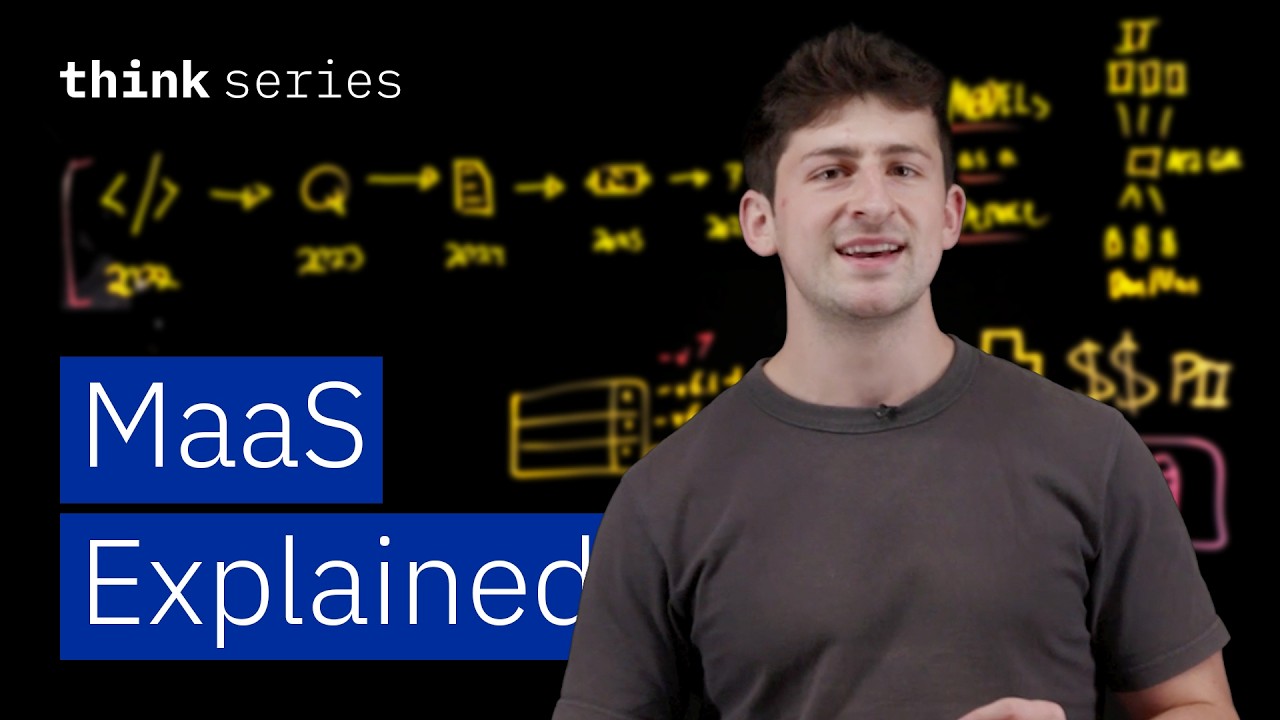
AI Models as a Service: Powering Agentic AI, Privacy, & RAG
Keywords
Summary
164 words
Critical Evaluation
The video provides a solid introductory overview of Models-as-a-Service, a topic of growing relevance in enterprise AI deployment. The speaker, Cedric Clyburn, effectively explains the concept by drawing parallels to Software-as-a-Service and illustrating the architecture with clear layers. The content is accurate and aligns with current industry practices, referencing open-source tools like Kubernetes, vLLM, KServe, and observability stacks such as Prometheus, Grafana, and Jaeger. However, the video lacks depth in several areas. For instance, it does not delve into specific implementation details, configuration, or potential challenges such as model versioning, GPU optimization, or security considerations beyond general statements. The argumentation is coherent but relies heavily on high-level assertions without concrete examples or case studies. The sources cited are limited to IBM’s promotional links, which, while relevant, do not provide independent verification. The video’s strength lies in its clarity and accessibility, making it suitable for a technical audience new to MaaS. However, for experts, it may feel superficial. The title accurately reflects the content, and the video fulfills its promise of explaining MaaS in the context of agentic AI and RAG. Overall, the video is a useful primer but not a comprehensive technical guide.
193 words
Title / Content Match
The title accurately reflects the content, which covers AI Models-as-a-Service in the context of agentic AI, privacy, and RAG.
Quality & Reliability
7/10
The video provides a clear conceptual overview of Models-as-a-Service, referencing open-source tools like Kubernetes, vLLM, KServe, and observability stacks. However, it lacks detailed technical depth and does not cite specific academic or industry sources beyond IBM's own resources. The information is accurate but presented at a high level, suitable for an introductory audience.
Key Moments
Markers derived by PSI from the transcript: the creator did not define chapters.
- Introduction to the speaker's journey with generative AI and the problem of third-party APIs.
- Definition of Models-as-a-Service and its analogy to Software-as-a-Service.
- Explanation of how AI giants use a similar model access pattern.
- Discussion on model lifecycle management and the issue of deprecated versions.
- Focus on sensitive environments like healthcare and finance, and the need for on-premise deployment.
- Architecture overview: infrastructure layer with Kubernetes/OpenShift.
- AI platform layer with inference engines like vLLM and KServe.
- API gateway for enterprise capabilities and observability.
- Observability tools like Prometheus, Grafana, and Jaeger for AI applications.
- Conclusion: MaaS as a standard for sovereign AI infrastructure and call to action.
Cited Sources
- IBM watsonx AI Assistant Engineer certification — Mentioned in the description as a certification opportunity.
- AI As A Service learning resource — Linked in the description for further learning on AI as a service.
- IBM AI newsletter — Sign-up link for monthly AI updates from IBM.
Concurring Sources
- IBM watsonx AI Assistant Engineer certification — IBM's official certification aligns with the video's content on AI deployment.
- AI As A Service learning resource — IBM's learning resource on AI as a service supports the video's topic.
Contribution & Novelties
The video provides a clear, accessible introduction to Models-as-a-Service, emphasizing its role in enabling agentic AI and RAG while addressing privacy and governance. It highlights the practical benefits of running models in-house, such as cost control and lifecycle management, and outlines a reference architecture using open-source tools. The presentation is particularly useful for organizations considering sovereign AI deployments.
Pour aller plus loin :
- Kubernetes — Official documentation for container orchestration, foundational to the discussed infrastructure.
- vLLM — An open-source library for fast LLM inference, mentioned in the video.
- KServe — A Kubernetes-based platform for serving machine learning models, referenced in the video.
- Prometheus — Open-source monitoring and alerting toolkit, part of the observability stack.
- Grafana — Analytics and visualization platform, used for monitoring AI applications.
- Jaeger — Open-source distributed tracing system, relevant for observability in AI workflows.
137 words
Radar Profile
The radar profile shows balanced scores across information quantity, quality, technical level, and reliability, with a slight emphasis on quality and reliability. This indicates a well-structured but not deeply technical presentation, suitable for an introductory audience.