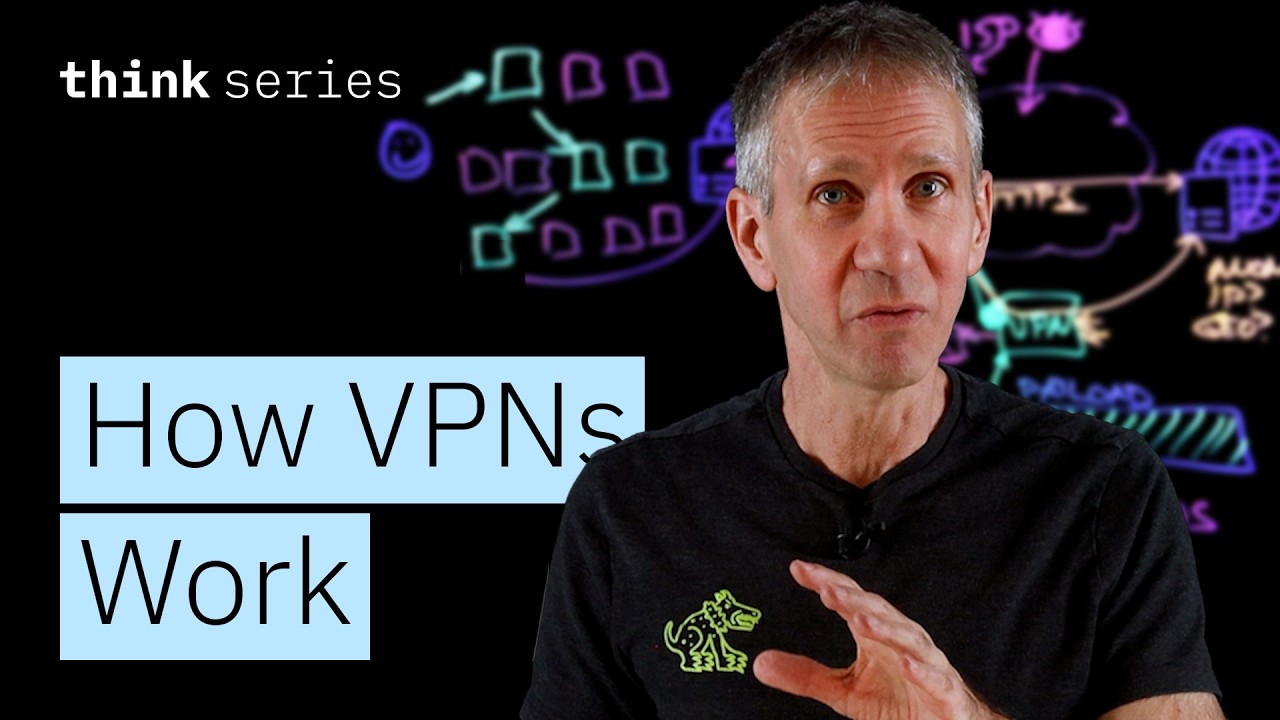
Personal VPNs: Encryption Myths and Data Security Explained
Keywords
Summary
159 words
Critical Evaluation
The video provides a solid, accessible explanation of personal VPNs, correcting a previous technical error and clarifying common misconceptions. Jeff Crume’s expertise is evident, and the content is well-structured, progressing from basic concepts to more nuanced discussions of trust and anonymity. The explanation of packet headers and payloads is particularly valuable, as it clarifies what HTTPS does and does not protect. The comparison between VPNs and Tor is balanced, highlighting the trade-offs between speed, simplicity, and anonymity. However, the video lacks depth in certain areas, such as the technical details of VPN protocols (e.g., OpenVPN, WireGuard) and the legal/regulatory aspects of VPN use. The sources cited are limited to IBM’s own resources, which, while credible, do not provide external validation. The video’s strength lies in its clarity and practical advice, but it could benefit from more concrete examples and data. The adéquation between title and content is good, as the video indeed explains encryption myths and data security. Overall, the video is a valuable resource for general audiences, but it does not delve into advanced technicalities, making it less suitable for experts. The public comments are overwhelmingly positive, with many praising the clarity of the explanation, though several note an audio issue with only left channel output. The correction of the previous error is appreciated by viewers. The video’s approach is ethical and responsible, avoiding sensationalism and providing balanced information. The main limitation is the lack of external sources and the relatively shallow treatment of some topics, but for its intended purpose, it is highly effective.
256 words
Title / Content Match
The title accurately reflects the content, focusing on personal VPNs, encryption myths, and data security.
Quality & Reliability
8/10
The video is presented by an IBM expert, Jeff Crume, and provides a clear, technically accurate explanation of VPNs, correcting a previous error. It covers key concepts such as encryption, packet headers/payloads, and trust transfer. The information is consistent with standard cybersecurity knowledge, though it lacks in-depth technical details and citations.
Key Moments
Markers derived by PSI from the transcript: the creator did not define chapters.
- Introduction and purpose of the video: correcting a previous error and addressing comments.
- Review of VPN basics: how a VPN works and the role of HTTPS.
- Correction: most VPNs do not create a second encrypted tunnel; they rely on HTTPS.
- Explanation of packet headers and payloads, and what HTTPS protects.
- Reasons to use a VPN: bypassing geo-restrictions and censorship.
- Discussion of trust transfer: VPN providers may log data, and free VPNs may sell data.
- Comparison of VPN and Tor: anonymity, speed, and simplicity.
- Considerations for public Wi-Fi and other use cases.
- Conclusion: VPNs are not a silver bullet; choose wisely.
Cited Sources
- Cost of a Data Breach Report — Referenced in the description as a resource for understanding data breach impacts.
- Learn more about Virtual Private Network (VPN) — Linked in the description for further reading on VPNs.
- QRadar SIEM V7.5 Plus CompTIA Cybersecurity Analyst Certification — Mentioned in the description as a related certification course.
Concurring Sources
- Cost of a Data Breach Report — IBM's report on data breaches, which aligns with the video's discussion of ISP data breaches.
Contribution & Novelties
The video provides a clear correction to a common misconception about VPN encryption, emphasizing that most personal VPNs do not create a second encrypted tunnel. It also offers a practical comparison between VPNs and Tor, highlighting trade-offs in anonymity, speed, and simplicity. The explanation of packet headers and payloads is particularly useful for understanding what HTTPS protects and what remains exposed.
Pour aller plus loin :
- Virtual Private Network (Wikipedia) — Provides a comprehensive overview of VPN technologies and protocols.
- Tor (Wikipedia) — Detailed information on the Tor network and its anonymity properties.
- HTTPS (Wikipedia) — Explains the HTTP Secure protocol and its encryption mechanisms.
105 words
Radar Profile
The radar profile shows high scores in quality of information and global reliability, with moderate scores in quantity and technical level. This indicates a well-explained, trustworthy video that is accessible to a general audience but may not satisfy experts seeking deep technical details.
💬 Très positif : Sur les 30 commentaires analysés, la grande majorité exprime une appréciation claire de la clarté et de la qualité de l'explication, avec quelques remarques sur un problème audio (son uniquement à gauche).