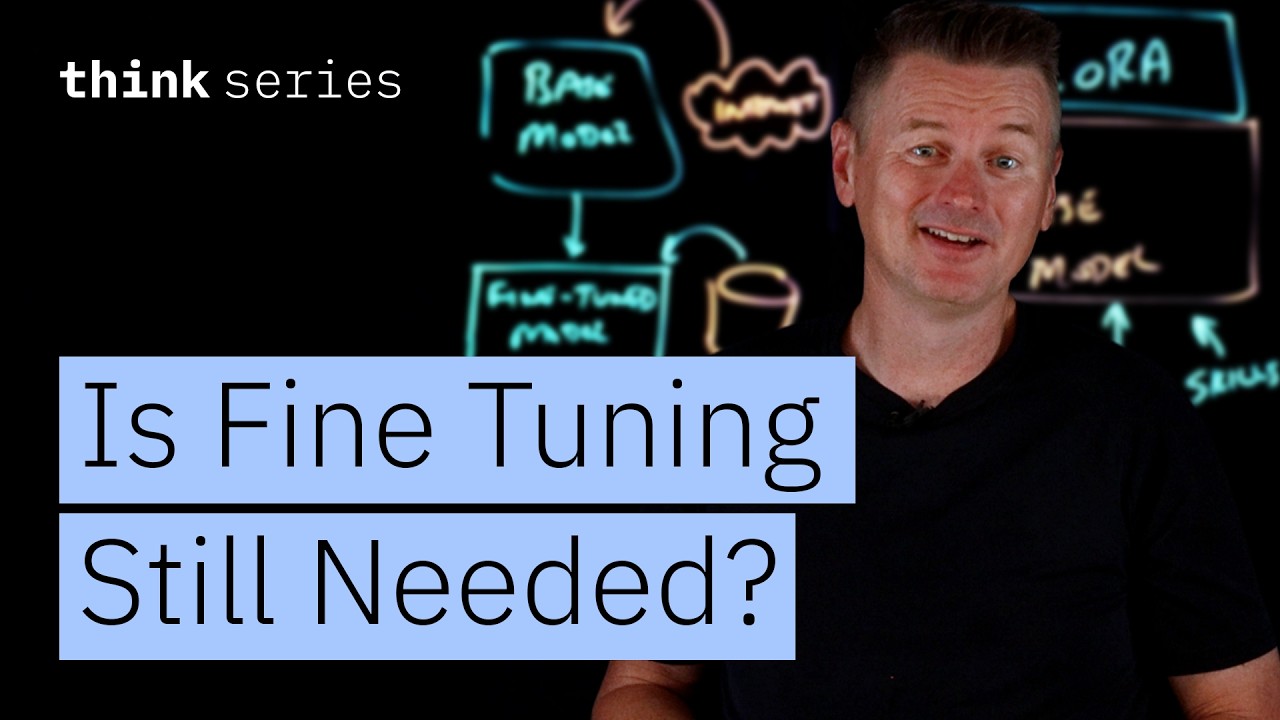
Is Fine-Tuning Still Needed? LLMs, RAG, & LoRA
Keywords
Summary
183 words
Critical Evaluation
The video offers a well-reasoned and balanced perspective on the role of fine-tuning in contemporary LLM development. Martin Keen, an IBM expert, presents a clear narrative that acknowledges the historical success of fine-tuning while demonstrating its diminishing returns against rapidly improving frontier models. The use of concrete examples, such as the legal AI company and BloombergGPT, grounds the discussion in real-world evidence, enhancing credibility. The argumentation is logically structured: it first establishes the problem (fine-tuning’s cost and moving-target nature), then introduces weight-free alternatives (RAG, context engineering, agent skills), and finally delineates scenarios where fine-tuning remains valuable (latency, distillation, RFT). This progression is pedagogically effective and avoids oversimplification. However, the video lacks rigorous scientific depth: it does not provide quantitative comparisons, detailed methodologies, or citations to primary research. The claims about frontier models surpassing fine-tuned ones are anecdotal and not backed by published benchmarks. Additionally, the presenter’s affiliation with IBM could introduce bias, though the content appears objective. The discussion of LoRA is brief and does not delve into technical details, which might leave advanced viewers wanting more. The video’s strength lies in its clarity and practical decision framework, making it highly useful for practitioners. Yet, for a scientific audience, the absence of empirical data and references is a notable weakness. The title accurately reflects the content, and the video successfully addresses the central question without overpromising. Overall, it is a valuable educational resource that synthesizes current industry knowledge, but it should be complemented with primary sources for deeper understanding.
249 words
Title / Content Match
The title accurately reflects the content, which directly addresses the ongoing relevance of fine-tuning in the context of modern LLM workflows.
Quality & Reliability
8/10
The video provides a balanced, well-structured overview of fine-tuning versus alternative customization techniques, referencing real-world examples (legal AI company, BloombergGPT) and current methods (LoRA, RAG, distillation, RFT). The presenter is an IBM expert, and the content aligns with industry knowledge, though it lacks detailed citations and empirical data.
Key Moments
Markers derived by PSI from the transcript: the creator did not define chapters.
- Introduction: legal AI company fine-tuned model preferred over GPT-4 in 2023.
- Definition of fine-tuning: continuing training on focused dataset.
- 2025 benchmark: seven frontier models surpass the custom fine-tuned model.
- BloombergGPT example: GPT-4 outperforms on financial benchmarks.
- Reasons for frontier model improvement: larger context windows, reasoning, cheaper inference.
- Alternatives to fine-tuning: RAG, context engineering, agent skills.
- Costs of fine-tuning: training, data collection, evaluation, maintenance.
- LoRA: low-rank adaptation for parameter-efficient fine-tuning.
- When fine-tuning still makes sense: latency, distillation, RFT.
- Decision framework: start with context engineering, add RAG, skills, then fine-tune if needed.
Cited Sources
- IBM Fine-Tuning Resource — Linked in the description as a resource to learn more about fine-tuning.
- IBM AI Newsletter — Linked in the description for signing up to receive AI updates from IBM.
Concurring Sources
- BloombergGPT paper — The video references BloombergGPT, and this paper describes its training and evaluation.
Dissenting Sources
- Fine-tuning vs. RAG: A Comparative Study — This paper suggests that fine-tuning can still outperform RAG in certain domain-specific tasks, contrasting with the video's emphasis on RAG as a primary alternative.
Contribution & Novelties
The video provides a clear, up-to-date synthesis of the debate on fine-tuning versus alternative customization methods, offering a practical decision framework. It highlights the shift from fine-tuning as a default to a last resort, and introduces modern techniques like LoRA, distillation, and RFT in a concise manner.
Pour aller plus loin :
- Retrieval-Augmented Generation (RAG) — Wikipedia article explaining the RAG technique.
- Low-Rank Adaptation (LoRA) — Original paper on LoRA, a parameter-efficient fine-tuning method.
- Knowledge Distillation — Wikipedia article on the concept of distilling large models into smaller ones.
- Reinforcement Fine-Tuning (RFT) — Concept discussed in the video; no specific URL provided, but related to reinforcement learning from human feedback (RLHF).
111 words
Radar Profile
The radar profile shows high scores in information quantity, quality, and reliability, with a slightly lower technical depth. This indicates a well-balanced, informative video that is accessible to a broad audience while maintaining scientific credibility.
💬 Positif. Sur les 30 commentaires analysés, la majorité exprime un accord avec le contenu et apprécie la clarté de l'explication, certains ajoutant des nuances sur les cas d'usage du fine-tuning.