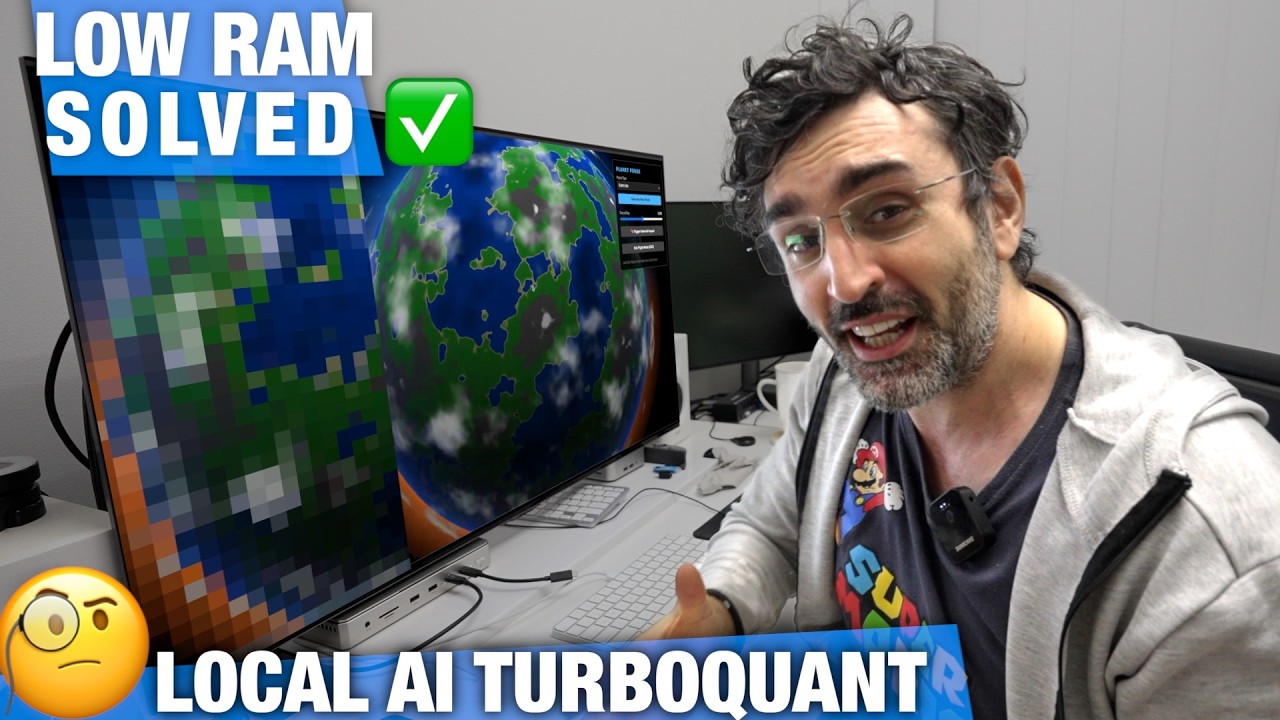
How to Run TurboQuant - "Lossless" Quantization for Local AI TESTED ✅
Keywords
Summary
158 words
Critical Evaluation
Value of the Information & Strength of the Argument
The video provides a hands-on evaluation that is more credible than typical hype due to its systematic testing and transparent reporting. The creator acknowledges the limits of the technique and shares raw data like token accuracy and perplexity scores. However, the argumentation sometimes relies on anecdotal visual comparisons and a single model (Llama 1B) which limits generalizability. The distinction between first and second pass is clearly explained, and the measured divergence from official claims is well-documented. The value lies in practical guidance for practitioners considering TurboQuant.
Scientific Rigor, Source Quality, Title Accuracy
The creator cites the TurboQuant paper and open-source implementations, though only the paper is mentioned without specific URL. The description includes affiliate links and companion videos, which are not scientific references but help contextualize. The title accurately reflects the content, and the video delivers an honest test. No peer-reviewed sources are directly referenced; the evaluation is based on user experimentation. The creator does not misrepresent the data and clearly notes discrepancies with published results, increasing epistemic trustworthiness.
178 words
Title / Content Match
The title correctly advertises an evaluation of TurboQuant, and the video indeed tests lossless claims, debunking them partially.
Quality & Reliability
6/10
The test is practical and systematic, but limited to a few models and configurations, and some results conflict with official claims. Author openly shares methodology and limitations.
Key Moments
Markers derived by PSI from the transcript: the creator did not define chapters.
- Introduction to TurboQuant and the promise of lossless KV cache quantization
- Controversy between New York University and RabbitQ over code credit
- Explanation of two-pass quantization technique with Johnson-Lindenstrauss transform
- Overview of implementations in MLX-LM and MLX-VLM, including CPU and shader versions
- Demonstration of spaceship generation with different quantization levels (9-bit, 4-bit, 3-bit)
- Comparison of memory savings and visual quality showing 4-bit TurboQuant preserves scene coherence
- Token inspector analysis showing token probabilities drift with quantization
- Perplexity and top-token accuracy measurements for various bit rates, debunking losslessness
- Mixed-precision quantization improves 3-bit results but 2-bit fails completely
Cited Sources
- Inferencer App — The tool used for testing TurboQuant in the video
- Companion video: Context Precision — Earlier video on context precision methods referenced for background
- Companion video: Model Streaming — Related video on model streaming techniques
- Companion video: S26 vs iPhone AI — Video comparing AI capabilities on different devices
- Companion video: Kimi K2.5 AI Cluster — Video on Kimi K2.5 AI cluster performance
- Affiliate: LG C2 42" Monitor — Product link for monitor used in setup (affiliate)
Concurring Sources
- Context Precision video — Earlier findings on context precision align with the observed trade-offs in quality.
Dissenting Sources
- TurboQuant paper (claimed lossless results) — The paper reports 99.7% accuracy with 2-bit quantization, but the video's tests on Llama 1B show much lower accuracy and high perplexity, indicating a gap between official results and practical reproduction.
Contribution & Novelties
This video adds practical first-hand testing of TurboQuant, revealing that the ’lossless’ claim does not hold in real-world scenarios, at least on tested models. It provides concrete memory savings and accuracy metrics, contributing knowledge beyond the paper’s theoretical results.
Pour aller plus loin :
- Johnson-Lindenstrauss lemma — Underlying dimensionality reduction technique used in TurboQuant’s second pass.
- Quantization (signal processing) — General concept of quantization, relevant to understanding KV cache compression.
- KV Cache quantization — Blog on KV cache quantization with PyTorch, providing context on existing methods.
- MLX LM — Open-source repository for running LLMs on Apple silicon, used for implementations tested.
101 words
Radar Profile
The radar profile shows high scores in quantitative information and technical level, but lower for source reliability and overall quality, reflecting a practical yet partially speculative evaluation. The video is dense in benchmarks but lacks external validation and peer-reviewed backing.
💬 Sur les 30 commentaires analysés, l'orientation globale est positive, avec des éloges pour la méthodologie et les tests, mais quelques interrogations sur les différences avec le papier et des demandes de clarification sur l'implémentation.