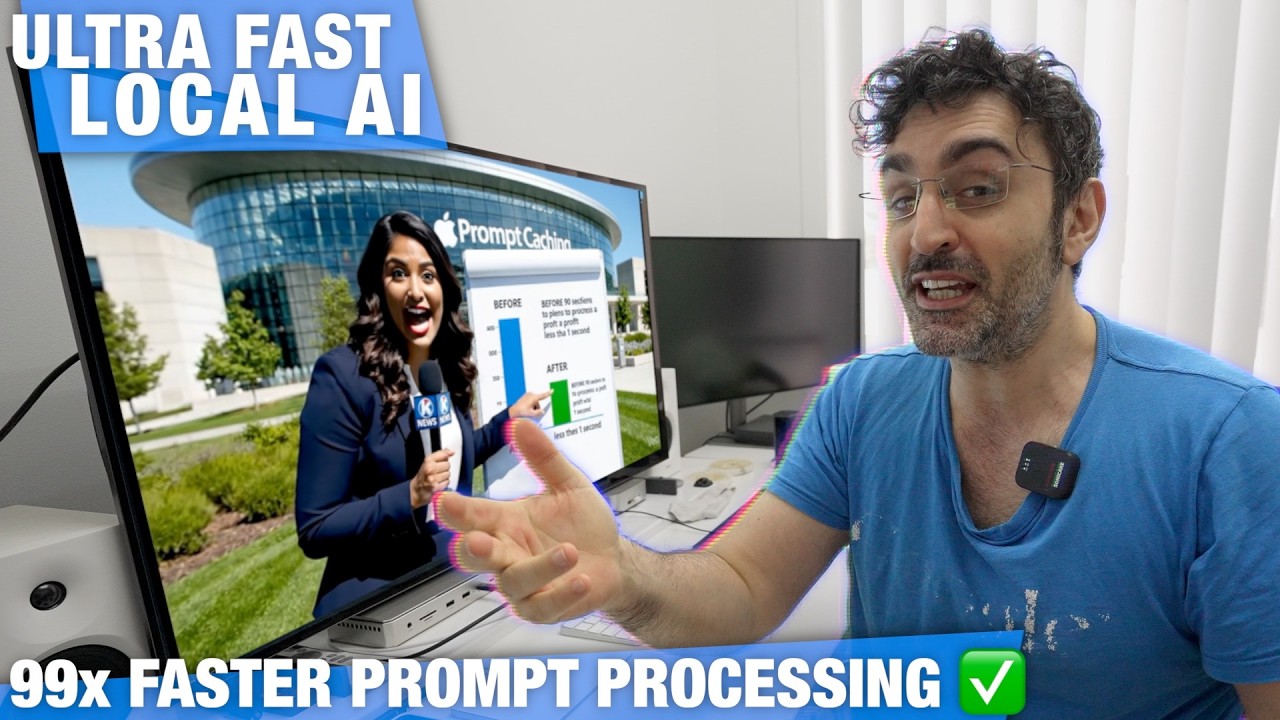
How to 99x Speed up LOCAL AI, OpenClaw & Coding Agents | Prompt Caching Explained
Keywords
Summary
176 words
Critical Evaluation
Value of the Information & Strength of the Argument
The video delivers practical, actionable information on enabling and configuring prompt caching in a local AI environment. The demonstrations are clear and quantify speed improvements (e.g., from 91 seconds to under 1 second). However, the explanatory depth is limited: it does not discuss underlying mechanisms (e.g., KV cache, memory layout) or potential trade-offs beyond SSD wear. The argumentation is based on anecdotal evidence from the creator’s testing, which is sufficient for a tutorial but not for rigorous scientific validation.
Scientific Rigor, Source Quality, Title Accuracy
The video’s scientific rigor is moderate: it is a hands-on tutorial without citation of academic references, relying on the creator’s experience and software documentation. The sources listed in the description are product links (Inferencer, affiliate shopping links) and related companion videos, not scholarly works. The title accurately describes the content, focusing on the speed improvement and the technique of prompt caching, with no significant mismatch. No comments were provided for analysis.
165 words
Title / Content Match
The title accurately reflects the content: a practical guide to speeding up local AI agents via prompt caching, with demonstrations on Mac Studio.
Quality & Reliability
7/10
The video demonstrates real-world implementations of prompt caching with concrete performance measurements, but lacks rigorous theoretical analysis and relies on the creator's own empirical tests. Claims are plausible and consistent, though no external scientific validation is provided.
Key Moments
Markers derived by PSI from the transcript: the creator did not define chapters.
- Introduction to prompt caching and cache settings in Inferencer
- Demonstration of Quen 3 Coder X caching with prefix matching
- Demonstration of Quen 3 base model caching and set-date feature
- Server API options for fixed date to reuse cache
- Integration with VS Code and Kilo Code agent, showing fast repeated prompts
- Test with OpenClaw and Kimi 2.5, showing new session speed improvement
Cited Sources
- Inferencer — Software used for testing prompt caching
- Coding Agents companion video — Related video on coding agents
- OpenClaw companion video — Related video on OpenClaw
- Xcode Intelligence companion video — Related video on Xcode
- LM Studio vs Inferencer video — comparison between inferencer and LM Studio
External References
Contribution & Novelties
The video contributes a practical demonstration of prompt caching in local AI setups, quantifying speed gains and providing configuration tips (e.g., fixed date) to maximize cache reuse. It highlights differences across models and suggests future optimizations like quantization. While not offering novel scientific findings, it serves as a hands-on guide for practitioners.
Pour aller plus loin :
- Prompt caching in LLMs — Background on prompt caching techniques.
- KV cache — Conceptual foundation of caching key-value states in transformers.
- Quantization in machine learning — Discusses reducing cache precision for efficiency.
- Prefix caching — NVIDIA blog on prefix caching for LLMs.
99 words
Radar Profile
The profile shows balanced scores across information quantity, quality, and technical level, but with slightly lower reliability due to lack of external references. The high technical level indicates a specialized audience.