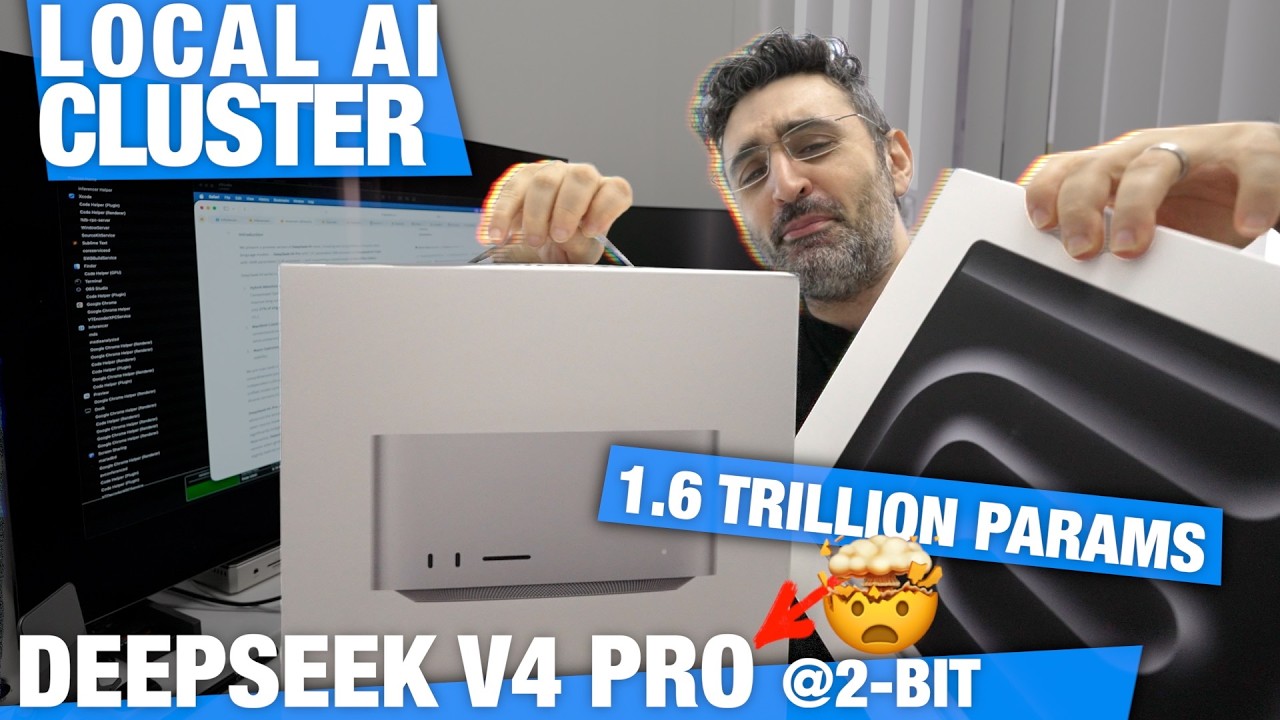
DeepSeek V4 Pro at 2-Bit?! | Local AI Cluster vs 1.6T Params 🤯
Keywords
Summary
194 words
Critical Evaluation
Value of the Information & Strength of the Argument
The video offers a practical, hands-on evaluation of running a 1.6T param model at 2.8-bit quantization on a local cluster, providing concrete performance numbers (tokens/sec, memory usage) and qualitative results (which tasks succeed/fail). The argumentation is transparent: the creator shows failures as openly as successes, and explicitly warns about degraded accuracy. The value lies in demonstrating the feasibility and limits of extreme quantization with distributed memory, which is useful for researchers and hobbyists. However, the evaluation is not rigorous—there are no controlled benchmarks, the sample size is small (a few code generation attempts), and the methodology is informal. The argumentation relies on anecdotal evidence, but the live demonstrations add credibility.
Scientific Rigor, Source Quality, Title Accuracy
The video is based on direct experimentation with publicly available model checkpoints and open-source tools. The creator provides links to the quantized models on Hugging Face, the Inferencer app, and companion videos, which serve as reproducible sources. The title is well-aligned with the content, as it explicitly mentions the 2-bit quantization and the local cluster. The sources are not rigorously cited (no academic papers), but the practical nature of the content doesn’t demand formal citations—the included links allow viewers to verify and reproduce the results. The discourse is honest about limitations, and the technical explanations (e.g., quantization levels, memory usage) are clear and accessible.
229 words
Title / Content Match
The title accurately reflects the content: testing DeepSeek V4 Pro and Flash at 2-bit quantization on a local AI cluster.
Quality & Reliability
6/10
The video presents live testing and real performance metrics, but it is anecdotal, not peer-reviewed, and lacks systematic benchmarks.
Key Moments
Markers derived by PSI from the transcript: the creator did not define chapters.
- Introduction: testing DeepSeek V4 Pro and Flash at 2.8-bit quantization on a local AI cluster.
- Flash model generates a playable Snake game in HTML at 2.8-bit quantization.
- Flash model successfully produces a Tetris game, showing coherent code generation.
- Distributed compute setup for Pro: memory usage on Mac Studio (456 GB) and MacBook Pro (70 GB).
- Pro model attempts Snake game but fails due to logic bug, despite code looking plausible.
- Creative writing test: Pro generates a short story, demonstrating coherence.
- Pro solves the trolley problem correctly, indicating preserved reasoning abilities.
- Discussion on limitations and future plans for full V4 Pro release with multimodal features.
- Tutorial on setting up distributed compute using the Inferencer app: server and client connection.
- Final thoughts: call for community collaboration on a massive multiplayer compute lobby.
Cited Sources
- DeepSeek V4 Pro MLX 2.8-bit (Hugging Face) — The quantized Pro model used in the video for distributed compute testing.
- DeepSeek V4 Flash MLX 9-bit (Hugging Face) — Higher-quality quantized Flash model referenced as a contrast.
- DeepSeek V4 Flash MLX 2.8-bit (Hugging Face) — The quantized Flash model used for the 128 GB single-machine tests.
- Inferencer App — Software used to run distributed compute across the Macs.
- Companion video: GLM 5.1 2-bit — Referenced as a related test of a different model at 2-bit.
- Companion video: Context Attention — Referenced for context handling techniques.
- Companion video: Expert Controls — Referenced for model control features.
- Companion video: Kimi K2.5 Local Cluster — Referenced as a previous local cluster test.
Contribution & Novelties
This video contributes practical insights into running a 1.6-trillion-parameter model at 2.8-bit quantization on consumer hardware using distributed compute. It demonstrates that while code generation degrades severely, reasoning and creative writing remain surprisingly coherent, offering a nuanced understanding of the trade-offs of extreme quantization. The video also introduces a reproducible setup with specific model checkpoints and software, advancing community knowledge on local LLM deployment.
Pour aller plus loin :
- Quantization (machine learning) — Core concept behind the video’s approach to reduce model size.
- Distributed computing — Foundation for the cluster setup used to pool memory.
- MLX (Apple’s framework) — The underlying framework for the quantized models on Apple Silicon.
- DeepSeek V4 Pro — The model family website for official information (without URL certainty).
123 words
Radar Profile
The radar profile shows balanced scores across information quantity, quality, technical level, and reliability, with slightly lower reliability. This reflects a hands-on, demo-based video that is informative but lacks rigorous methodology.