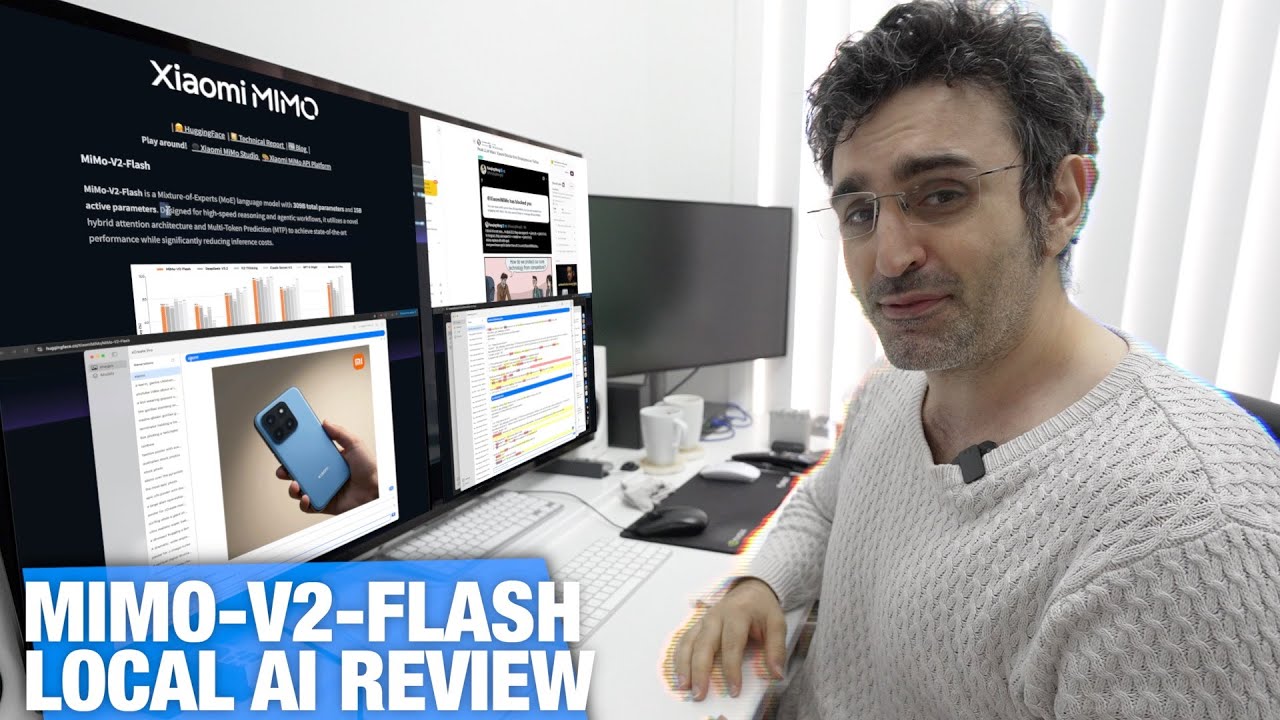
Let's Run MiMo-V2-Flash Local AI - Super Fast "Kimi K2" Competitor Review by Xiaomi
Keywords
Summary
160 words
Critical Evaluation
Value of the Information & Strength of the Argument
The video offers a hands-on, practical evaluation of a newly released open-weight model, providing real performance metrics (token generation speed) and side-by-side comparisons with benchmarks. The argumentation is straightforward but uneven: it effectively demonstrates the model’s speed and basic reasoning, yet the tests are not systematic and rely on anecdotal examples. The presenter openly acknowledges the model’s failures (e.g., the React bug) which adds credibility, but the lack of a rigorous benchmark protocol and the reliance on personal experience weakens the overall evidence. The value lies in the experiential feedback for users considering local deployment of MiMo-V2-Flash, particularly in terms of speed and MLX integration on Apple silicon.
Scientific Rigor, Source Quality, Title Accuracy
The rigor is limited: the review is based on the presenter’s own setup and impressions, with references to public benchmarks but no detailed methodology. Sources cited include the Hugging Face model repository and the Inferencer app, both directly relevant, but there is no citation of independent academic or technical papers. The title is accurate, as it clearly states the purpose and the competitor comparison. The video includes affiliate links but no overt sponsorship segment. The presentation style is informal, with some tangents (e.g., the Twitter block drama), which detracts from scientific focus. The sources provided in the description are mostly commercial or supplementary, and no discordant or independent scientific sources are included.
235 words
Title / Content Match
The title accurately reflects the content: a practical review of running the MiMo-V2-Flash model locally, with comparisons to Kimi K2 and other models.
Quality & Reliability
5/10
The review is based on hands-on testing and some benchmark comparisons, but methodology is informal and largely subjective, lacking controlled experiments or third-party verification.
Key Moments
Markers derived by PSI from the transcript: the creator did not define chapters.
- Introduction to MiMo-V2-Flash, its parameters and purpose.
- Benchmark comparisons and discussion of competitor tensions with Kimi K2.
- Testing the surgeon riddle; model answers 'mother' with 88% confidence.
- Batching demonstration: running two inferences simultaneously, reaching ~48 tokens/second.
- Tool call test for fetching webpage content; model misnames the domain initially.
- Coding challenges: Swift and C++ questions answered correctly, React quantization bug fails.
- Word processor and MS Paint clone generation; word processor works, paint has runtime errors.
- Final verdict: fast and MIT-licensed but not ideal for complex app generation.
Cited Sources
- MiMo-V2-Flash-MLX-6.5bit on Hugging Face — The model repository used for the local deployment and quantization.
- Inferencer Application — The inference app used for testing the model.
- Mac Studio (affiliate link) — Hardware used for the local testing environment.
- MacBook Pro (affiliate link) — Alternative hardware mentioned in the video.
- Companion video: DeepSeek V3.2 review — Related review by the same creator.
- Companion video: Kimi K2 Thinking review — Related review of a competitor model.
Concurring Sources
- MiMo-V2-Flash Model Card — The model card provides official technical details and benchmarks.
Dissenting Sources
- Reaction from Kimi K2 community — The video mentions a dispute regarding the model's architectural similarities to DeepSeek, indicating a skeptical perspective from competitors.
External References
Contribution & Novelties
The video provides an early hands-on assessment of Xiaomi’s MiMo-V2-Flash, focusing on its practical speed and usability on Apple Silicon via MLX. It adds real-world observations on batching, tool calls, and coding limitations, which are valuable for developers considering local AI deployment. The creator’s experiments with quantization levels (Q6/Q8) offer practical guidance, though the analysis is not exhaustive. The coverage of the model’s sparse attention issues and occasional failures gives a balanced picture.
Pour aller plus loin :
- Mixture of experts — Core architecture concept behind MiMo-V2-Flash’s sparse activation.
- Quantization (machine learning) — Explanation of Q6/Q8 and its impact on model size and speed.
- Apple MLX framework — The framework used to run the model on Apple silicon.
118 words
Radar Profile
The radar profile shows moderate scores across all dimensions, indicating a balanced but not exceptional review. Quantity and technical level are slightly above average, while qualitative aspects and reliability are lower, reflecting the informal nature of the assessment.