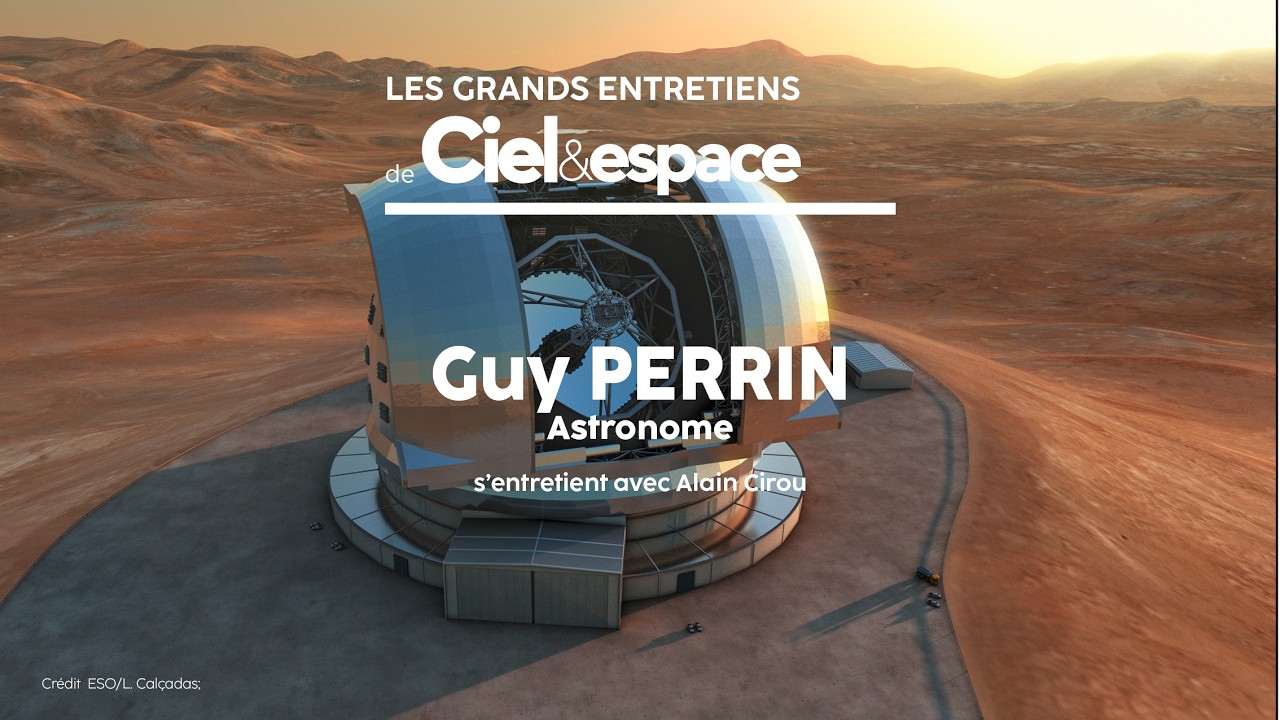
Télescopes du futur, l’ère des géants, Grand entretien de Guy Perrin
Keywords
Summary
136 words
Critical Evaluation
The interview provides a comprehensive overview of the future of ground-based astronomy, centered on the ELT and other major projects. Guy Perrin, as a leading expert, offers valuable insights into the scientific goals and technological challenges. The discussion is technically accurate, covering concepts like active optics, adaptive optics, and interferometry with clarity. The historical context, from Galileo to the VLT, helps illustrate the rapid progress in telescope design. However, the interview is largely qualitative and lacks specific data or references to peer-reviewed studies. The sources cited are not explicitly mentioned, and the description only provides general context. The title accurately reflects the content, and the interview is well-structured. The main strength is the expert perspective, but the lack of concrete examples or citations limits its scientific rigor. The public comments (if any) are not provided, so no analysis of audience reception is possible. Overall, this is a valuable resource for understanding the future of astronomy, but it should be complemented with more detailed technical sources.
165 words
Title / Content Match
The title accurately reflects the content: a discussion about future giant telescopes, focusing on the ELT and other projects.
Quality & Reliability
8/10
The interview features a recognized expert (Guy Perrin, astronomer at Paris Observatory, member of the French Academy of Sciences) discussing future telescopes (ELT, SKA) with technical depth. The content is accurate and well-grounded, though it is an opinion/expert interview rather than a peer-reviewed study. The description provides context but no direct sources.
Key Moments
Markers derived by PSI from the transcript: the creator did not define chapters.
- Introduction to the ELT and its 39-meter mirror.
- Discussion on what the ELT will see: first stars, exoplanet atmospheres, and stars near the black hole.
- Historical comparison from Galileo to Palomar and the need for technological leaps.
- Explanation of active optics and thin mirrors.
- Adaptive optics and correcting atmospheric turbulence.
- Introduction to interferometry and its history from Fizeau to Michelson.
- The VLT and its interferometric mode as a risky but successful project.
- Future projects: SKA and complementarity with space telescopes.
Cited Sources
- ESO - Extremely Large Telescope — Mentioned as the main project discussed.
- SKA Observatory — Mentioned as another major future telescope.
Concurring Sources
- ESO - ELT — Official project page confirming the ELT's specifications.
Contribution & Novelties
The interview provides an expert perspective on the scientific motivations and technological innovations behind the next generation of giant telescopes, particularly the ELT. It highlights the importance of active and adaptive optics and the historical development of interferometry.
Pour aller plus loin :
- Extremely Large Telescope (Wikipedia) — Overview of the ELT project.
- Adaptive optics (Wikipedia) — Explanation of the technology used to correct atmospheric turbulence.
- Astronomical interferometry (Wikipedia) — Background on the technique discussed in the interview.
78 words
Radar Profile
The radar profile shows high scores in information quantity, quality, and reliability, with a slightly lower technical level, indicating a well-balanced and informative interview suitable for a broad audience.