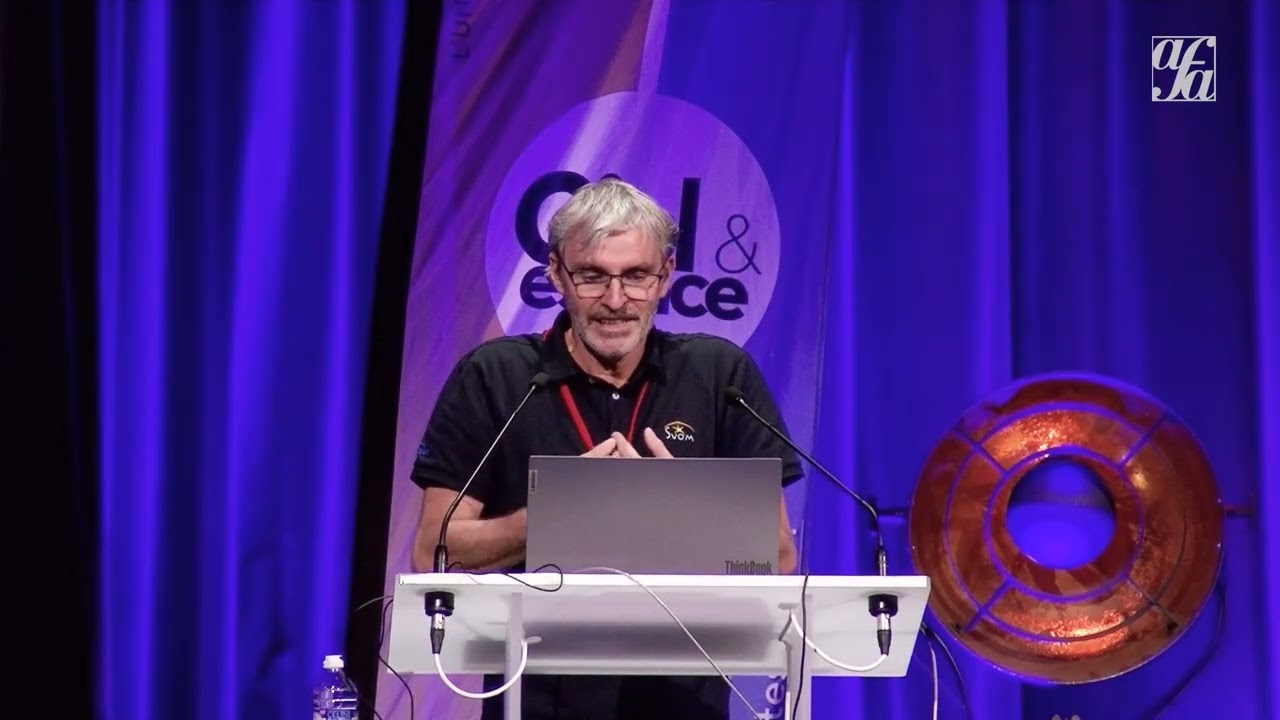
Sursauts gamma, premiers résultats de la mission SVOM par Bertrand Cordier
Keywords
Summary
163 words
Critical Evaluation
The presentation by Bertrand Cordier is a comprehensive and authoritative overview of gamma-ray bursts and the SVOM mission. As the principal investigator, Cordier provides first-hand insights into the mission’s design, objectives, and early results, lending high credibility to the content. The historical narrative is well-researched, accurately tracing the discovery of GRBs from the Vela satellites to the BATSE era and the pivotal 1997 afterglow detection. The explanation of the coded mask imaging technique is clear and accessible, illustrating a key technological advancement. The talk is well-structured, progressing logically from the phenomenon to the mission and its results. The scientific rigor is evident in the careful presentation of data and the acknowledgment of uncertainties. The inclusion of first results from SVOM, such as the detection of GRB 240622A, adds current relevance. However, the talk is aimed at a general audience, so some technical details are simplified, but this does not undermine its scientific value. The speaker’s expertise and the mission’s significance make this a valuable resource for understanding GRBs and modern space astronomy. The title accurately reflects the content, and the talk fulfills its promise of presenting both the phenomenon and the mission’s achievements.
193 words
Title / Content Match
The title accurately reflects the content: a presentation on gamma-ray bursts and the first results of the SVOM mission.
Quality & Reliability
8/10
The speaker is a senior astrophysicist and mission scientist for SVOM, providing authoritative first-hand information. The content is well-structured, historically accurate, and includes recent results from the mission. Minor simplifications for a general audience do not detract from overall reliability.
Key Moments
Markers derived by PSI from the transcript: the creator did not define chapters.
- Introduction to gamma-ray bursts and their historical discovery by Vela satellites.
- Explanation of the two classes of GRBs: short and long, based on duration.
- BATSE sky map showing isotropic distribution, suggesting extragalactic origin.
- 1997 breakthrough: first afterglow detection and cosmological distance measurement.
- Introduction to coded mask imaging technique for precise localization.
- Overview of SVOM mission: French-Chinese collaboration, launch, and instruments.
- First results from SVOM: detections and performance of the instruments.
- Discussion of multi-messenger astronomy and future prospects.
Cited Sources
- SVOM mission official website — Mentioned as the mission's official site for more information.
- CNES SVOM page — Referenced as a source for mission details.
Concurring Sources
- NASA's Fermi Gamma-ray Space Telescope — Fermi has observed many GRBs, supporting the scientific context.
Contribution & Novelties
The talk provides an insider’s perspective on the SVOM mission, including its design, challenges, and early scientific results. It highlights the importance of rapid localization and multi-wavelength follow-up in GRB research. The presentation also underscores the value of international collaboration in space science.
Pour aller plus loin :
- Gamma-ray burst - Wikipedia — Comprehensive overview of GRBs, their properties, and research history.
- SVOM mission - Wikipedia — Detailed article on the SVOM mission, its instruments, and objectives.
- Coded aperture - Wikipedia — Explanation of the coded mask imaging technique used in GRB detectors.
93 words
Radar Profile
The radar profile shows high scores in information quantity, quality, and reliability, with a moderate technical level, indicating a well-balanced presentation suitable for a general audience while maintaining scientific depth.