SVOM et la civilisation du ciel transitoire en Chine
Keywords
Summary
152 words
Critical Evaluation
The conference provides a compelling and well-informed overview of Chinese astronomical history and its relevance to modern astrophysics. The speaker, Jean-Marc Bonnet-Bidaud, is an astrophysicist at CEA with direct involvement in the SVOM mission, lending credibility to his presentation. He effectively contrasts the European geocentric and immutable view of the heavens with the Chinese dynamic and observational approach, supported by historical examples such as the Crab Nebula supernova of 1054 and the Dunhuang star map. The argument that Chinese astronomy was driven by political and philosophical imperatives is well-supported by references to the concept of the Mandate of Heaven and the establishment of imperial observatories. The talk is well-structured, moving from historical context to the modern SVOM mission, and is accessible to a general audience while maintaining scientific rigor. However, some claims, such as the uniqueness of Chinese astronomical continuity, could benefit from more explicit citations to historical sources. The speaker acknowledges his own background and the limitations of his expertise in sinology, which adds transparency. The presentation includes a book reference for further reading, but no direct URLs are provided. Overall, the talk is informative and thought-provoking, successfully bridging history and modern science. The title accurately reflects the content, and the inclusion of the SVOM mission provides a forward-looking perspective. The main weakness is the lack of detailed references for some historical claims, but this is typical for a public lecture. The speaker’s enthusiasm and expertise make this a valuable resource for understanding the cultural and scientific significance of Chinese astronomy.
252 words
Title / Content Match
The title accurately reflects the content, which covers both the historical Chinese tradition of observing transient celestial phenomena and the modern SVOM mission as a continuation of that tradition.
Quality & Reliability
8/10
The speaker is an astrophysicist at CEA with direct involvement in the SVOM mission and historical research on Chinese astronomy. The content is well-structured, based on historical documents and scientific evidence, and includes references to his book and the SVOM mission. However, some claims are presented without detailed citations, and the talk is a popular science lecture, not a peer-reviewed presentation.
Key Moments
Markers derived by PSI from the transcript: the creator did not define chapters.
- Introduction and request to forget European astronomy history
- Introduction to the Temple of Heaven and Chinese astronomical tradition
- Personal story: discovery of the Crab Nebula supernova date from Chinese records
- Explanation of Chinese cosmology: sky as mirror of Earth, Mandate of Heaven
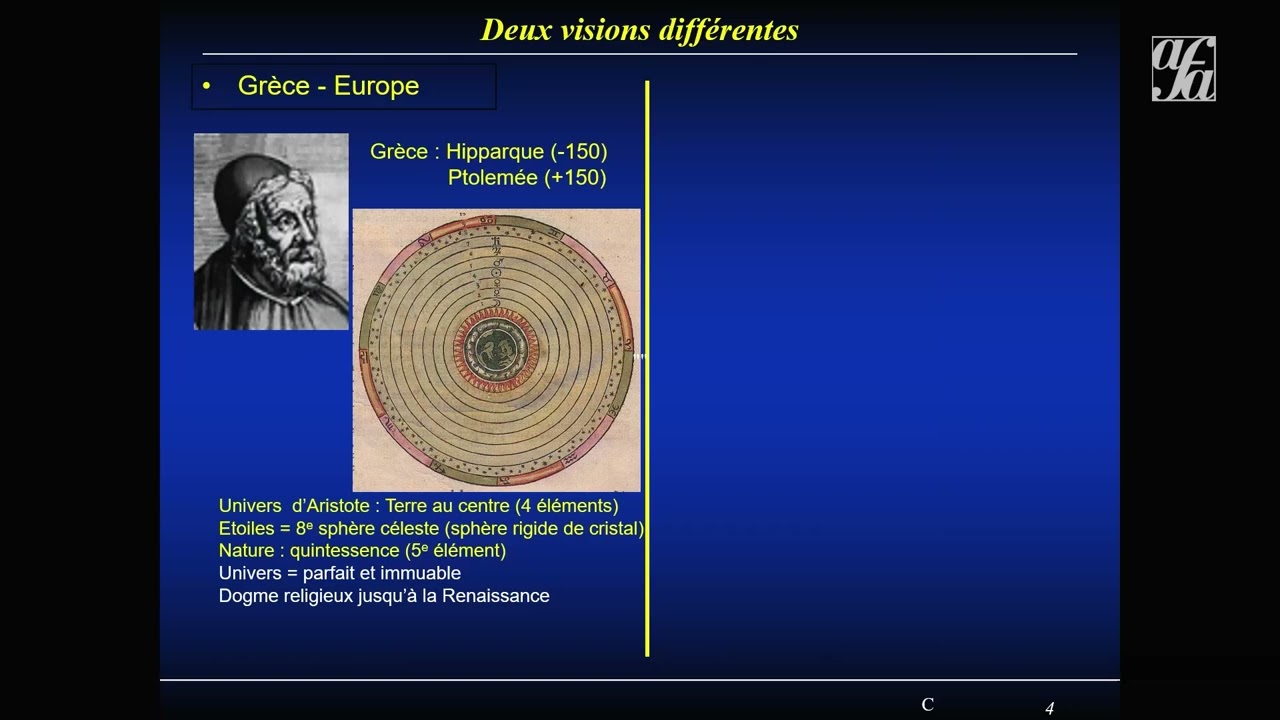
- Contrast with European geocentric and immutable celestial spheres
- Chinese discoveries: comets, supernovae, sunspots; institutional observatories
- Lack of original European documents vs. Chinese textual continuity
- The Dunhuang star map and its significance
- Transition to modern astronomy and the SVOM mission
- SVOM mission objectives and French-Chinese collaboration
Cited Sources
- 4000 ans d'astronomie chinoise (book) — Mentioned as a book by the speaker containing detailed information on Chinese astronomy.
Concurring Sources
- Chinese astronomy — Provides general information on Chinese astronomical traditions and discoveries.
- SVOM — Describes the SVOM mission and its scientific goals.
Dissenting Sources
- European astronomy history — The talk contrasts European and Chinese astronomical traditions, but no specific discordant sources are cited.
Contribution & Novelties
The talk provides a unique perspective on the cultural and historical context of Chinese astronomy, emphasizing its continuous observation of transient phenomena, which contrasts with the European static view. It highlights the SVOM mission as a modern continuation of this tradition, offering a novel angle on international collaboration in astrophysics.
Pour aller plus loin :
- Chinese astronomy — Overview of Chinese astronomical history and practices.
- SVOM — Information on the SVOM mission and its objectives.
- Dunhuang Star Chart — Details on the ancient star map discovered at Dunhuang.
88 words
Radar Profile
The radar profile shows high scores in quantity and quality of information, with a moderate technical level, indicating a well-balanced presentation suitable for a general audience. The reliability score is also high, reflecting the speaker's expertise and the use of historical evidence.
💬 Sur les 0 commentaires analysés, aucune tendance n'est disponible.