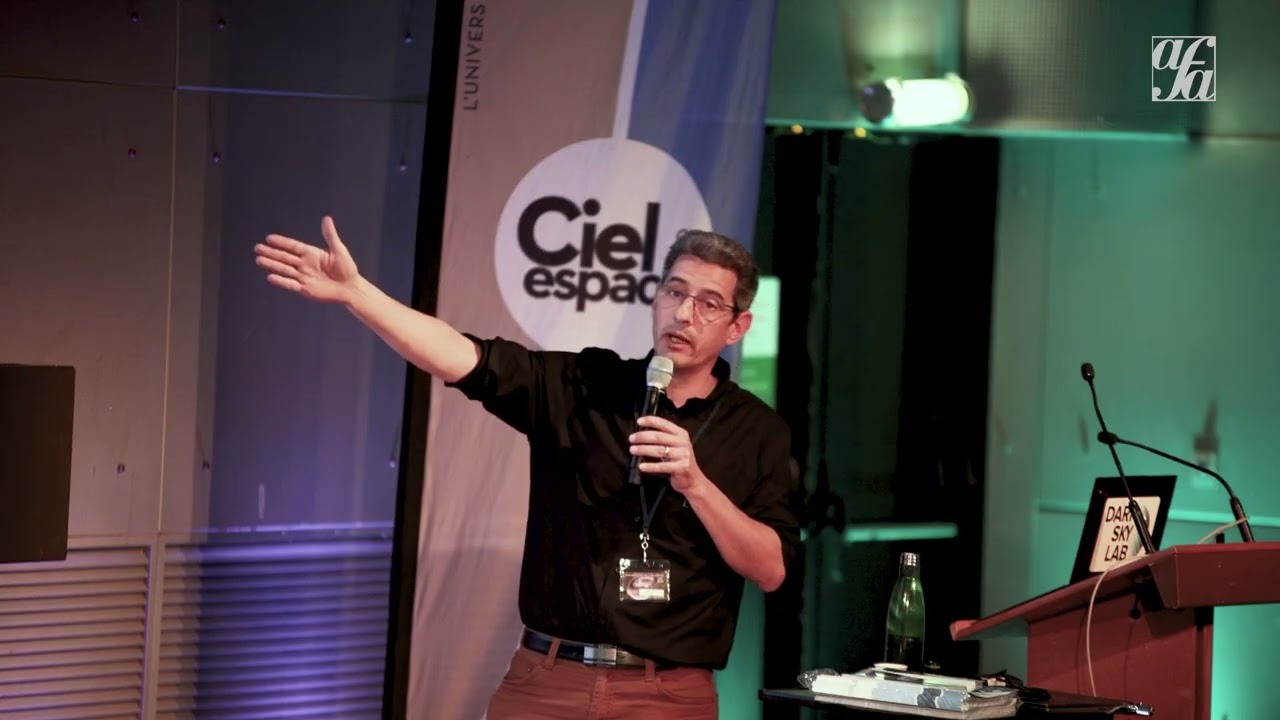
Protection de la nuit : La France leader mondial ?
Keywords
Summary
190 words
Critical Evaluation
The talk provides a comprehensive and well-informed overview of light pollution in France, supported by recent satellite data and the speaker’s expertise. Vauclair effectively balances the positive news of decreasing radiance with a critical perspective on what this actually signifies. He correctly points out that the decrease is primarily due to extinguishing public lighting, which is a relatively simple measure, and that more complex issues such as direct glare and spectral composition remain. The argumentation is solid, with clear explanations of technical terms like radiance and the distinction between direct and diffuse pollution. The speaker’s credibility is enhanced by his academic background and practical experience in the field. The sources cited include the article in Ciel & Espace and the Light Pollution Platform, which are relevant and credible. The talk is well-structured and accessible, though it assumes some prior knowledge of the topic. The title’s question is directly addressed, and the content matches the title well. Overall, the talk is a valuable contribution to raising awareness about light pollution and its multifaceted nature, though it could have delved deeper into specific scientific studies and policy measures.
186 words
Title / Content Match
The title poses a question that is directly addressed and answered with nuance, matching the content well.
Quality & Reliability
8/10
The speaker is an astrophysicist with a PhD and extensive experience in dark sky protection, and the talk is based on recent satellite data and scientific studies. The presentation is well-structured and provides nuanced analysis, though it is a conference talk rather than a peer-reviewed publication.
Key Moments
Markers derived by PSI from the transcript: the creator did not define chapters.
- Introduction: speaker's background and context of the talk.
- Presentation of satellite data showing 25% decrease in radiance in France (2022-2023).
- Discussion of the long-term trend and the importance of context in interpreting relative changes.
- Introduction of Dark Sky France association and its role in federating efforts.
- Explanation of light pollution types: direct vs. diffuse, and the importance of timing.
- Discussion of economic and energy impacts of public lighting.
- Impact on biodiversity and human health, comparison to pesticides.
- Presentation of the Light Pollution Platform and its global map.
- Discussion of dark sky reserves in France and worldwide.
- Conclusion: France's leadership is nuanced; true progress requires more than turning off lights.
Cited Sources
- Ciel & Espace article on dark sky reserves — Mentioned as a recent article detailing the dark sky reserves in France.
- Light Pollution Platform — Presented as a tool offering the first global calibrated light pollution map.
- Dark Sky France website — Mentioned as the website for the new association.
Concurring Sources
- The New World Atlas of Artificial Night Sky Brightness — Provides global data on light pollution that aligns with the talk's satellite measurements.
Contribution & Novelties
The talk provides an up-to-date analysis of light pollution trends in France using recent satellite data, and critically examines the meaning of these trends. It highlights the need for a more comprehensive approach beyond simply turning off lights, and introduces the Light Pollution Platform as a new tool for measurement and mapping.
Pour aller plus loin :
- International Dark Sky Association — Official organization for dark sky protection.
- Light pollution on Wikipedia — Overview of light pollution types and impacts.
- The New World Atlas of Artificial Night Sky Brightness — Scientific paper on global light pollution mapping.
97 words
Radar Profile
The radar profile shows high scores in quantity and quality of information, with a slightly lower technical level, indicating a well-balanced presentation that is informative and credible but not overly technical. The reliability score is high, reflecting the speaker's expertise and use of recent data.
💬 No comments were provided for analysis.