Eric Roots: Deformation-controlled fluid mass-transfer processes in ancient orogens
Keywords
Summary
188 words
Critical Evaluation
Value of the Information & Strength of the Argument
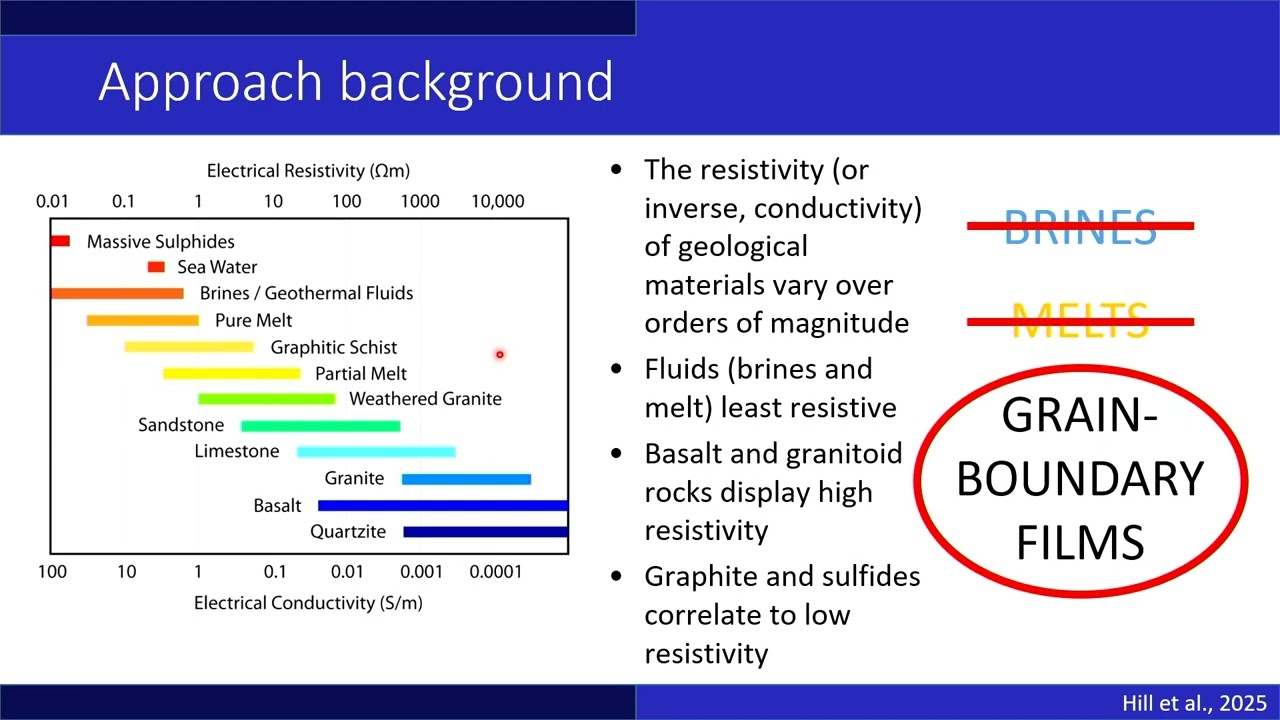
The talk provides valuable insights into the interpretation of magnetotelluric data in ancient orogens, proposing a novel link between Coulomb stress modeling and conductive features. The argumentation is logical, building from mineral systems theory to geophysical observations and then to a deformation-controlled fluid flow model. The use of analogies with modern fault systems (Turkey) strengthens the hypothesis. However, the presentation is a summary, and some details of the modeling and data processing are glossed over. The argument for graphitic films over brines or melts is presented but not deeply justified in this talk, relying on citations to published work.
Scientific Rigor, Source Quality, Title Accuracy
The talk references a published paper in AGU Geophysical Research Letters (December 2025) and cites work by Bedard et al. (2018) and Australian studies on grain boundary films. The sources are appropriate and credible. The title accurately reflects the content. The presenter is transparent about the collaborative nature and the fact that it is not his original work, which adds to the credibility. However, the talk does not provide a detailed critique of the methods or alternative interpretations, limiting the scientific rigor in this presentation.
199 words
Title / Content Match
The title accurately reflects the content, focusing on deformation-controlled fluid mass-transfer in ancient orogens, as presented.
Quality & Reliability
7/10
The talk presents a published study (AGU Geophysical Research Letters, Dec 2025) combining magnetotelluric and seismic data with Coulomb stress modeling. The presenter is transparent about the source and the collaborative nature. However, the talk is a summary by a colleague, not the original author, and lacks detailed methodological scrutiny.
Key Moments
Markers derived by PSI from the transcript: the creator did not define chapters.
- Introduction and context: presenter explains he is giving the talk on behalf of Eric Roots and Graeme Hill, referencing a published paper in AGU GRL.
- Mineral systems framework: sources of fluids, heat, metals, and deposition mechanisms.
- Introduction to Metal Earth project and Larder Lake transect, highlighting gold endowment.
- Physical properties: electrical conductivity, MT method sensitivity to conductive features like graphitic films.
- MT data inversion and seismic reflectors: identification of lower crustal conductor and aseismic zones.
- Comparison with modern fault systems (Turkey) and Coulomb stress modeling.
- Stress models for transform faults and their relation to MT conductive features.
- Interpretation: fluids flow through damage zones, MT images only top and bottom of conductive zones.
- Brittle-ductile transition, metamorphic fluids, CO2, and gold transport.
- Conclusion: geophysical signatures reflect last major earthquake event; implications for mineral exploration.
Cited Sources
- AGU Geophysical Research Letters (Dec 2025) publication — The talk is based on this published paper by Graeme Hill et al., combining MT and seismic data with Coulomb stress modeling.
- Bedard et al. (2018) — Cited for fault damage zone concepts and fluid flow in the Cadillac-Larder Lake fault.
Concurring Sources
- Bedard et al. (2018) — Supports the idea of fault damage zones and fluid flow in the Cadillac-Larder Lake fault.
Dissenting Sources
- Alternative interpretations of conductive features (brines, melts) — The talk argues for graphitic films, but acknowledges that brines and melts are also possible, though considered less likely in Archean settings.
Contribution & Novelties
The talk presents a novel interpretation of magnetotelluric data in ancient orogens, linking conductive features to Coulomb stress fields and deformation-controlled fluid flow. It suggests that discontinuous conductive zones may represent continuous fault pathways, with MT imaging only capturing the top and bottom. This provides a new perspective for mineral exploration in similar settings.
Pour aller plus loin :
- Magnetotellurics — Overview of the MT method used in the study.
- Coulomb stress transfer — Concept applied to fault interactions and fluid flow.
- Abitibi greenstone belt — Geological context of the study area.
92 words
Radar Profile
The radar profile shows balanced scores across all dimensions, indicating a solid but not exceptional presentation. The talk provides good information and technical depth, but the reliance on a summary and lack of detailed methodology slightly reduce its overall impact.
💬 No comments were provided for analysis.