Base metal deposits of the Woman River iron formation, Swayze, Abitibi greenstone belt
Keywords
Summary
219 words
Critical Evaluation
Value of the Information & Strength of the Argument
The presentation provides valuable insights into the geological controls on base metal mineralization in a poorly endowed area. The speaker presents a clear research question and systematically addresses it through field observations, geochemical data, and structural analysis. The argumentation is solid, based on extensive data collection (over 2,000 geochemical analyses) and detailed mapping. The speaker acknowledges limitations, such as non-compliant historical resources and incomplete data, but uses these to justify further work. The comparison between the Swayze area and the rest of the Abitibi belt is well-articulated, highlighting differences in host rock and mineralization style. The conclusion that the lack of thermally mature crust explains the absence of VMS deposits is plausible and supported by evidence of inherited zircons and less volcanism. Overall, the value of the information is high for researchers in economic geology, and the argumentation is coherent and evidence-based.
Scientific Rigor, Source Quality, Title Accuracy
The scientific rigor is high, with the speaker referencing a submitted manuscript to the Canadian Journal of Earth Sciences and presenting new geochronological data. The sources are primarily the speaker’s own research and historical data, which are clearly identified. The title accurately reflects the content, focusing on base metal deposits in the Woman River iron formation. The presentation is part of a scientific meeting, indicating peer review context. However, since the research is ongoing and not yet fully published, the sources are not all verifiable. The speaker does not cite external references, but the data presented are from systematic field and laboratory work. The adequacy between title and content is excellent, as the talk directly addresses the topic. No public comments were provided, so no analysis of audience reception is possible.
288 words
Title / Content Match
The title accurately reflects the content, focusing on base metal deposits in the Woman River iron formation within the Swayze area of the Abitibi greenstone belt.
Quality & Reliability
8/10
Presentation of ongoing research with detailed field observations, geochemical analyses, and reference to submitted manuscripts. The speaker is a researcher presenting at a scientific meeting, and the content is based on systematic data collection. However, the talk is an update and not peer-reviewed yet, and some historical resources are non-compliant.
Key Moments
Markers derived by PSI from the transcript: the creator did not define chapters.
- Introduction and outline of the presentation
- Research problem: why does Swayze have less base metal endowment?
- Overview of the study area and mapping progress
- First manuscript submitted to CJS; new geochronology
- Comparison of VMS deposits across the Abitibi belt
- Jefferson and Vancan prospects: Blake's work and new data
- Field work and alteration mapping in Jefferson area
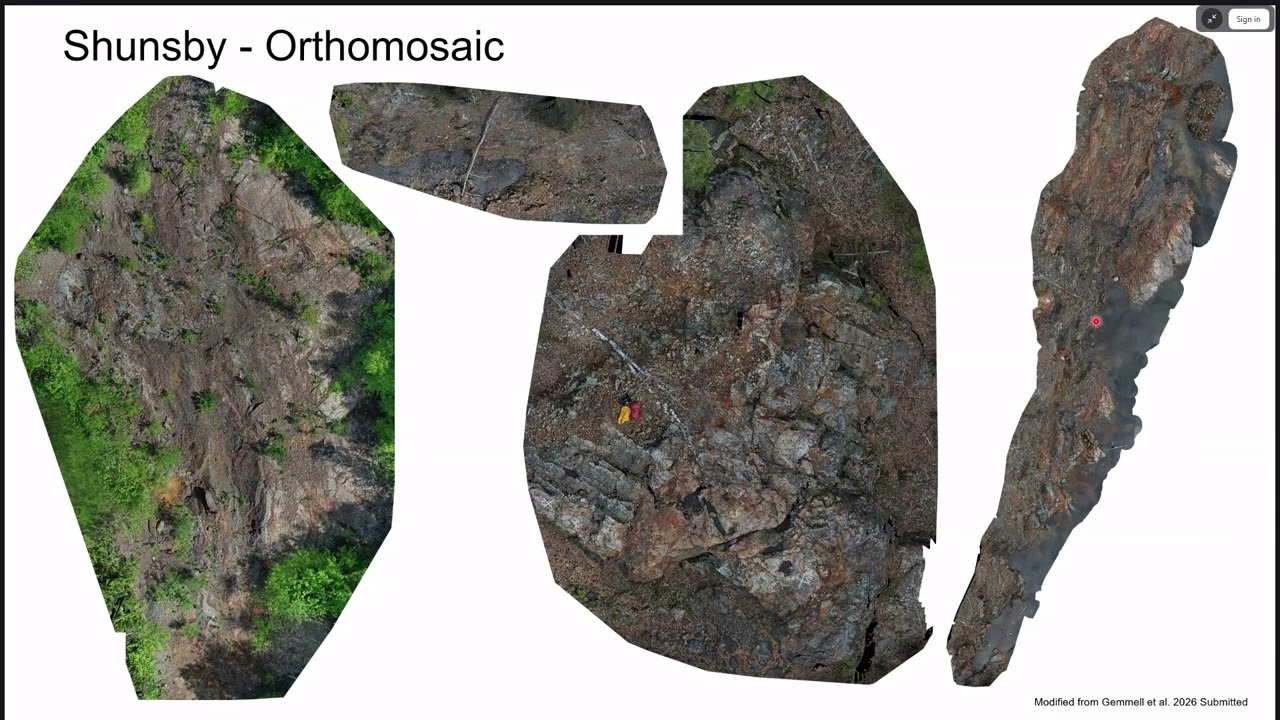
- Shunsby area: historical resource and drill core logging
- Other prospects and unique massive sulfide in Blake River
- Conclusions and implications for Abitibi
Cited Sources
- Canadian Journal of Earth Sciences (submitted manuscript) — The first manuscript on crustal architecture and revised geochronology of the Swayze area has been submitted to this journal.
Concurring Sources
- Ontario Geological Survey maps — The speaker mentions using OGS mapping data and releasing new maps, which are consistent with the geological framework.
Contribution & Novelties
This presentation provides an update on ongoing research that contributes new geological mapping, geochemical data, and geochronological constraints to the understanding of base metal mineralization in the Swayze area. The key novelty is the identification that all significant base metal mineralization is hosted within the Woman River iron formation, contrasting with the rest of the Abitibi belt where mineralization occurs within volcanic assemblages. This finding challenges the assumption that the presence of similar assemblages implies similar mineral potential. The research also provides detailed alteration maps and drone orthomosaics, offering a high-resolution view of the geology. The work is significant for mineral exploration in greenstone belts.
Pour aller plus loin :
- Volcanogenic massive sulfide ore deposit — Provides background on VMS deposits and their formation.
- Abitibi greenstone belt — Overview of the geological context of the study area.
- Iron formation — Explanation of iron formations and their significance in hosting mineralization.
150 words
Radar Profile
The radar profile shows high scores in quantity and quality of information, with a slightly lower technical level, indicating a presentation that is detailed but accessible. The overall reliability is high, reflecting the scientific rigor of the research.