Sarah Speight: Zr & melt inclusion, petrogenesis & metallogeny of VMS systems in the Abitibi belt
Keywords
Summary
208 words
Critical Evaluation
Value of the Information & Strength of the Argument
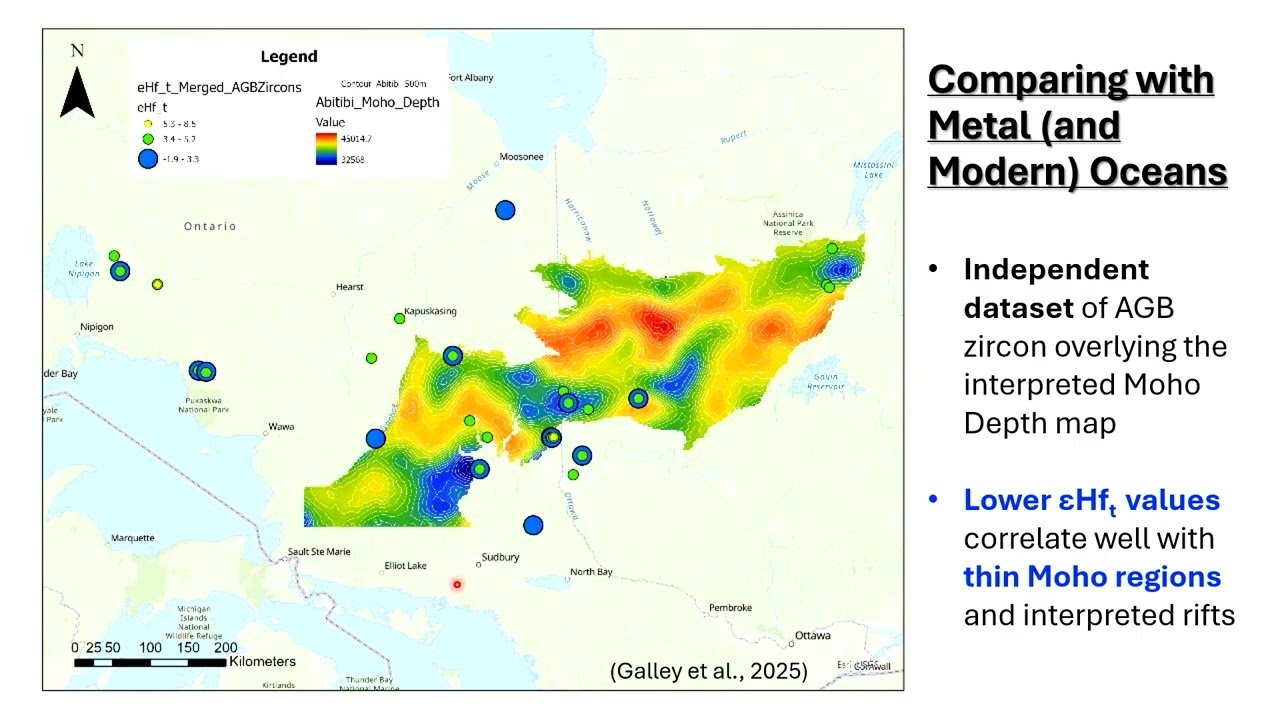
The presentation provides valuable new data on zircon chemistry and melt inclusions from the Abitibi belt, offering insights into the magmatic processes that may control VMS endowment. The argumentation is solid, as the speaker systematically compares spatial variations in epsilon Hf with tectonic interpretations from Moho depth maps, and uses melt inclusion data to track metal evolution and oxygen fugacity. The integration of multiple datasets (zircon chemistry, melt inclusions, whole-rock data) strengthens the conclusions. The speaker acknowledges limitations, such as the spatial resolution of zircon data and the need for further work, which adds to the credibility.
Scientific Rigor, Source Quality, Title Accuracy
The presentation demonstrates scientific rigor through a detailed analytical workflow and careful data interpretation. The speaker references previous work and integrates with the Metal Earth project, but does not cite specific external sources in the talk. The title accurately reflects the content, and the presentation is well-structured. The speaker does not mention any commercial interests or sponsorships.
169 words
Title / Content Match
The title accurately reflects the content, focusing on zircon and melt inclusion constraints on petrogenesis and metallogeny of VMS systems in the Abitibi belt.
Quality & Reliability
8/10
The presentation is based on original research with a clear methodology, including detailed analytical workflows and integration of multiple datasets. The speaker is a postdoctoral researcher and the work is part of a collaborative project (Metal Earth). Limitations are acknowledged, and the results are interpreted with appropriate caution.
Key Moments
Markers derived by PSI from the transcript: the creator did not define chapters.
- Introduction and project overview
- Analytical workflow for zircon analysis
- Sample locations and color scheme for transects
- Epsilon Hf data and spatial variations
- Comparison with Moho depth and rifting
- Melt inclusion data from Kidd Creek
- Metal contents in melt inclusions and degassing
- Oxygen fugacity and temperature trends
- Summary and implications for VMS endowment
Contribution & Novelties
This presentation contributes new zircon and melt inclusion data from the Abitibi belt, linking magmatic processes to VMS mineralization. The integration of spatial variations in epsilon Hf with Moho depth interpretations provides a novel perspective on the tectonic controls on VMS endowment. The melt inclusion data from Kidd Creek offer insights into metal degassing and oxygen fugacity variations, which are critical for understanding gold-rich vs. gold-poor systems.
Pour aller plus loin :
- Zircon geochemistry — Background on zircon and its use in geochemistry.
- Volcanogenic massive sulfide ore deposit — Overview of VMS deposits and their formation.
- Hafnium isotopes — Information on hafnium and its isotopes in geochemistry.
107 words
Radar Profile
The radar profile shows high scores across all dimensions, indicating a well-balanced and reliable presentation. The high scores in quantity and quality of information reflect the detailed data and rigorous analysis, while the technical level is appropriate for a specialized audience.