Theory & application of trace elements in quartz: Au settings, Superior Province
Keywords
Summary
215 words
Critical Evaluation
Value of the Information & Strength of the Argument
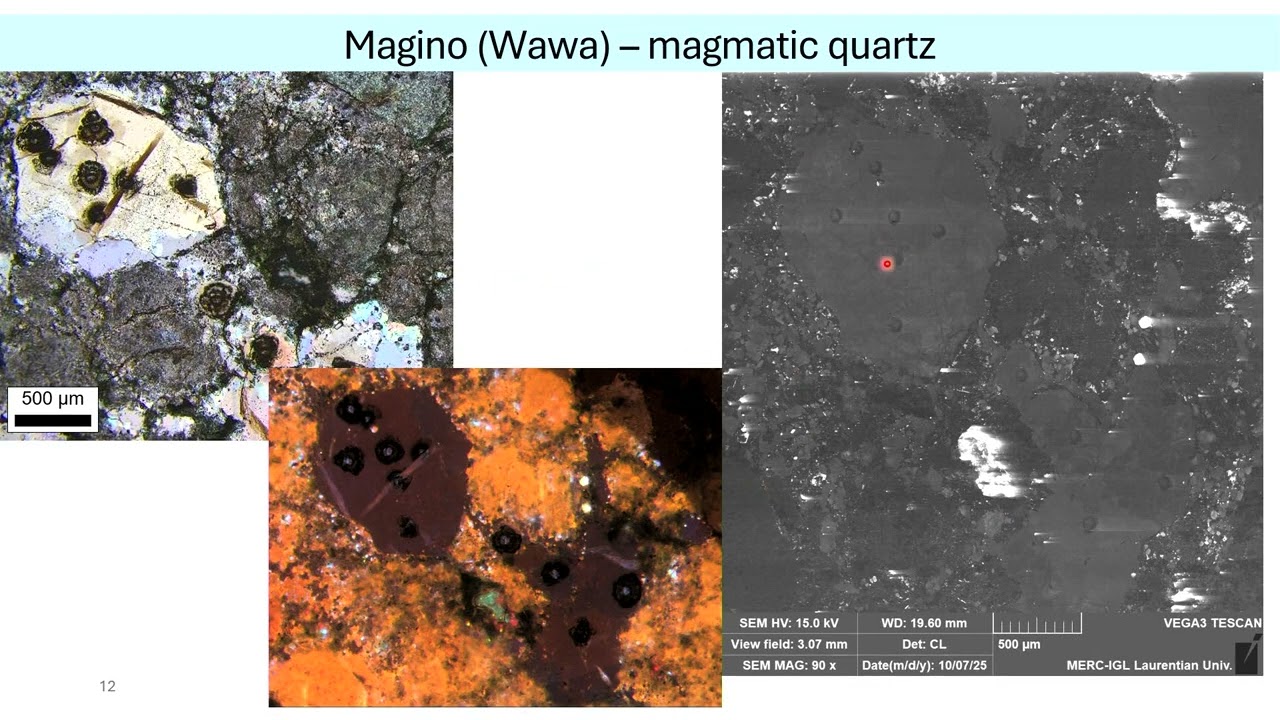
The value of the information lies in its contribution to a debated topic in economic geology: distinguishing intrusion-related from orogenic gold deposits using quartz chemistry. The speaker provides a comprehensive dataset from multiple deposits, which is valuable for comparative analysis. The argumentation is systematic, starting with background theory, then methodology, results, and conclusions. She carefully interprets the data, acknowledging where results align or deviate from expectations. For instance, she notes that most intrusion-related deposits in Superior do not show high titanium, which could be due to recrystallization or misclassification. She also highlights exceptions like Côté and Magino, prompting further investigation. The argumentation is solid, though some interpretations are speculative and require additional validation.
Scientific Rigor, Source Quality, Title Accuracy
The scientific rigor is evident in the detailed methodology and the use of established techniques (CL, LA-ICP-MS). The speaker references prior work, such as Rusk (2012) and Müller et al., for classification schemes. However, the study is preliminary and not yet peer-reviewed, and the sample size per deposit is limited. The title accurately reflects the content, focusing on theory and application. The presentation is well-structured and clear, with appropriate caveats about the limitations of the study.
204 words
Title / Content Match
The title accurately reflects the content, which focuses on the theory and application of trace elements in quartz to distinguish gold deposit types in the Superior Province.
Quality & Reliability
7/10
The presentation is based on original research with a clear methodology, including CL imaging and LA-ICP-MS analysis. The speaker acknowledges limitations and uncertainties, and references prior work. However, the study is preliminary and not peer-reviewed, and some interpretations are speculative.
Key Moments
Markers derived by PSI from the transcript: the creator did not define chapters.
- Introduction and background on distinguishing intrusion-related vs orogenic gold deposits.
- Hypothesis: Can quartz chemistry differentiate deposit types? Overview of trace element work in minerals.
- Background on quartz trace elements and titanium geothermometer.
- Compilation of data from various deposit types, showing titanium trends.
- Description of samples from Superior Province and other regions.
- Methodology: CL imaging and LA-ICP-MS analysis, with tips for quartz ablation.
- Examples of CL textures in different deposit types, including Macassa zonation.
- Laser data results: titanium, aluminum, lithium, and germanium distributions.
- Application of Rusk and Müller classification schemes to the data.
- Discussion of anomalies and potential explanations, such as recrystallization.
- Conclusions and future work, including PCA and additional sampling.
Cited Sources
- Gregory et al. (pyrite trace elements) — Referenced for using pyrite chemistry to differentiate deposit types (VMS vs porphyry).
- Wininger et al. (titanium-in-quartz geothermometer) — Referenced for the titanium-in-quartz geothermometer.
- Rortier and Cassanova (background on quartz trace elements) — Referenced for general background on trace elements in quartz.
- Rusk (2012) classification scheme — Used to classify deposits based on trace element ratios.
- Müller et al. (germanium/aluminum classification) — Used for a classification scheme based on germanium/aluminum ratios.
- Monakey et al. (CL color interpretation) — Referenced for interpreting blue CL as indicative of higher temperature systems.
Concurring Sources
- Gregory et al. (2013) - Pyrite trace elements — Supports the use of trace elements in minerals to differentiate deposit types.
- Rusk (2012) - Quartz trace element classification — Provides a classification scheme that the study applies to its data.
Dissenting Sources
- Campos et al. (on Magino) — They interpret Magino as intrusion-related, while recent research on Island Gold suggests orogenic, leading to debate.
Contribution & Novelties
The study provides a novel application of quartz trace element chemistry to a long-standing problem in Archean gold deposits. It systematically compares multiple deposit types and highlights the potential of titanium, lithium, and germanium as discriminators. The use of CL imaging to guide LA-ICP-MS analysis is emphasized, and the observation of zoned CL in Macassa suggests possible magmatic-hydrothermal influence, challenging its classification as purely orogenic. The study also identifies anomalies, such as low titanium in many intrusion-related deposits, prompting further investigation into recrystallization effects.
Pour aller plus loin :
- Titanium-in-quartz geothermometer — Provides background on the Ti-in-quartz geothermometer.
- Cathodoluminescence — Explains the technique used for imaging quartz zones.
- LA-ICP-MS — Details the analytical method used for trace element analysis.
- Orogenic gold deposits — Overview of orogenic gold deposit characteristics.
- Intrusion-related gold deposits — Overview of intrusion-related gold deposit characteristics.
139 words
Radar Profile
The radar profile shows high scores in quantity of information and technical level, indicating a data-rich and methodologically advanced presentation. The quality of information and global reliability are slightly lower, reflecting the preliminary nature of the study and the need for further validation.