Erin Bethel: Multi-Parameter Geological Evidence of Archean Rifting in the Abitibi Greenstone Belt
Keywords
Summary
159 words
Critical Evaluation
Value of the Information & Strength of the Argument
The presentation offers substantial value by synthesizing a wide range of geological and geophysical data to test a hypothesis about Archean rifting. The argumentation is systematic: each dataset is presented and its correlation with the Moho anomalies is assessed. The speaker acknowledges limitations, such as mapping biases and the difficulty of assessing certain areas, which strengthens the credibility. The use of multiple independent lines of evidence (structure, lithology, geochemistry, geophysics) provides a robust case for the rift interpretation. However, some interpretations, particularly the trans-tensional zone, are speculative and lack direct evidence, though they are framed as hypotheses.
Scientific Rigor, Source Quality, Title Accuracy
The scientific rigor is high, with the study being based on a peer-reviewed publication in Nature Communications. The speaker cites specific sources, including the Moho depth model paper and Goodwin’s 1973 classification of iron formations. The methodology is clearly explained, and the use of extensive databases (e.g., 30,000 rock samples, 600,000 sediment samples) adds robustness. The title accurately reflects the content, which is a multi-parameter geological analysis. The presentation is well-structured and transparent about uncertainties.
187 words
Title / Content Match
The title accurately reflects the content, which focuses on multi-parameter geological evidence for Archean rifting in the Abitibi Greenstone Belt.
Quality & Reliability
8/10
The presentation is based on a peer-reviewed study (published in Nature Communications) and integrates multiple datasets (geophysics, geochemistry, remote sensing) with clear methodology. The speaker acknowledges limitations and biases, enhancing credibility. However, some interpretations are speculative and not yet fully validated.
Key Moments
Markers derived by PSI from the transcript: the creator did not define chapters.
- Introduction and context: study aims to find geological evidence for rifting in the Abitibi.
- Overview of Moho depth model and identification of seven rift segments.
- Discussion of major fault structures and their correlation with Moho anomalies.
- Presentation of fault complexity analysis using remote mapping and heat maps.
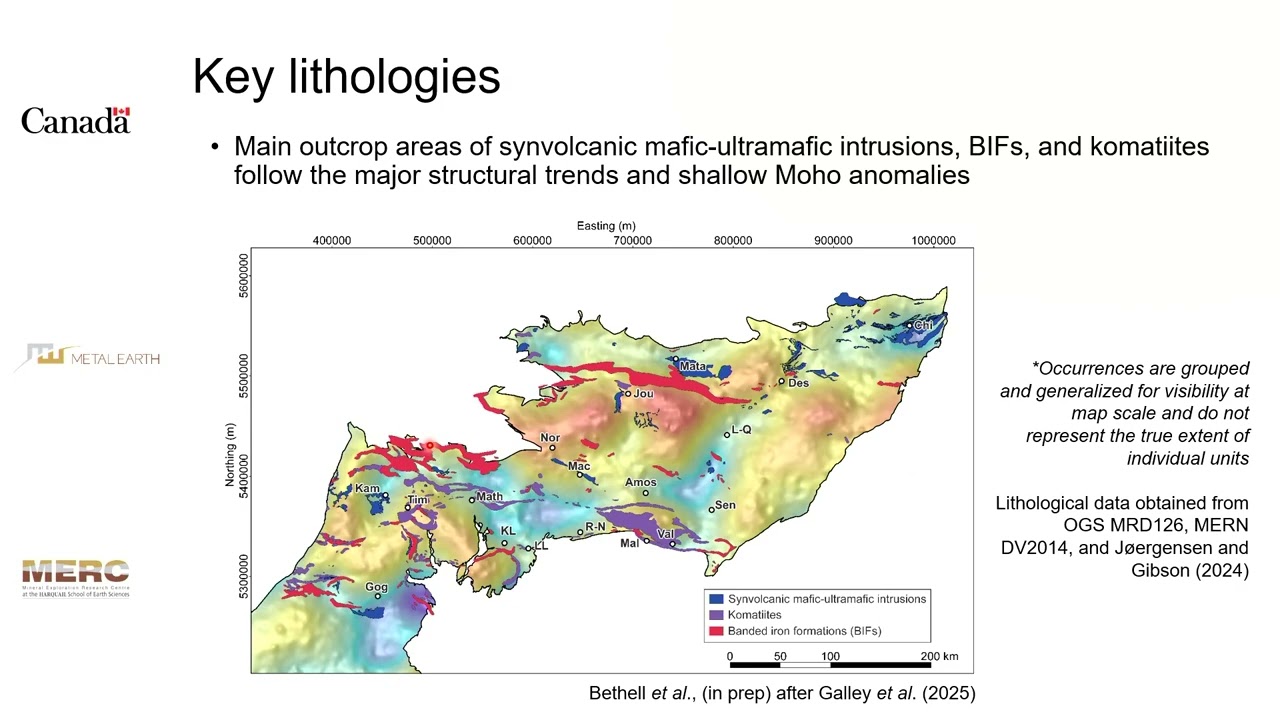
- Examination of key lithologies: komatiites, banded iron formations, and synvolcanic intrusions.
- Analysis of VMS mineral occurrences and their spatial distribution.
- Discussion of alteration indices from whole-rock geochemistry database.
- Use of surficial sediment geochemistry to trace hydrothermal signatures.
- Integration of geophysical data: magnetics and electromagnetics.
- Synthesis and interpretation: support for Archean rifting and potential trans-tensional zone.
- Comparison with modern Iceland rift migration and conclusion.
Cited Sources
- Nature Communications article on Moho depth model — Referenced as the source of the Moho depth model and rift architecture interpretation.
- Goodwin (1973) classification of iron formations — Used to classify banded iron formations into oxide, sulfide, and carbonate facies.
Concurring Sources
- Nature Communications article on Moho depth model — Provides the geophysical model that this study tests with geological data.
Contribution & Novelties
This study provides a novel integration of multiple geological datasets to validate geophysically inferred rift structures in the Abitibi Greenstone Belt. It offers a comprehensive multi-parameter approach, including fault complexity, lithological distributions, geochemical alteration, and geophysical signatures, to support the interpretation of Archean rifting. The identification of a prominent northeast-southwest oblique boundary as a potential trans-tensional zone is a new contribution, drawing analogies to modern Iceland. This work enhances understanding of the tectonic evolution of the Abitibi and provides a framework for mineral exploration.
Pour aller plus loin :
- Abitibi Greenstone Belt — Overview of the geological context.
- Volcanogenic massive sulfide ore deposit — Connection between VMS deposits and extensional settings.
- Moho discontinuity — Explanation of the Moho and its significance in geophysics.
123 words
Radar Profile
The radar profile shows high scores in quantity of information, quality, and technical level, with slightly lower but still strong reliability. This indicates a dense, well-presented scientific talk with robust data integration, though some speculative elements temper the reliability score.