Age & electric resistivity of the Hope Bay greenstone belt, Bathurst, Slave craton
Keywords
Summary
148 words
Critical Evaluation
Value of the Information & Strength of the Argument
The value of the information is high, as it presents new geochronological and geophysical data from a remote and underexplored region. The argumentation is logical, building from age constraints to geophysical anomalies and their tectonic implications. The speaker acknowledges uncertainties and alternative interpretations, such as the origin of conductive fingers. The combination of methods is innovative and strengthens the interpretation.
Scientific Rigor, Source Quality, Title Accuracy
The scientific rigor is good, with clear presentation of data and methods. The speaker references previous work and collaborates with industry, but specific sources are not cited in the talk. The title accurately reflects the content. The talk is a conference presentation, so it is not peer-reviewed, but the data appear robust. The adequacy between title and content is excellent.
135 words
Title / Content Match
The title accurately reflects the content, focusing on age constraints and electric resistivity of the Hope Bay greenstone belt.
Quality & Reliability
8/10
The presentation is based on original geochronology and magnetotelluric data, with clear methodology and interpretation. The speaker is a researcher presenting at a scientific meeting, and the work is collaborative with industry. However, the talk is a conference presentation and lacks detailed peer-review context, and some interpretations are speculative.
Key Moments
Markers derived by PSI from the transcript: the creator did not define chapters.
- Introduction to the Hope Bay greenstone belt and study objectives
- Overview of the Slave Craton and greenstone belts
- Geological setting of Hope Bay and previous age constraints
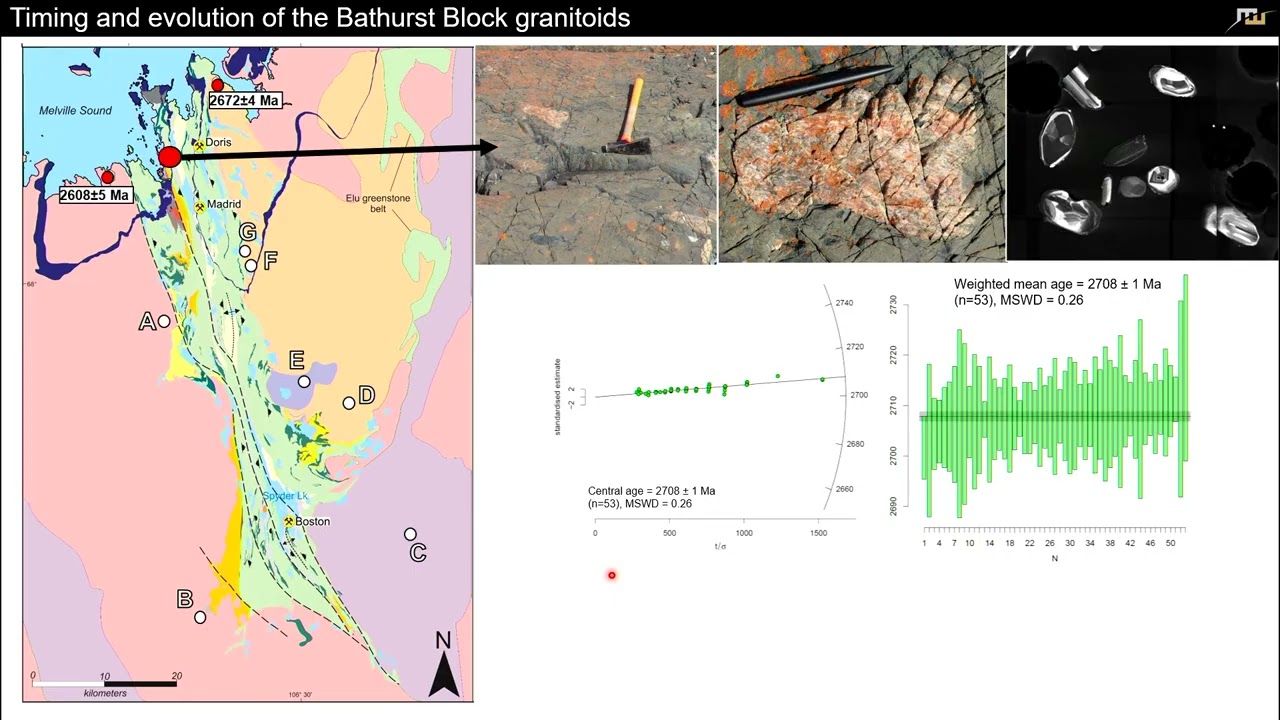
- New geochronology results on granitoids flanking the belt
- Summary of age data and implications for belt evolution
- Introduction to magnetotelluric (MT) survey and depth profiles
- Identification of conductive anomalies C1, C2, C3 and C4
- Vertical slice showing connection of anomalies to depth
- Comparison with Abitibi crustal architecture
- Interpretation of C4 anomaly in relation to Thelon Tectonic Front
Contribution & Novelties
This study provides new geochronological constraints on granitoids flanking the Hope Bay greenstone belt, revealing syn-volcanic intrusions and a younger western flank. The MT data offer a detailed 3D resistivity model of the belt, identifying conductive anomalies that may be linked to gold mineralization. The integration of geochronology and geophysics is novel for this region and provides a framework for understanding crustal architecture and tectonic history.
Pour aller plus loin :
- Magnetotellurics — Overview of the MT method used in the study.
- U-Pb geochronology — Technique used for age dating.
- Slave Craton — Geological context of the study area.
- Thelon Tectonic Zone — Regional tectonic feature relevant to interpretation.
109 words
Radar Profile
The radar profile shows high scores across all dimensions, indicating a well-rounded presentation with substantial information, technical depth, and reliability. The lowest score is in 'quantite_information' relative to others, but still high, reflecting the focused scope of the talk.