Timing & Sources of Au Mineralization @DPFZ: Geochron and Isotopic Contraints
Keywords
Summary
159 words
Critical Evaluation
Value of the Information & Strength of the Argument
The value of the information lies in its contribution to understanding the timing and sources of gold mineralization in a major gold-producing region. The argumentation is based on field observations, petrography, and geochronological data, which are systematically presented. The speaker acknowledges uncertainties and limitations, such as the need for careful monazite screening and the preliminary nature of some isotope results. The logical flow from geochronology to stable isotopes is clear, and the conclusions are consistent with the data shown. However, some interpretations are speculative, as the speaker notes that further data are needed to confirm patterns.
Scientific Rigor, Source Quality, Title Accuracy
The presentation demonstrates scientific rigor through detailed methodology and acknowledgment of limitations. The speaker references previous studies (e.g., Herzog et al. 2023) and uses established dating techniques. The title accurately reflects the content. No external sources are cited in the description, but the presentation is part of a scientific meeting, implying peer context. The adequacy between title and content is high.
172 words
Title / Content Match
The title accurately reflects the content, focusing on timing and sources of gold mineralization along the DPFZ, with geochronological and isotopic constraints.
Quality & Reliability
8/10
The presentation is based on original research with detailed methodology, including field sampling, SEM, EPMA, U-Pb dating, and isotope analyses. The speaker acknowledges limitations and ongoing work, demonstrating scientific rigor. However, the results are preliminary and not yet peer-reviewed.
Key Moments
Markers derived by PSI from the transcript: the creator did not define chapters.
- Introduction and overview of the study area and objectives.
- Discussion of mineralization styles and previous geochronological data.
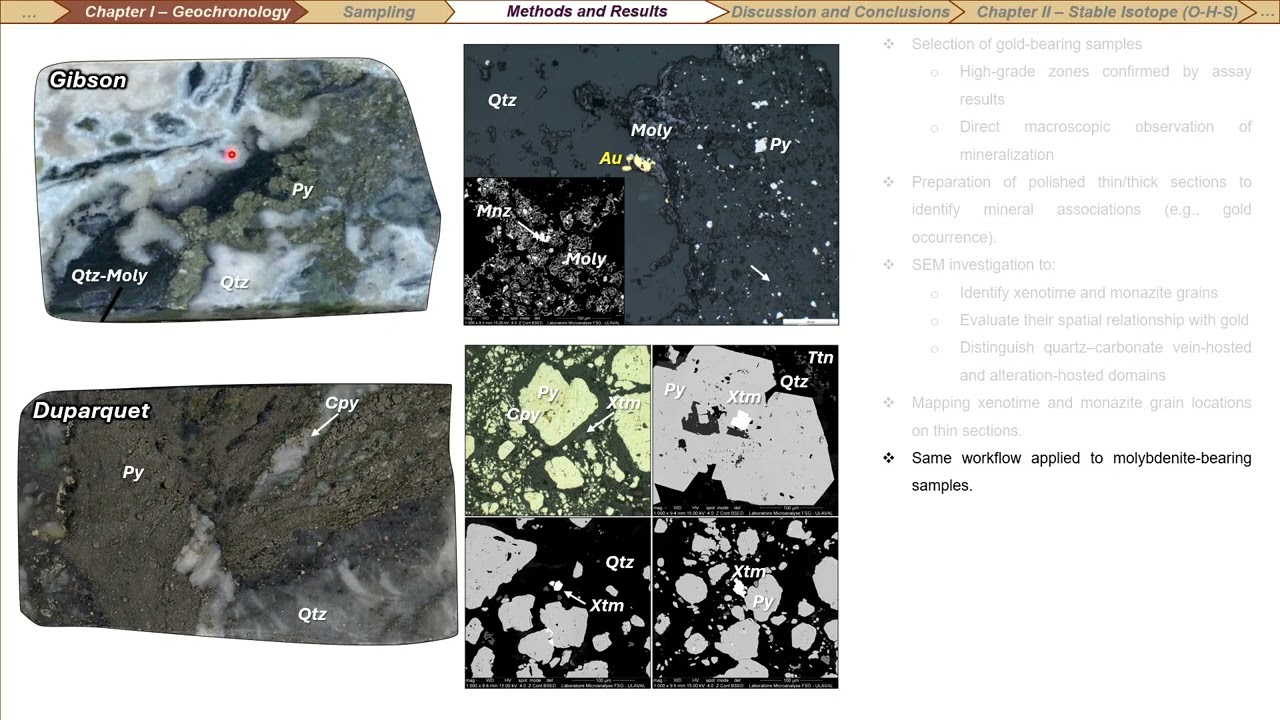
- Methodology for geochronology: sample selection, SEM, EPMA, and U-Pb dating.
- Presentation of monazite and xenotime ages, including failures and successes.
- Interpretation of geochronological results: timing of mineralization events relative to deformation.
- Introduction to stable isotope chapter: oxygen, hydrogen, and sulfur isotopes.
- Preliminary isotope results and observed patterns across different camps.
- Summary of completed and ongoing analyses, and future plans.
Contribution & Novelties
This research provides new geochronological and isotopic data for gold mineralization along the Destor-Porcupine Fault Zone, addressing gaps in existing knowledge. The use of in-situ U-Pb dating on monazite and xenotime, combined with Re-Os on molybdenite, offers a more precise timing framework. The integration of oxygen, hydrogen, and sulfur isotopes aims to constrain fluid and sulfur sources, which is crucial for understanding ore-forming processes. The study also highlights methodological challenges, such as monazite screening, contributing to best practices in geochronology.
Pour aller plus loin :
- Orogenic gold deposits — Provides background on the deposit type discussed.
- U-Pb dating — Explains the geochronological method used.
- Stable isotope geochemistry — Overview of isotope applications in geology.
114 words
Radar Profile
The radar profile shows high scores in quality and reliability, with moderate quantity and technical level. This indicates a well-executed but focused presentation, suitable for a specialized audience.