Inteligencia Local para la Automatización de Alimentadores y Resiliencia de la Red
Keywords
Summary
179 words
Critical Evaluation
Value of the Information & Strength of the Argument
The presentation provides valuable insights into a practical approach for improving distribution grid resilience using local intelligence. The argumentation is coherent and well-structured, starting with a real-world scenario to illustrate the problem, then explaining the solution concept, its benefits, and applicability. The speaker effectively contrasts traditional fuse-based protection with smart devices, highlighting the advantages of automatic fault clearing and restoration. However, the argumentation is somewhat one-sided, as it primarily promotes the speaker’s company’s products without discussing potential limitations or alternative solutions. The claims about 80-90% of faults being temporary are consistent with industry knowledge, but specific data or case studies are not provided to substantiate the effectiveness of the proposed devices.
Scientific Rigor, Source Quality, Title Accuracy
The scientific rigor is moderate. The speaker is an experienced engineer, and the technical explanations are plausible, but the content is largely based on expert opinion and company experience rather than peer-reviewed research. No external sources are cited, and the presentation has a promotional tone. The title accurately reflects the content, which focuses on local intelligence for feeder automation and grid resilience. The webinar includes a Q&A session where practical questions about communication, power supply, and fault detection are addressed, adding credibility. However, the lack of independent references and the commercial nature of the talk reduce its overall scientific rigor.
226 words
Title / Content Match
The title accurately reflects the content, which focuses on local intelligence for feeder automation and grid resilience.
Quality & Reliability
7/10
The speaker is a senior engineer with 25+ years of experience, but the content is largely promotional for his company's products, with limited independent verification of claims.
Key Moments
Markers derived by PSI from the transcript: the creator did not define chapters.
- Introduction of the speaker and topic
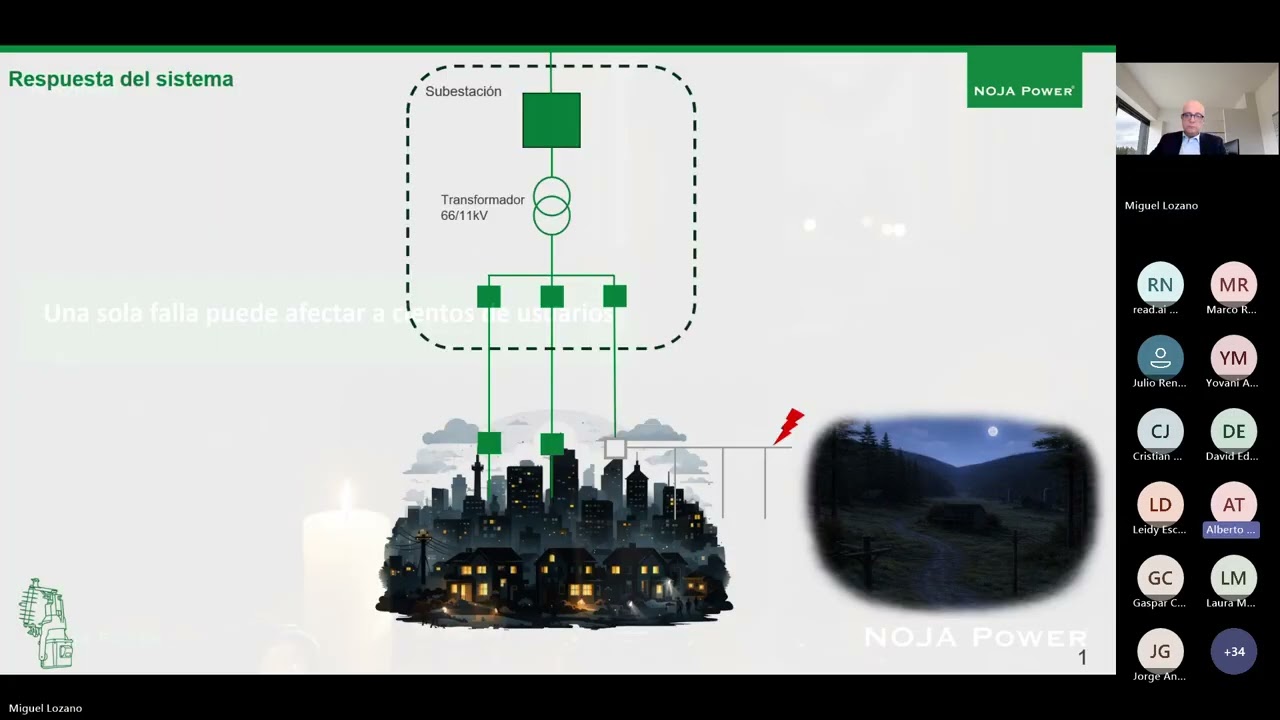
- Real-world example of a fault in a rural feeder causing extended outage
- Explanation of traditional fuse-based protection and its limitations
- Introduction of local intelligence concept and smart devices
- How local intelligence works: detection, action, restoration
- Benefits for reliability indices (SAIDI, SAIFI) and carbon footprint
- Applicability to rural, mining, and hard-to-access networks
- Q&A: communication interfaces and SCADA integration
- Q&A: power supply via supercapacitors and maintenance
- Q&A: fault detection capabilities and conclusion
Contribution & Novelties
The webinar presents a practical approach to enhancing distribution grid resilience by deploying local intelligence at the feeder lateral level, replacing traditional fuses with smart devices that can automatically clear temporary faults. This concept is not entirely new but is presented in a clear and accessible manner, emphasizing the benefits for remote and rural networks. The speaker’s experience adds practical insights, but the novelty is limited as similar solutions exist in the market.
Pour aller plus loin :
- Distribution Automation — Provides background on automation technologies in distribution networks.
- SAIDI and SAIFI — Explains the reliability indices mentioned in the talk.
- Recloser — Details on the device type that enables automatic fault clearing.
113 words
Radar Profile
The radar profile shows moderate scores across all dimensions, with slightly higher scores in quantity of information and technical level, reflecting the speaker's expertise and the detailed explanation of the technology. The lower scores in quality and reliability are due to the promotional nature and lack of independent sources.