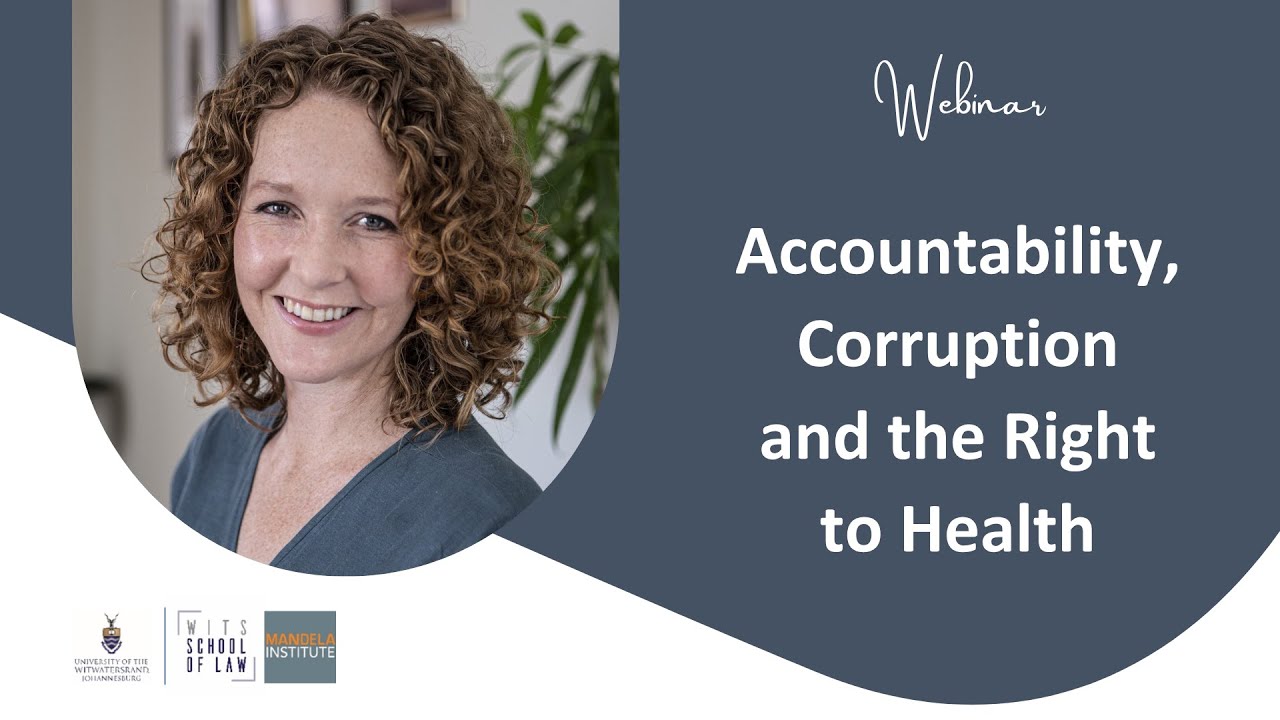
Webinar | Accountability, Corruption and the Right to Health
Keywords
Summary
128 words
Critical Evaluation
Value of the Information & Strength of the Argument
The webinar provides valuable insights into the specific mechanisms of corruption in South Africa’s health sector, supported by concrete examples and data from official reports. Stevenson’s argumentation is coherent and well-structured, linking corruption to systemic failures and proposing actionable solutions. She effectively uses case studies to illustrate the human cost of corruption and the need for systemic change. The presentation is persuasive, though it relies heavily on anecdotal evidence and media reports rather than peer-reviewed research.
Scientific Rigor, Source Quality, Title Accuracy
Stevenson cites specific reports (SIU, Auditor-General) and legal cases (Life Esidimeni, Glenister) to support her claims. The sources are credible and directly relevant. The title accurately reflects the content. However, the presentation is primarily an expert opinion, and some claims are based on media reports (e.g., News24) without independent verification. The webinar does not include a formal bibliography, but the sources mentioned are sufficient for the context.
158 words
Title / Content Match
The title accurately reflects the content, which focuses on accountability, corruption, and the right to health in South Africa.
Quality & Reliability
8/10
The webinar is presented by a recognized human rights lawyer and executive director of SECTION27, with extensive experience in health rights litigation. The content is grounded in specific legal cases, official reports (SIU, AG), and constitutional provisions. However, it is an opinion-based presentation with limited peer-reviewed sources, and some claims rely on media reports.
Key Moments
Markers derived by PSI from the transcript: the creator did not define chapters.
- Introduction by Tracy Lynfield, setting the context on predatory systems and corruption.
- Sasha Stevenson begins her talk, highlighting the susceptibility of health sector to corruption.
- Discussion of Tembisa Hospital looting and SIU report findings.
- Examples of corruption in Gauteng Health, including PPE scandal and Anglo Gold Shanti hospital.
- Analysis of why corruption persists: lack of systems, accountability, and leadership.
- Discussion of Life Esidimeni case and the need for accountability beyond criminal prosecution.
- Proposal for systemic solutions: prevention, accountability, and leadership.
- Emphasis on the right to health as a central principle for the health system.
- Q&A session begins; discussion on implementation vs. new laws.
- Discussion on citizen accountability and the role of civil society.
Cited Sources
- SECTION27 — Organization led by the speaker, working on health rights.
- Special Investigating Unit (SIU) Report on Tembisa Hospital — Report on corruption at Tembisa Hospital, cited by the speaker.
- Auditor-General of South Africa — Audit findings on provincial health departments, referenced in the talk.
- Constitution of the Republic of South Africa, 1996 — Legal framework for the right to health and section 100 interventions.
- Life Esidimeni Arbitration Award — Arbitration award in the Life Esidimeni case, mentioned by the speaker.
Concurring Sources
- Transparency International - Corruption in Health — Global perspective on health sector corruption, aligning with the speaker's points.
- World Health Organization - Health Systems Governance — WHO's framework on health system governance, supporting the need for accountability.
Dissenting Sources
- Government of Gauteng Province - Response to SIU Report — The provincial government claims to be addressing corruption, which contrasts with the speaker's assertion of systemic failure.
Contribution & Novelties
The webinar provides a detailed, expert analysis of corruption in South Africa’s health sector, linking specific cases to systemic failures and proposing concrete solutions. It highlights the human rights dimension of corruption and the need for a people-centered health system. The speaker’s experience adds practical insights into legal and advocacy strategies.
Pour aller plus loin :
- Right to health — WHO overview of the right to health.
- Corruption in the health sector — Transparency International’s resources on health corruption.
- Life Esidimeni inquest — Legal documents related to the Life Esidimeni case.
- Glenister v President of the Republic of South Africa — Constitutional Court judgment on independence of anti-corruption units.
109 words
Radar Profile
The radar profile shows high scores in information quantity and quality, reflecting the detailed and well-supported presentation. The technical level is moderate, suitable for a general audience. The overall reliability is high due to the speaker's expertise and use of official sources, though the subjective nature of the talk slightly lowers the score.
💬 No comments were provided for analysis.