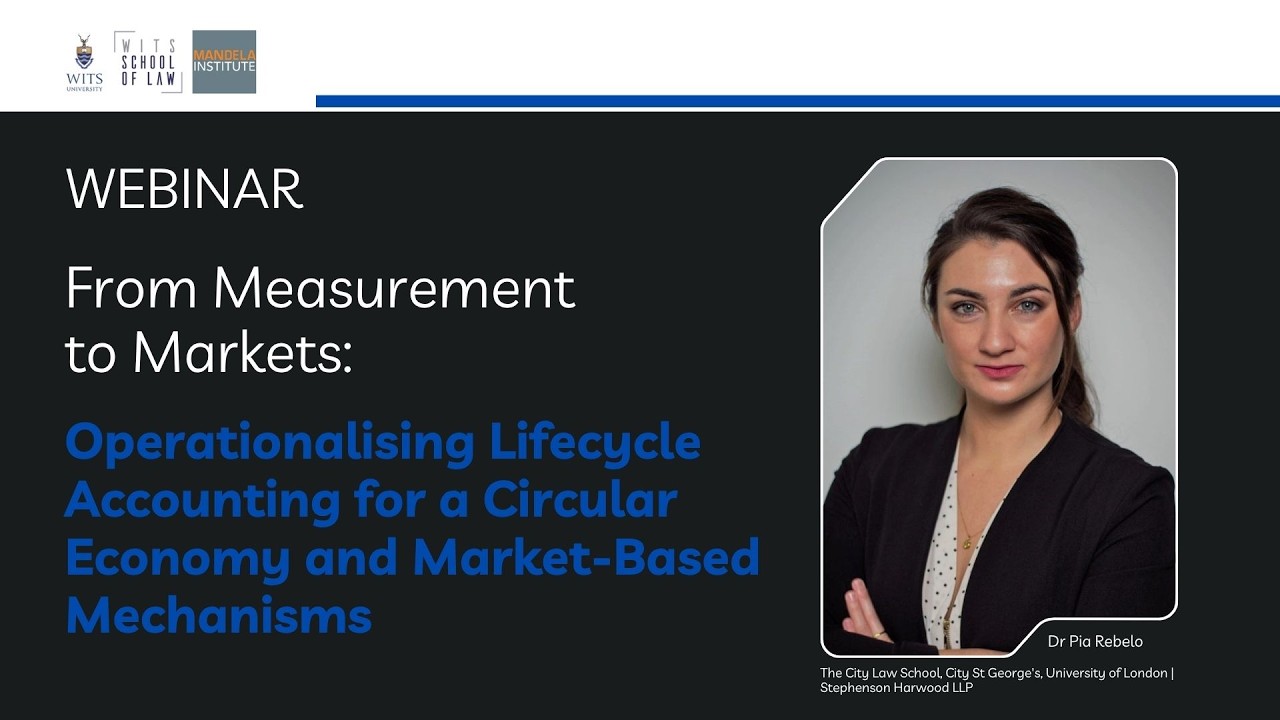
Webinar | From Measurement to Markets
Keywords
Summary
157 words
Critical Evaluation
Value of the Information & Strength of the Argument
The webinar provides valuable insights into the practical application of lifecycle accounting in regulatory and voluntary contexts. The speaker effectively explains complex concepts such as carbon intensity, environmental attributes, and book-and-claim systems using clear examples. The argumentation is coherent, building from foundational concepts to specific applications, and is supported by references to real-world regulations and market mechanisms. The speaker’s legal perspective adds a unique dimension, highlighting the role of contracts in enabling these systems. However, the presentation is primarily descriptive rather than analytical, and the speaker acknowledges her non-technical background, which may limit the depth of technical discussion. Overall, the information is valuable for understanding the intersection of measurement and markets in decarbonisation.
Scientific Rigor, Source Quality, Title Accuracy
The webinar demonstrates scientific rigour in its explanation of lifecycle assessment methodologies and their regulatory applications. The speaker references key frameworks such as the EU Renewable Energy Directive, FuelEU Maritime, and IMO’s net-zero framework, and mentions certification schemes like ISCC. However, specific sources are not cited in detail, and the presentation relies on the speaker’s expertise rather than peer-reviewed literature. The title accurately reflects the content, which focuses on the transition from measurement to markets. The speaker’s legal background is evident in the emphasis on contractual mechanisms, which is appropriate given the topic. Overall, the content is reliable for an introductory overview, but viewers seeking in-depth technical details may need to consult additional sources.
242 words
Title / Content Match
The title accurately reflects the content, which focuses on the transition from measurement (lifecycle accounting) to markets (market-based mechanisms).
Quality & Reliability
7/10
The webinar is presented by a legal expert with practical experience in maritime decarbonisation, providing a clear and accurate overview of lifecycle accounting and market mechanisms. However, it is an expert opinion rather than a peer-reviewed study, and the speaker acknowledges her non-technical background, which may limit depth in some areas.
Key Moments
Markers derived by PSI from the transcript: the creator did not define chapters.
- Introduction by Xavier, followed by Dr Rebelo's opening remarks on the importance of measurement in the low-carbon transition.
- Overview of the webinar structure: background on carbon accounting, lifecycle assessment methodology, measurement and certification, and market applications.
- Comparison between traditional carbon accounting and lifecycle assessment, introducing the concept of carbon intensity.
- Explanation of well-to-wake approach and treatment of different fuel types: fossil fuels, biofuels, and RFNBOs.
- Discussion on measurement and certification, including the formula from the EU Renewable Energy Directive and the role of certification schemes like ISCC.
- Regulatory applications: CORSIA, ReFuelEU Aviation, and FuelEU Maritime, with a focus on lifecycle assessment requirements.
- Case study of FuelEU Maritime: compliance balance, surplus trading, and pooling mechanism.
- Introduction to voluntary carbon markets and the concept of environmental attributes.
- Explanation of book-and-claim systems with a maritime example, illustrating decoupling of physical fuel and environmental benefits.
- Concluding remarks on operationalisation, challenges, and the role of contracts in making these mechanisms work.
Cited Sources
- EU Renewable Energy Directive — Referenced as the framework for lifecycle assessment methodology and certification requirements for fuels.
- FuelEU Maritime — Discussed as a regulatory example of lifecycle-based fuel standards and pooling mechanisms.
- CORSIA (Carbon Offsetting and Reduction Scheme for International Aviation) — Mentioned as an international scheme using lifecycle assessment for sustainable aviation fuels.
- IMO Net-Zero Framework — Referenced as an upcoming international framework for maritime decarbonisation, including lifecycle assessment methodology.
- ISO 14040 — Cited as the standard for lifecycle assessment methodology.
- ISCC (International Sustainability and Carbon Certification) — Mentioned as a major certification scheme, with an example of its limitations.
Concurring Sources
- Life Cycle Assessment (LCA) – European Environment Agency — Provides a definition and context for LCA, aligning with the webinar's explanation.
- GHG Protocol — Referenced as the standard for corporate carbon accounting, which the webinar contrasts with LCA.
Dissenting Sources
- Critique of carbon offsetting – Carbon Market Watch — Some critics argue that market-based mechanisms like book-and-claim may not deliver real emission reductions, a perspective not fully addressed in the webinar.
Contribution & Novelties
The webinar provides a clear and accessible explanation of lifecycle accounting and its application to market-based mechanisms, particularly in the maritime sector. It bridges the gap between technical measurement and legal/contractual frameworks, offering a unique perspective from a legal expert. The discussion of book-and-claim systems and environmental attributes is particularly valuable for understanding how voluntary markets operate.
Pour aller plus loin :
- Life-cycle assessment - Wikipedia — Provides a comprehensive overview of LCA methodology and its applications.
- Book and claim - Wikipedia — Explains the concept of book and claim in supply chains, relevant to the discussion.
- Sustainable Aviation Fuel - Wikipedia — Offers background on SAF and its role in aviation decarbonisation.
- EU ETS - Wikipedia — Context for market-based mechanisms in the EU.
- IMO - Wikipedia — Background on the IMO and its regulatory role in shipping.
139 words
Radar Profile
The radar profile shows high scores in quantity and quality of information, reflecting the webinar's comprehensive coverage. The technical level is moderate, suitable for a general audience. Reliability is good but not exceptional, as it relies on expert opinion rather than peer-reviewed sources.
💬 No comments were provided for analysis.