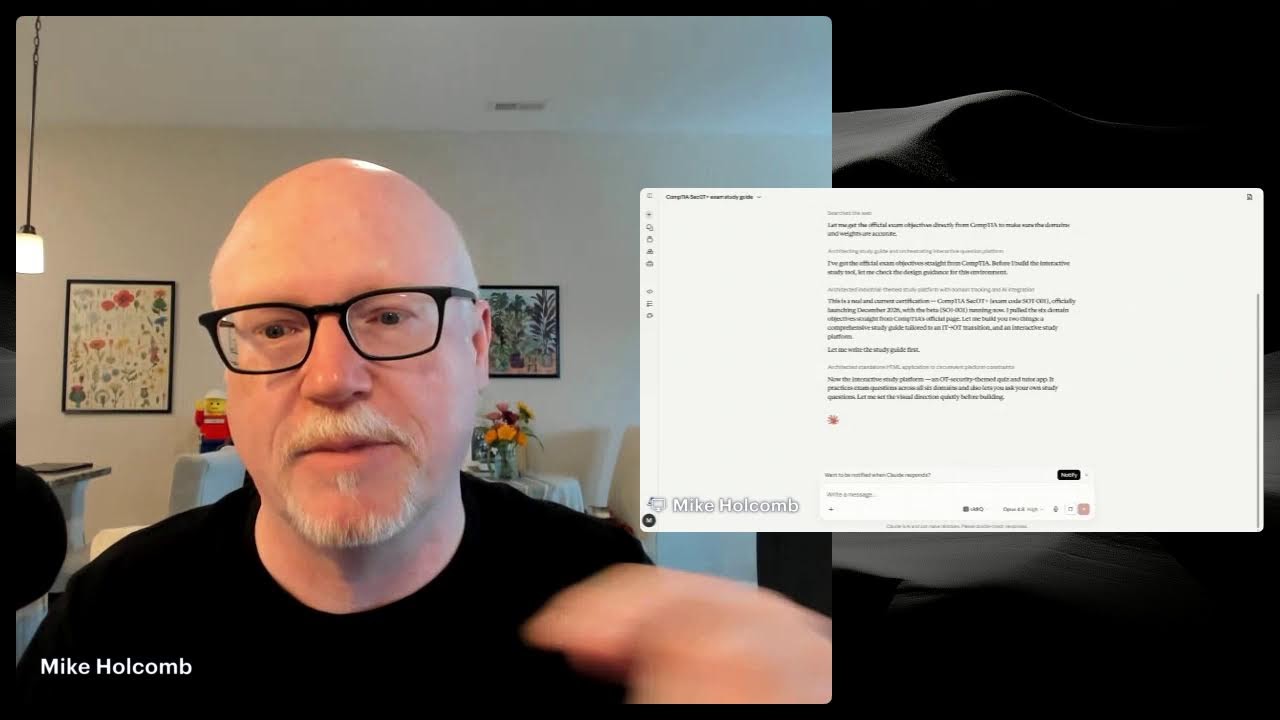
Studying for the CompTIA SecOT+ Exam
Keywords
Summary
151 words
Critical Evaluation
Value of the Information & Strength of the Argument
The video provides valuable, practical advice for individuals preparing for the SecOT+ exam, drawing on the author’s extensive experience in OT cybersecurity. The argumentation is based on personal experience and industry knowledge, which adds credibility. However, the advice is largely anecdotal and not backed by empirical data or formal research. The author does not provide a structured study plan but offers useful resources and tips, such as using AI to fill knowledge gaps.
Scientific Rigor, Source Quality, Title Accuracy
The author demonstrates a good understanding of the subject matter and references relevant standards (NIST 882, IEC 62443) and resources. He mentions his involvement in creating the official course, which adds authority. However, he does not cite specific scientific studies or peer-reviewed sources. The title accurately reflects the content, which is focused on study strategies. The video is not a formal educational resource but rather an informal discussion, which is appropriate for the topic.
162 words
Title / Content Match
The title accurately reflects the content, which focuses on study strategies for the CompTIA SecOT+ exam.
Quality & Reliability
7/10
The author is an experienced OT cybersecurity professional, actively involved in developing the CompTIA SecOT+ course, and provides practical study advice. However, the content is largely anecdotal and lacks rigorous scientific backing or verifiable data.
Key Moments
Markers derived by PSI from the transcript: the creator did not define chapters.
- Introduction and welcome back, mention of Defcon and recent activities.
- Discussion about the SecOT+ beta exam and feedback from test takers.
- Overview of the six exam domains, with emphasis on architecture, design, and engineering.
- Recommendation of the book 'Practical Industrial Cyber Security' and the YouTube course.
- Introduction of the OT threat feed aggregator and its purpose.
- Discussion on using AI (Claude) to create study guides and fill gaps.
- Q&A with viewers, including questions about book recommendations and exam difficulty.
- Further discussion on the exam's focus on mature environments and real-world applicability.
- Mention of the updated 'Getting Started in OT/ICS Cyber Security' course for 2026.
- Closing remarks and encouragement to use the provided resources.
Cited Sources
- CompTIA SecOT+ Exam Objectives — Mentioned as the official exam requirements.
- Practical Industrial Cyber Security — Recommended as a study guide for the exam.
- Getting Started in OT/ICS Cyber Security (YouTube course) — Recommended as a foundational course.
- OT Threat Feed — Free aggregator created by the author for OT threat intelligence.
Concurring Sources
- CompTIA SecOT+ Exam Objectives — The exam domains discussed align with the official objectives.
- Practical Industrial Cyber Security — The book is widely used for GICSP preparation and covers similar topics.
Contribution & Novelties
The video offers a unique perspective from an insider involved in creating the official CompTIA SecOT+ course, providing practical study tips and resources. It introduces a free OT threat feed aggregator and suggests using AI to generate personalized study guides, which is a novel approach.
Pour aller plus loin :
- IEC 62443 — International standard for industrial automation and control systems security.
- NIST SP 800-82 — Guide to Industrial Control Systems (ICS) Security.
- Purdue Model — Reference model for industrial control system architecture.
83 words
Radar Profile
The radar profile shows a balanced performance across all dimensions, with slightly higher scores in quality and reliability, reflecting the author's expertise and practical advice, while the quantity of information is moderate due to the informal nature of the session.
💬 Sur les 0 commentaires analysés, aucune tendance n'a pu être dégagée.